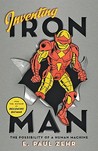
BOOK REVIEW: Inventing Iron Man by E. Paul Zehr

Inventing Iron Man: The Possibility of a Human MachineInventing Iron Man: The Possibility of a Human Machine by E. Paul Zehr

My rating: 4 of 5 stars

Amazon page

As the title suggests, this book examines whether Iron Man could exist in the real world. As with Michio Kaku’s book Physics of the Impossible, answering the question involves defining the various meanings of “impossible.”

One way to parse the question is, “Is Iron Man possible today given the existing state of technology?” In and of itself, this question is of limited interest because the answer is, “no.” There’s certainly a demand, and so if Iron Man could exist given current technology, he probably would. That’s not to say it isn’t interesting to learn about what technologies are holding us back and where the cutting edge of relevant technologies lies—both of which are addressed by the book.

Still, a more interesting inquiry is, “Will Iron Man ever be reality given the physical laws that we know to govern the universe?” While more intriguing, it’s also a harder question to definitively answer. It’s impossible to foresee all the technological developments that might come along to answer the seemingly insurmountable challenges (e.g. Tony Stark’s inevitable Traumatic Brain Injury (TBI).) The book deals with the critical question of what challenges would have to be overcome for Iron Man to be reality.

As Zehr suggests, the appeal of Iron Man is that he’s considered to be among superheroes for the common man. Like Batman, the sufficiently bright and diligent nerd may fantasize that, “That could be me.” You or I can’t be Superman or Wolverine, but given enough money, smarts, and training we could be Batman, or—even better—pilot the Iron Man suit. Put in this light, the book may seem like just another frivolous attempt to capitalize on the popularity of superheroes to sell books. However, there’s actually a great deal of food for thought packed in the book. Like others, I read the book because its title is Inventing Iron Man and not Neuro-motor control of a self-propelled armor system or some other suitably scholarly title.

Dr. Zehr has the bona fides to delve into this topic. He is a Professor who investigates questions of how the nervous system controls movement. That subject may not constitute the sum total of critical concerns, but it’s one of the most important challenges. For Iron Man to move the way he does in the movies and comic books, Tony Stark’s impulses to move have to be transmitted seamlessly to the servo-motors that move the suit. From dodging Col. Rhodes’ (i.e. War Machine’s) punches to ducking RPGs, Stark can’t be quick enough if he has to manually steer the device. Then, of course, there’s the issue of feedback. Any neophyte meditator who’s had his or her foot fall sound asleep will know how difficult it is to walk surefootedly when one can’t feel anything through one’s foot.

[Iron Man 3 spoiler commentary in this paragraph.] One of the most damning challenges for making Iron Man a reality is the high probability of severe concussions. Let’s say you make the suit out of a material that is virtually indestructible? This may be possible. However, the pilot’s mushy brain is still sloshing around inside that impenetrable armor. One can remotely pilot the suit in order to negate this (as has been done in the comic books and the third movie), but—at that point—is it still Iron Man? I know from a writer’s perspective it’s a lot harder to maintain tension if there’s nothing human on the line. In the third movie about 30 autonomously piloted suits get wiped out and the viewer doesn’t care—the only source of tension is that Tony Stark is without armor half the time.

Some of the most interesting discussions are about where the current state of the art lies with respect to: a.) direct mind control over mechanical systems; b.) a “flying suit”; and c.) robotic movement enhancers. Zehr conducts interviews with those engineers and technologists involved in such technologies, and finds out where we are presently. Letter “a” above seems to be the least developed of the three technologies, but they are all active lines of research.

I enjoyed this book and found it interesting. I think anyone who is interested in the state of technology and its limits will find it a nice pop-sci introduction to the subject. The use of superheroes as a pedagogic device may be overdone, but it continues to work because we are fascinated by the edge of possibility, and that’s what superheroes represent.

View all my reviews

BOOK REVIEW: Justice League Vol. 1: Origin by Geoff Johns

Justice League, Vol. 1: OriginJustice League, Vol. 1: Origin by Geoff Johns

My rating: 2 of 5 stars

Amazon Page

Amazon had the Kindle edition of this graphic novel on sale recently. With all the talk of a Justice League movie, and whether it can ever get off the ground, my curiosity in these characters was piqued.

This volume was released in August of 2011 as the leading edge of a reboot of the entire DC comics line called “the New 52.” This is the origin story for the Justice League as a team, though all but one of the individual characters–Cyborg–is an existing hero at the time the story begins. The other characters, i.e. Batman, Green Lantern, Superman, Flash, Wonder Woman and Aquaman are familiar to the world but are not well liked. (and are introduced into the story arc in that order.)The volume consists of Issues #1 – 6 of the Justice League [New 52] reboot.

In the beginning, there’s only one dyad among this group who knows each other personally, the Green Lantern and the Flash–we don’t really know how they know each other. Most of the other characters are aware of each other’s existence (or myth), but have never met. Of course, Cyborg doesn’t exist at the beginning of the story, and his individual origin story is woven in throughout the book as a subplot so that he can be introduced into the arc at the climax. The characters are assumed to each operate in his (or her) own domains, i.e. Gotham City, Metropolis, Coast City, Central City, etc.

As the story opens, Batman is chasing down a stocky, non-human creature on the roof tops of Gotham in order to try to figure out what the nefarious character is up to. Green Lantern is inexplicably introduced into the middle of this chase scene. Batman and Green Lantern viscerally despise each other from the get go. This isn’t surprising as Green Lantern is an arrogant ass throughout the entire story. Perhaps the highlight of the book (which is sad as it happens so early) is when Lantern is busy mocking Batman, and the Dark Knight steals his ring–the source of his power–right off his finger.

The Green Lantern and Batman witness the inhuman creature planting a piece of alien-looking technology (later revealed to be a “mother box”), and Green Lantern’s ring confirms it to be otherworldly. The pair decide to pay a visit to the Earth’s resident alien, a.k.a. Superman. Green Lantern immediately runs afoul of Superman, arrogantly thinking he can subdue the Man of Steel, and has to call his old friend the Flash. The quartet finally stop fighting and begrudgingly agree to put their heads together.

After seeing a piece of the Cyborg origin story, we are introduced to Wonder Woman. She is probably the character that we get the greatest sense of. (Besides Lantern, who is unlikable throughout.] The Amazonian seems more alien than Superman. She’s never had ice cream but loves it, but not quite as much as a good fight. She’s not emotional about fighting, neither fearful nor angry, but is at her most happy when fighting. She’s the character most out of touch with the world she is occupies. She joins up with the four in the chase for the winged, alien monsters, forming a quintet and instilling some gender equity.

The Cyborg origin story comes to a head when Silas Stone, a brilliant defense industry scientist, turns his dying son, Victor, into the Cyborg, thinking it the only way to save the young man after he suffered severe burns from a mother box explosion. The former star football player is now a kind of Frankenstein’s monster, part himself and part autonomous machine. There’s a cacophony in his head as he can now pick up various radio signals.

It’s shortly thereafter that Aquaman is introduced. Considerable artistic effort was put into manning up Aguaman, who always seemed the weak link in this team. The group happens to be standing around near the water when Aquaman and his fish minions chase some of the evil army to the surface

The enemy is Darkseid, a juggernaut warlord from another world (or a parallel universe), whose army of evil minions have been the ones that the newly formed League have been fighting both individually and as a group. When Cyborg goes running away from his father–and his creator as a machine-man, he runs into the six superheroes, and the team of seven is fully assembled. Darkseid’s power is so great that he relatively easily captures and subdues Superman.

Batman goes to rescue Superman as the rest of the team regroups. The Dark Knight’s tactic is letting one of the evil, winged, juggernaut minions capture him–as they have been capturing others.

I won’t spoil the ending, but will say that it was pretty weak, and a large part of the reason I gave this work such a low rating.

A two star rating may seem a little harsh. The dialogue in this work is better than most comic books. There’s relatively less “As you know, Bob,…” style exposition. There is some, as when Green Lantern feels the need to explain to Batman about how there are other Green Lanterns and this is his space sector. However, there are also clever uses of action to present background, as when Lantern begins to admit that he’s a show-off and it turns out he’s brushing up against Wonder Woman’s truth lasso. (This is a much better way to do it than Wonder Woman saying, “And now my lasso is around you and you’ll have to tell the truth, for whosoever the lasso touches cannot bear false witness.” Which would be the typical comic book way of revealing the lasso’s power.)

There are two problems with this work that are too serious to overlook. First is the deus ex machina ending. The authors make a bold choice as to who will save the day, perhaps to create surprise and perhaps to highlight the character. But the whole resolution strains credulity. Second, there is no good explanation for why these characters keep piling into each other (except for the Xenophobic thought processes of Batman and the Green Lantern that Superman must know about anything alien.) These evil minions are supposedly everywhere, and yet the individual superheroes keep running into each other–and continuing to stay together despite the fact that most of them clearly don’t like the others. I think the author takes this “we hate each other, but are begrudgingly working together” trope a little too far. It feels as if this Wizard of Oz cast hadn’t come together by commonly following the yellow brick road, but rather that seven separate and randomly moving tornadoes picked up one each and just happened to stack them in a neat pile.

Besides Green Lantern being arrogant and unlikable and Wonder Woman being endearingly alien, we get very little sense of individual characters. Batman and the Flash are the voices of reason of two differing type, but Superman and Aquaman are just muscle.

I have a black and white Kindle, but the art looked good to me–but that’s not my forte. I applaud the artists for getting rid of Superman’s red tighty-whities and making Aquaman look more manly. At the end there’s some alternative artwork and info on costume development for those who geek out on such things.

If there’s any hope for a Justice League movie, it’s not to be found in this story line. If you’re a DC fan, you’ve already read this–like it or not. If you’re wondering whether to become a DC fan, I wouldn’t start here.

View all my reviews

DAILY PHOTO: Daylight Bat-signal in Tallinn, Estonia

I'm Batman!

I’m Batman!