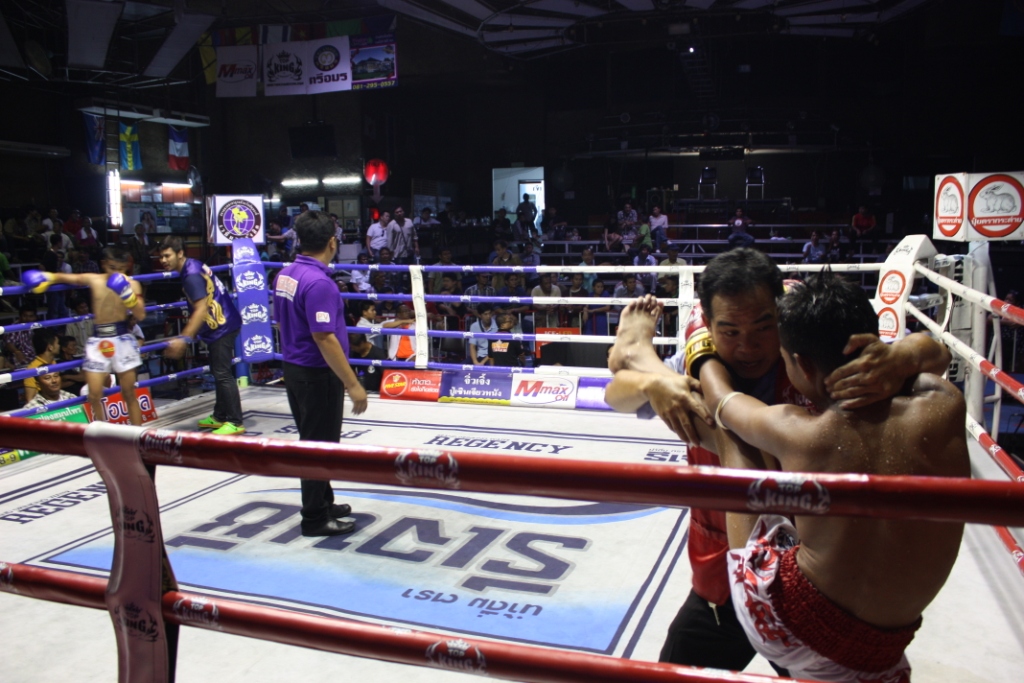
Taken September 6, 2015 at Rangsit International Boxing Stadium

Taken September 6, 2015 at Rangsit International Boxing Stadium
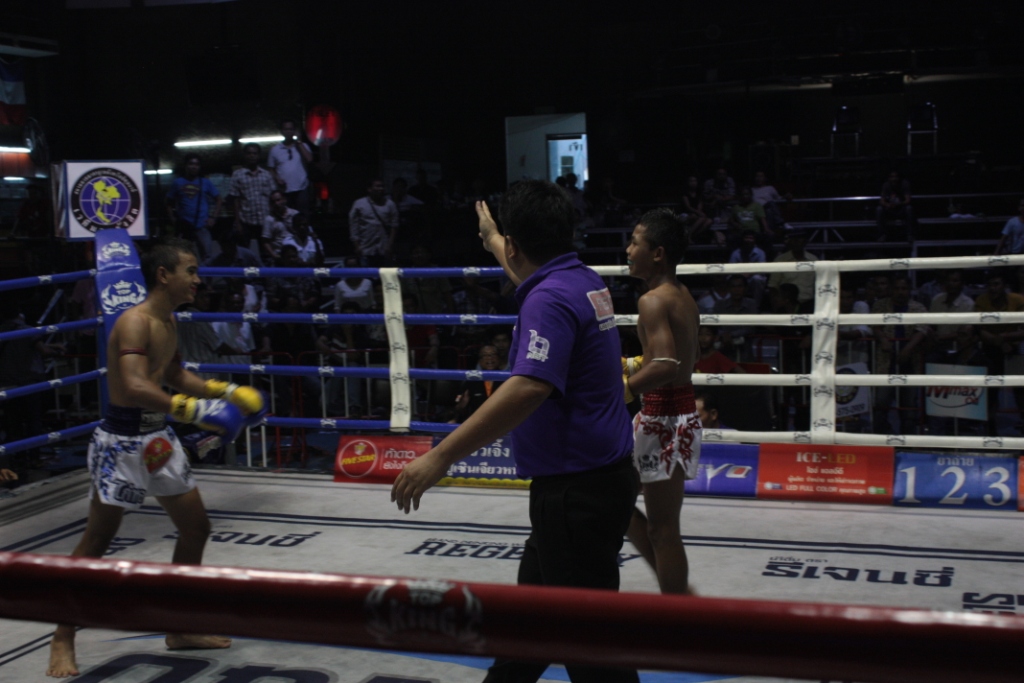
Taken September 6, 2015 in Rangsit, Thailand

Source: Muaythai Institute of Rangsit, Thailand
Walking around the lobby of the Muaythai Institute [MTI] is an education unto itself. There are many photos, articles, and memorabilia–as well as a few educational placards. Over the office and weight room there are a series of old photos from an earlier era in the development of this martial art. Of course, Muaythai already had a long history before there were cameras around to document it. (As witnessed by the presence of boxing gloves in the photo above [and most of the other photos here.] Gloves were probably a relatively new addition from the previous rope hand-wraps at the time of many of these photographs.)
Yesterday, I noticed the following poster describing the principles of Muaythai:
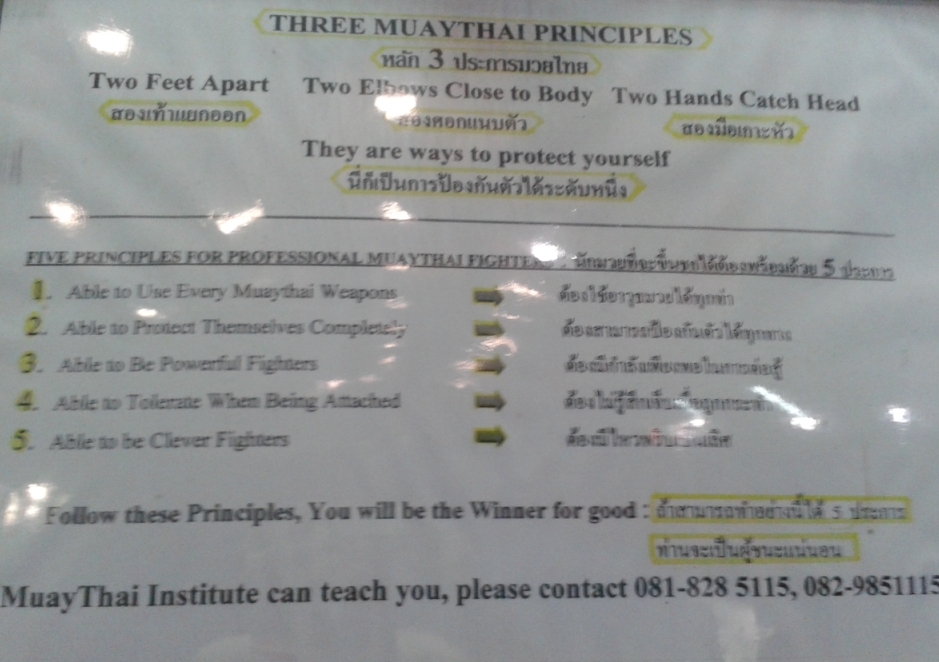
Poster in the gym at the Muaythai Institute
As it’s difficult to read, I’ll paraphrase the contents:
First, the three principles of Muaythai:
1.) Feet apart
2.) Elbows close to the body
3.) Hands guard the head
Second, there are the five principles for professional Muaythai fighters:
1.) Use all Muaythai weapons [i.e. fists, feet, elbows, and knees.]
2.) Protect oneself completely.
3.) Be powerful.
4.) Tolerate (persevere) attacks.
5.) Be clever.
I started to think of these guidelines in terms of the concept of budō-kun, which are the guiding principles of a given school of martial arts or even a specific teacher. The budō-kun concept is seen in Japanese martial arts, and at first blush it seems quite different from the muaythai principles stated above. While budō-kun typically have a philosophical / moral bent, the Muaythai principles seem quite pragmatic.
However, one can see broader meanings in these simple statements.
1.) The admonition to use all Muaythai weapons can be seen as a suggestion to be flexible and adaptable, and not to latch onto a single approach. I find the talk in judō about “favorite” or “match-winning” techniques (tokui waza) to be intriguing. Historically, martial artists seem to have avoided giving the impression that they had a favorite techniques. The logic behind this secretiveness can be described by Ralph Waldo Emerson’s quote: “If I know your sect, I anticipate your argument.” Or, expanding further, if I know your feelings on a subject I can respond to them to my advantage.
2.) “Protecting oneself completely” can be seen as valuing one’s body over one’s ego. In Thaiboxing, as in almost all combative sports, one sees instances in which a fighter drops his guard to either encourage an attack or just to showboat for the audience. Sometimes this works out as desired, but often it results in the fighter waking up on his back.
3.) Be powerful seems self-evident, but incumbent in the statement is the need to train hard. One doesn’t become powerful without working hard to develop both form and fitness.
4.) Being able to tolerate being under attack is another point that may seem less than profound, but it speaks to the realization that both fitness and capacity to “take a licking and keep on ticking” matter. Sometimes the outcome hinges on the durability and resilience of a given fighter–much as we might like to think that technique always and everywhere trumps all.
5.) Being clever speaks to the creative element. One must be able to adjust to changing circumstances, and sometimes victory hinges on actions that are unconventional.
I’m curious about the interpretations of others on this subject.
Taken in September of 2014 in Bangkok
“The title of this post doesn’t make a lick of sense?” you say.
But it does. This is my 1,300th post, and I’m going on travel for a few weeks to train muaythai at the Muay Thai Institute in Rangsit, Thailand. I may or may not post during the next three weeks depending upon what kind of pummeling I sustain to the brain-pan region.
The photo above as taken about a year ago on the Chao Phraya in Bangkok.
I’ll leave you with a thought for the day: If everybody around you holds the same beliefs as you, you’re not a member of a community, you’re a member of a cult.
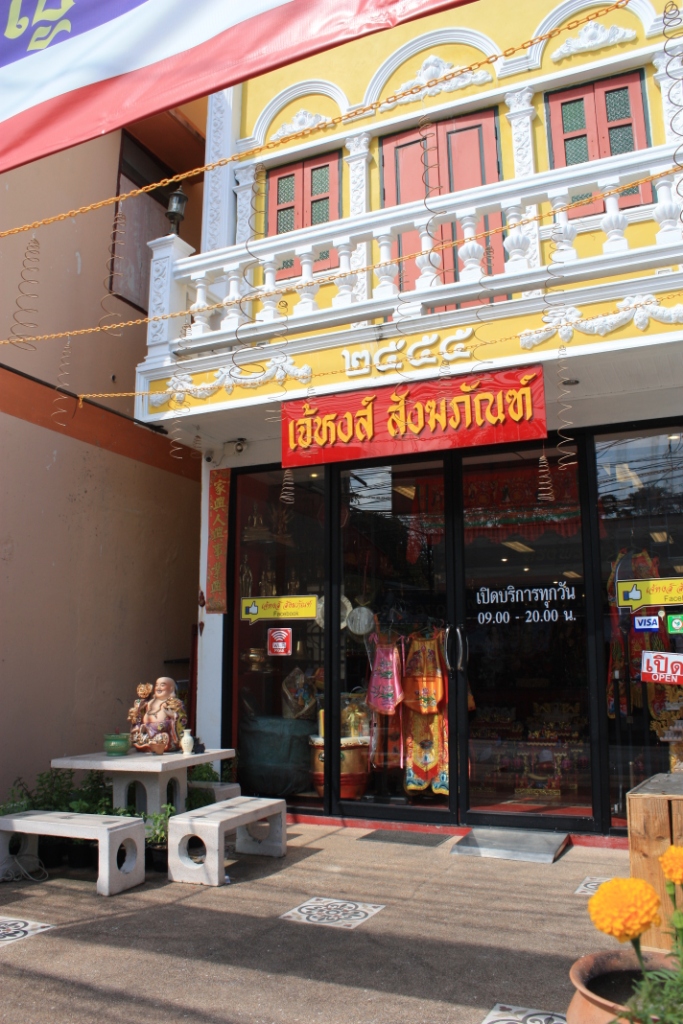
Taken in January of 2014 in Phuket Town

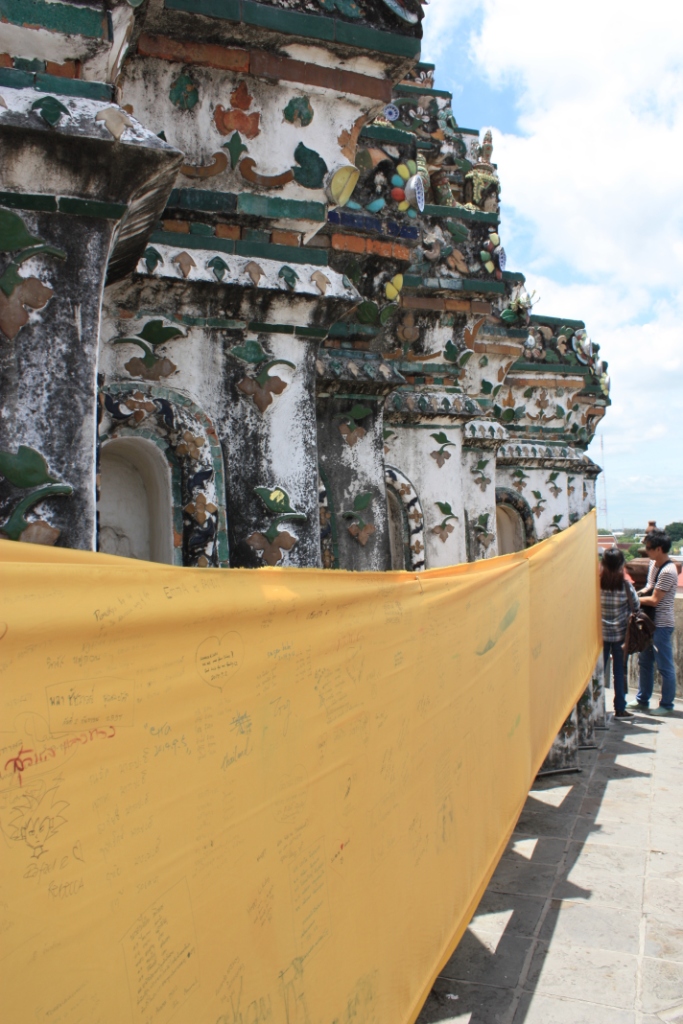
Taken in September of 2014 at Wat Pho in Thailand
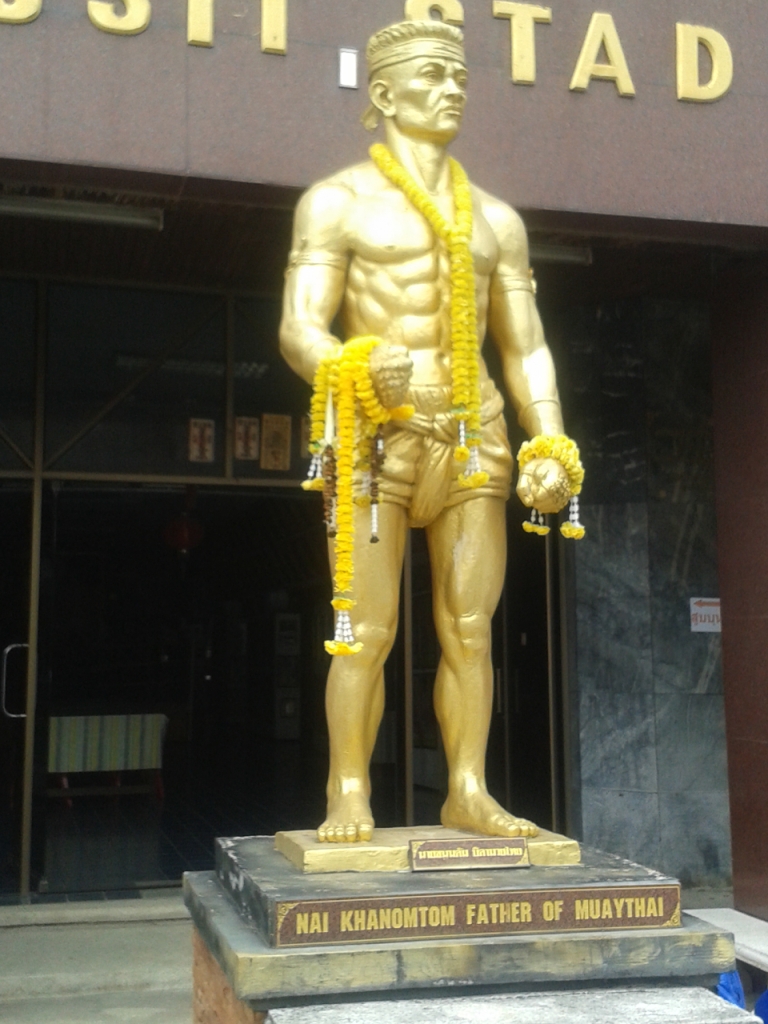
Muay Thai Institute in Rangsit, Thailand
In 1767 the Ayutthaya Kingdom of Siam fell to the Burmese. Burma occupied Siam only briefly because Burma’s king, King Hsinbyushin (a.k.a. King Mangra), was forced to withdraw his troops to combat a Chinese invasion to his homeland. The Thais were fabled to be valiant fighters and even had a numeric advantage, but they were easily put into disarray by Burmese forces. Even King Mangra was said to have declared that he couldn’t have taken Ayutthaya had the leadership of the opposition been more effective. [Keep in mind that even if he did say this, it might have been more a dig at his Thai counterpart than an expression of his true feelings.]
The Burmese captured a many prisoners during their Thai campaign and true warriors were particularly coveted as prisoners. One such fighter was Nai Khanomtom (fyi: it’s also written Nai Khanom Tom.) Nai Khonomtom was renowned for his skill in Muay Boran, an early Thai fighting style related to Muay Thai. This made him a logical choice to headline for the Thais in a tournament that would pit Muay Boran against Thiang–i.e. the indigenous martial arts of Burma (e.g. Lethwei and Bando.) The tournament would be part of King Mangra’s seven day festival in honor of Buddhist relics, the festivities of which would also include plays, comedians, and sword fights.
Nai Khanomtom was pitted against a Burmese champion, a man who was clearly the audience favorite. Timed rounds didn’t exist in those days. Fights stopped when one of the fighters was physically unable to continue, and not before. The Burmese fighter wore a kind of sarong that was the usual attire for the men of Burma, and Nai Khanomtom wore a loin cloth tied up in the traditional Thai style (see the statue pic above.) Each fighter wrapped only ropes on their forearms and hands, and each may have had some padding over the groin–though not as insurance against an accident, but because crotch kicks were fair game.
Nai Khanomtom began with a Wai Kru, which perplexed the Burmese. Wai Kru is a pre-fight ritual that has several purposes, the most important of which is to show respect for one’s teachers, deities, and the audience. The practice can take several minutes and some variants of it can be physically demanding.
When the fight started, Nai Khanomtom charged over the fight space taking the fight to his opponent and laying down a barrage of kicks, knees, elbows, and punches. By some accounts, his victory was declared invalid by a judge, who’d been distracted by other festival events (and who–no doubt–wasn’t pleased by the swift defeat of the Burmese champion.) The decision was made despite the fact that the Burmese fighter had been knocked unconscious.
The King was thrilled by the fight and offered Nai Khanomtom his freedom if he could fight nine more Burmese fighters. Nai Khanomtom didn’t get breaks between these fights, and as soon as an opponent went down the next was queued up to come after the Thai fighter. And so it was that Nai Khanomtom took on the Burmese fighters in an ironman fashion. The last of his opponents was a famous martial arts master teacher from Rakhine, a coastal region in Burma’s southwest. Nai Khanomtom went after the Rakhine master with flurry of kicks. It’s worth noting that in those days Burmese fighters were said to have relied much more heavily on hand strikes than kicks, and so the kicks may have given Nai Khanomtom a range advantage while presenting his opponent with attacks that the Burmese fighter was less practiced at defeating.
At the fight’s end, King Mangra honored his agreement, and Nai Khanomtom was granted his freedom and provided safe-conduct back to Siam. There are varying accounts that say that Nai Khonomtom returned home with either two Burmese wives or a number of his fellow prisoners as an additional payment for providing a spectacle that the Burmese king found gripping. In these accounts, Nai Khanomtom is usually said to have turned down a cash payment.
There’s a quote that’s often attributed to King Mangra that goes, “Every part of the Thai is blessed with venom, even with his bare hands he can fell ten opponents.” [FYI-It should be noted that seeing the same words quoted by several sources isn’t proof of truth, because the quotes could have a common (and false) point of origin. So take it all with a grain of salt.]
[Note: The details of this story vary. So you may hear–or have heard–a slightly different version of events. The exact details are likely lost to history and–when that happens–embellishment may creep in. That said, the variations that I’ve heard are neither great nor particularly significant. It’s also worth noting that these events are celebrated in Thailand every March 17th on what is called Boxer’s Day or National Muay Boran Day.]

Taken in August of 2014 at Wat Yai Chaya Mongkol





 Tiger Riding for Beginners