BOOK REVIEW: The Secrets of Judo by Jiichi Watanabe and Lindy Avakian

The Secrets of Judo: A Text for Instructors and StudentsThe Secrets of Judo: A Text for Instructors and Students by Jiichi Watanabe
My rating: 5 of 5 stars

Amazon page

Every once in a while, one stumbles onto a book that one feels desperately needed writing but which one thought didn’t yet exist. In the case of The Secrets of Judo, the book has been around for almost 60 years. First off, a more telling title for this book would be “The Science of Judo” or “The Physics of Judo.” It’s not a book that deals in arcane knowledge, as its title might suggest, but rather applies science to the skills of throwing, pinning, and submitting seen in judo.

While there’s a brief discussion of the nervous system as it pertains to reaction times, the bulk of the book is classic mechanics applied to judo techniques. The first six chapters (which constitute a little over half the book) provide a background of the relevant principles of both physics (e.g. force, momentum, and center of gravity) and judo (e.g. kuzushi [unbalancing], seiryoken zenyo [maximum efficiency], and ukemi [breakfalls].) The last two chapters provide explanations of how forces are applied to achieve successful throws (ch. 7) and grappling techniques—i.e. pins, chokes, and locks (ch. 8.)

I found this book to be invaluable and would recommend it for anyone who’s interested in grappling arts generally (whether judo or not) or even the science of human movement. The writing is clear. There are some mathematical equations, but just the algebraic formulas seen in basic physics. The graphics (mostly line drawings with a few photos) are useful, especially the drawings of the sequences of techniques which have letter labeled arrows to clarify the lines of force.

I should note that I read the original (1960) edition. Tuttle put out a 2011 edition that is probably what you will get–unless you stumble onto a copy in the used bookstore as I did. From a quick glance at the table of contents of the new edition, it doesn’t look like a major change and I suspect the new edition is at least as good.

View all my reviews

DAILY PHOTO: Struggle

Taken in September of 2015 in Rangsit, Thailand

Taken in September of 2015 in Rangsit, Thailand


DAILY PHOTO: Spinning Elbow

Taken at the Muay Thai Institute in Rangsit, Thailand.

Taken at the Muay Thai Institute in Rangsit, Thailand.

DAILY PHOTO: Pre-Fight Ritual

Taken on September 13, 2015 at Rangsit International Boxing Stadium

Taken on September 13, 2015 at Rangsit International Boxing Stadium

IMG_1742

DAILY PHOTO: In a Neutral Corner

Taken on September 13, 2015 at Rangsit Boxing Stadium

Taken on September 13, 2015 at Rangsit Boxing Stadium

IMG_1696 IMG_1693

DAILY PHOTO: Trainer Stretches Fighter

Taken September 6, 2015 at Rangsit International Boxing Stadium

Taken September 6, 2015 at Rangsit International Boxing Stadium

DAILY-ish PHOTO: Fight’s End

Taken September 6, 2015 in Rangsit, Thailand

Taken September 6, 2015 in Rangsit, Thailand

Principles of Muay Thai

Source: Muay Thai Institute of Rangsit, Thailand

Source: Muaythai Institute of Rangsit, Thailand


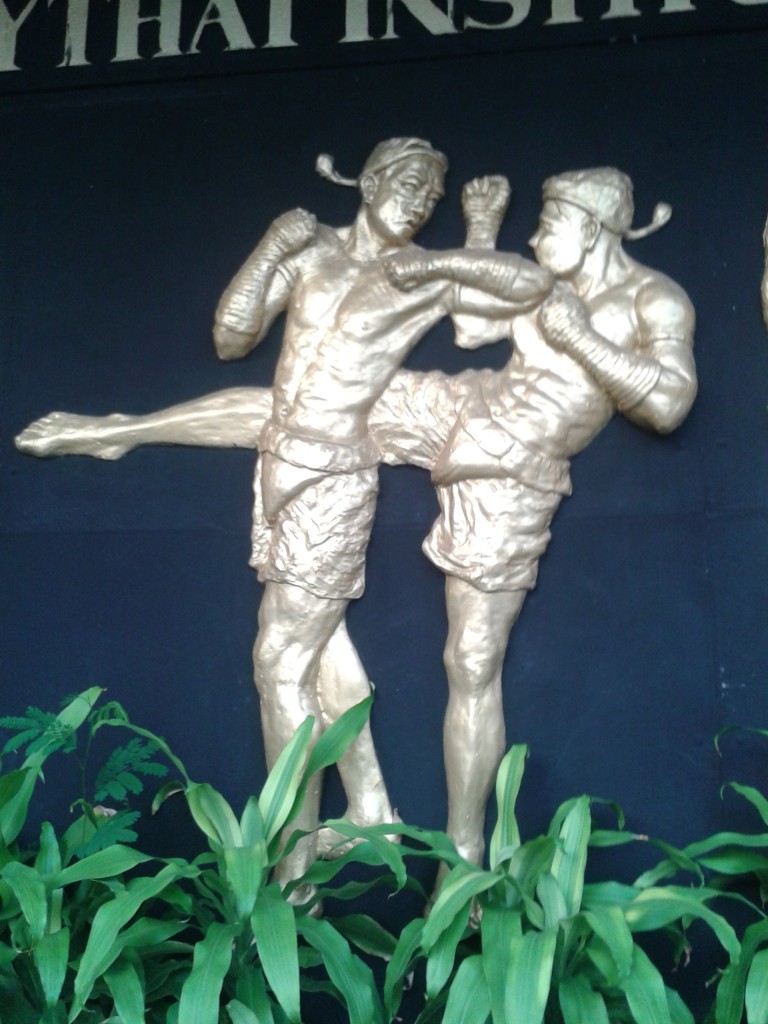
Walking around the lobby of the Muaythai Institute [MTI]  is an education unto itself. There are many photos, articles, and memorabilia–as well as a few educational placards. Over the office and weight room there are a series of old photos from an earlier era in the development of this martial art. Of course, Muaythai already had a long history before there were cameras around to document it. (As witnessed by the presence of boxing gloves in the photo above [and most of the other photos here.] Gloves were probably a relatively new addition from the previous rope hand-wraps at the time of many of these photographs.)


Yesterday, I noticed the following poster describing the principles of Muaythai:

?????????????

Poster in the gym at the Muaythai Institute


As it’s difficult to read, I’ll paraphrase the contents:

First, the three principles of Muaythai:

1.) Feet apart

2.) Elbows close to the body

3.) Hands guard the head


Second, there are the five principles for professional Muaythai fighters:

1.) Use all Muaythai weapons [i.e. fists, feet, elbows, and knees.]

2.) Protect oneself completely.

3.) Be powerful.

4.) Tolerate (persevere) attacks.

5.) Be clever.


I started to think of these guidelines in terms of the concept of budō-kun, which are the guiding principles of a given school of martial arts or even a specific teacher. The budō-kun concept is seen in Japanese martial arts, and at first blush it seems quite different from the muaythai principles stated above. While budō-kun typically have a philosophical / moral bent, the Muaythai principles seem quite pragmatic.


However, one can see broader meanings in these simple statements.


1.) The admonition to use all Muaythai weapons can be seen as a suggestion to be flexible and adaptable, and not to latch onto a single approach. I find the talk in judō about “favorite” or “match-winning” techniques (tokui waza) to be intriguing. Historically,  martial artists seem to have avoided giving the impression that they had a favorite techniques. The logic behind this secretiveness can be described by Ralph Waldo Emerson’s quote: “If I know your sect, I anticipate your argument.” Or, expanding further, if I know your feelings on a subject I can respond to them to my advantage.


2.) “Protecting oneself completely” can be seen as valuing one’s body over one’s ego. In Thaiboxing, as in almost all combative sports, one sees instances in which a fighter drops his guard to either encourage an attack or just to showboat for the audience. Sometimes this works out as desired, but often it results in the fighter waking up on his back.


3.) Be powerful seems self-evident, but incumbent in the statement is the need to train hard. One doesn’t become powerful without working hard to develop both form and fitness.


4.) Being able to tolerate being under attack is another point that may seem less than profound, but it speaks to the realization that both fitness and capacity to “take a licking and keep on ticking” matter. Sometimes the outcome hinges on the durability and resilience of a given fighter–much as we might like to think that technique always and everywhere trumps all.


5.) Being clever speaks to the creative element. One must be able to adjust to changing circumstances, and sometimes victory hinges on actions that are unconventional.


I’m curious about the interpretations of others on this subject.


Saving the Knees: Preventing Knee Injuries in the Martial Arts

Public Domain Image from Wikipedia

Public Domain Image from Wikipedia


The knee is a hinge joint. It’s designed to flex and extend with the thigh bone (femor) and the shin bone (tibia) in the same plane. A healthy joint can tolerate a certain amount of torquing or poor distribution of the body’s weight on occasion, but repetitive movements of that nature and /or severe uncontrolled movements can lead to permanent damage. Healthy knees are stable when straight (extended), but become slack when bent (flexed.)


Knee damage among martial artists is all too common, and the causes may or may not be self-evident. Martial artists whose practice includes kicks that require pivoting on a support leg or which involve landing leaping maneuvers may be intimately aware of the risks. However, the first martial art that I ever trained in had no twisting / pivoting kicks and few leaps (that were rarely practiced), but knee injuries were epidemic. The culprit in this case was low postures which required the thigh to be turned out (externally rotated and abducted) with the knee deeply flexed.


Well, I should say those postures were the culprit in conjunction with lack of flexibility and/or strength in all the right places. This isn’t to say that the individuals who developed knee problems weren’t strong or flexible, but the areas that needed work weren’t necessarily the big muscle groups that leap to mind when workout time comes around.   Emphasis on the big muscle groups (quadriceps and hamstrings) with neglect of the muscles involved with adduction, abduction, external rotation, internal rotation and stabilization can create some problems. If you’re a runner or a weightlifter (with good form) you may be able to get away with such a stretching and strengthening emphasis. [Note: I’m not advocating such an approach for anyone. What I’m saying is that if your knee is only worked with the knee straight below the hip and pointed forward in a hinge fashion, your risks are not the same as someone who works with a flexed knee with the thigh turned out. The likely injuries are different.]

Note: Knees pointing the same direction as the toes. (The back knee might be a little far back but that's an issue for the ankle health post.)

Note: Knees pointing the same direction as the toes. (The back knee might be a little far back but that’s an issue for the ankle health post.)

WRONG: Note: if one dropped a line down from the knee it would be well inside the foot. That means the ligaments are having to work too hard and your skeleton isn't doing enough

WRONG: Note: if one dropped a line down from the knee it would be well inside the foot. That means the ligaments are having to work too hard and your skeleton isn’t doing enough


To do a posture like the one above, one needs the flexibility to keep the knee wide enough so that it points the same direction as the toes.  The joint shouldn’t be wrenched or torqued with load on it. The four ligaments (Anterior Cruciate Ligament [ACL], Posterior Cruciate Ligament [PCL], Medial Collateral Ligament [MCL], and the Lateral Collateral Ligament [LCL]) and the surrounding musculature keep the joint snug during movements. And, as mentioned earlier, when the knee is deeply flexed it’s more sloppy than when extended.


-Increase flexibility in the muscles that internally rotate and adduct  the thigh: When one goes into a wide-legged stance, one’s thigh is pulled away from the body’s center-line (abducted) and the thigh externally rotates. If the muscles that act in the opposite direction (pulling the thigh back on center and rolling the thigh inward) are too tight to allow the knee to move into proper position, then the load of the body weight will be going into the ground through a kinked joint. Furthermore, one will end up torquing through the joint as one moves. Below are a few hip openers that will help one achieve the requisite range of motion.

Utkatakonasana (often called goddess pose) variations will show you whether you're getting your knees and toes in line.

Utkatakonasana (often called goddess pose) variations will show you whether you’re getting your knees and toes in line.

Badhakonasana (often called the butterfly stretch): Work on getting those knees down

Badhakonasana (often called the butterfly stretch): Work on getting those knees down

Place one foot on top of the opposite knee (and vice versa for the other side) carefully shift weight forward. This puts an intense stretch on the hip joint to help rotate the thigh sufficiently

Place one foot on top of the opposite knee (and vice versa for the other side) carefully shift weight forward. This puts an intense stretch on the hip-joint to help rotate the thigh sufficiently

Same as the last from the side

Same as the last from the side

Upavistakonasana: put legs at about 90 degrees relative to each other, and then lean forward with a flat back placing the stomach, chest, and chin on the floor (in that order.)

Upavistakonasana: put legs at about 90 degrees relative to each other, and then lean forward with a flat back placing the stomach, chest, and chin on the floor (in that order.)

Padmasana (lotus): If you meditate in padmasana, you probably already have the range of motion necessary. Note: if padmasana hurts your   knees, you need to go back to hip openers and discontinue the practice.

Padmasana (lotus): If you meditate in padmasana, you probably already have the range of motion necessary. Note: if padmasana hurts your knees, you need to go back to hip openers and discontinue the practice.


-Strengthen the muscles that stabilize the knee-joint. One begins this process with the usual suspects of leg exercise. One just needs to focus intently upon alignment. Here are a few of the exercises you may already be doing.


Wall squat: just like sitting on a chair with one's back  to the wall--sans the chair.

Wall squat: just like sitting on a chair with one’s back to the wall–sans the chair.

The classic squat

The classic squat

Side lunge: This one is  particularly important to get the knee aligned with the foot.

Side lunge: This one is particularly important to get the knee aligned with the foot.

The basic lunge: can be done stepping forward, backward, or both (the latter in an alternating fashion)

The basic lunge: can be done stepping forward, backward, or both (the latter in an alternating fashion)


As one needs more challenge, one can achieve it in the usual ways (single-legged, unstable surface, add weight, or combinations thereof.) Below are a couple of variations that combine single-limbed work with an unstable surface.


IMG_1537 IMG_1532


-Save static stretching for after the joint has warmed up. It used to be common to begin a workout with static stretching. While few do this anymore, it’s a practice that needs to be replaced. Stretch warm.


-Don’t neglect the opposing muscle groups: When I said that one needs to increase flexibility in adductors and internal rotators, that doesn’t mean to ignore the opposing muscles. Nothing  good comes of stretching or strengthening in an unbalanced fashion. Your musculature works as a team with agonists, antagonists, and stabilizers all working  in conjunction to produce effective movement.


-Don’t go overboard with stretching: If your aim is to be a contortionist, then by all means go ahead. However, highly flexible martial artists need to be concerned about joint laxity. Laxity is when the joint gets so loose that it’s vulnerable to popping out-of-place.  A martial artist needs a balanced style of fitness. Extreme flexibility results in weakness and lack of joint robustness, just like extreme strength training produces a body that lacks range of motion and stamina.


Most importantly, don’t ignore pain when it’s still at the minor twinge point. If you have knee pain you’re doing something that joint doesn’t like. One should reevaluate your movement and, if necessary, considering stepping back from your current practice to work on capacity building exercises.


DAILY PHOTO: Tai Chi in a Natural Setting

Taken in September of 2014 in Bangkok

Taken in September of 2014 in Bangkok

IMG_2074

IMG_2085