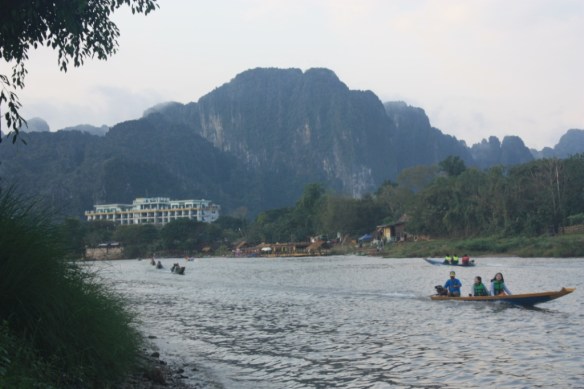
Taken in January of 2019 in Vang Vieng

Taken in January of 2019 in Vang Vieng
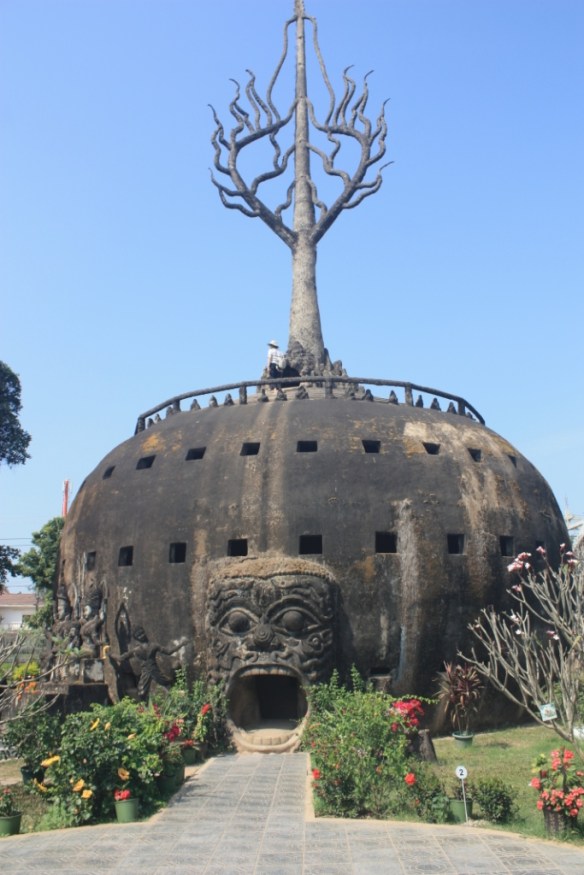
Taken in January of 2019 near Vientiane, Laos

Taken in January of 2019 near Vang Vieng, Laos
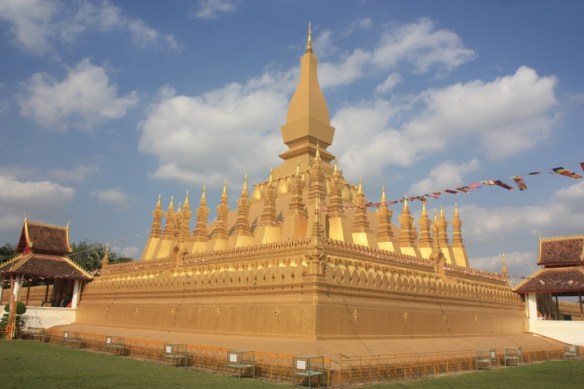
Taken on January 15, 2019 in Vientiane
 The Coroner’s Lunch by Colin Cotterill
My rating: 4 of 5 stars
The Coroner’s Lunch uses a popular and intriguing technique of setting a crime novel in an unconventional landscape. Like Martin Cruz Smith’s Arkady Renko novels (most famously Gorky Park), James Church’s Inspector O novels (e.g. A Corpse in the Koryo), or Laura Joh Rowland’s Sano Ichirō samurai detective novels, Cotterill’s book places a protagonist staunchly devoted to the truth into a sea of ideologues who value appearances more than facts and who will do anything to maintain their precarious grasp on power.
This approach appeals for a couple of reasons. First, it maintains a line of tension in terms of the world against the protagonist on top of whatever other plot conflicts may exist (criminal against investigator.) It also allows us to recognize the virtues that we find appealing amid a people that we think are a world apart.
While crime fiction is plot driven, this particular variant requires strong character development. We must have a lead character that stands out against the bleak landscape of the authoritarian regime that employs him. However, at the same time, the character mustn’t stand out by being bold and defiant in the manner we might expect of a crime novel set in New York City. Such a character is unbelievable amid totalitarian regimes like the Soviet Union, North Korea, feudal Japan, or—in Cotterill’s case—Laos, circa 1975. We can’t believe such a character wouldn’t be killed by leaders who have people summarily executed on a regular basis. So the character must be clever, adroit at manipulating the system, and a quiet anti-ideologue.
Cotterill’s Dr. Siri Paiboun largely fits the mold, but is a little more irreverent than usual. The old doctor is drafted into being Laos’ national coroner because most of the educated class has fled the country–this despite the fact that Paiboun’s medical expertise is not in forensics. The ultimate source of his bold demeanor is that he is an old man, and he figures that there’s not much that they can do to him. If he were to be executed he wouldn’t lose much longevity over his natural lifespan, and if they sent him to camp, it wouldn’t be as foreboding as the places he has once been. Additionally, he has a highly placed friend, and—beyond that–they can’t replace him in short order. Making Paiboun disappear as Communist regimes were known to do is not an option. Still Siri is clever and does know how to ride the line without tipping across it.
The plot revolves around two crimes. The first is the death of the wife of a high-ranking Party official. The second is the discovery of three Vietnamese government agents in a lake in rural Laos. Both of these cases are high-profile and create incentives to keep truth from coming out.
One element of Cotterill’s novel that is outside the mold for this type of book involves supernatural activities. It seems that–like The Sixth Sense’s Macualay Culkin—Dr. Paiboun sees dead people. Perhaps this device was added to set the novel apart from others in the aforementioned class. For me, this approach seemed superfluous and disadvantageous. Siri’s “gift” kind of detracts from his strength of character because it’s not so much his brilliant mind that is solving murders as the victims giving him hints.
I will say that this supernatural element is introduced in a great way and that it could have been used throughout the novel to a much better effect. When the dead people first visit him, it’s in the form of a dream. At first we don’t know whether his subconscious worked out the solution or whether there is something supernatural going on. However, the author adds a manipulation of the material world so that we know this is supposed to have really happened and later this becomes abundantly clear. I think it would have been better to maintain the ambiguity. People reach solutions to difficult problems through sleep all the time, but we don’t live in a world in which the physical is manipulated supernaturally. Not that there is anything wrong with supernatural fiction (I read a lot of it.) However, crime fiction works best in a realistic world, as does historical fiction. This novel straddles those two genres, and throwing in supernatural events muddles the setting a bit.
Overall, I thought the book was well-written and the main character was humorous and intriguing. If you liked the kind of books I mentioned in the first paragraph, I believe you’ll like adding this to the mix.
 Travels In Siam, Cambodia, Laos, And Annam by Henri Mouhot
My rating: 3 of 5 stars
If you can stomach the blatant racism and false notions of the virtue of Imperialism, reading the journals of 19th century naturalists and explorers can be fascinating for modern-day travelers. I will say that Mouhot’s work is less offensive than many of his contemporaries in this regard (e.g. the eugenicist polymath Francis Galton.) That is to say, he tries to be objective, and—when he fails–his condescension is as likely to be vaguely complimentary as not (e.g. noting certain “savages” are surprisingly intelligent.) However, one should remember that this is the journal of a journey that took place in years corresponding to the lead up to the American Civil War. (I should note that these snooty inclinations toward superiority aren’t uniquely Western, the Chinese diplomat Zhou Daguan also viewed the Southeast Asian people with condescension.)
Alexander Henri Mouhot left London on April 27th of 1858, traveled to and throughout Southeast Asia, and died in the jungle on November 10, 1861. The journal was received by the explorer’s brother, Charles Mouhot, who is responsible for seeing it published, and for adding some front matter as well as tying up the end of the journal because Henri Mouhot died fairly abruptly of a feverish ailment that he contracted in the jungle.
In many ways, Mouhot’s work is similar to Daguan’s 14th century Record of Cambodia. Mouhot covers a lot more ground, but they both chronicle the natural, cultural, and commercial environment of these lands. Mouhot prides himself in being a naturalist, and he writes quite a bit about the diverse flora and fauna of these lands as well as of the geography. Mouhot collected many specimens of plants and animals that were unknown in his native France. About mid journey, he lost his collection to a maritime accident. However, he was able to reacquire some of these specimens in the latter portion of his journey.
Mouhot writes extensively about the locals and their customs. As I already suggested, these descriptions are often highly biased. For example, he tends to refer to the indigenous spiritual beliefs of the locals as “superstitions” while he bemoans the fact that these people are “living and dying in utter ignorance of the only true God!” However, for the most part he tries to maintain a scholarly detachment, and often he is complimentary of the local people (e.g. his apparent surprise that some of hill people would be offended by being referred to as savages is an example of his benign condescension.)
Also like Daguan, he discusses the possibilities for trade. It’s clear that one of his intended audiences are those interested in the commercial potential of the region. He writes both about what natural resources these nations contain, and what products they might be sold. He is ambiguous about the local market for European goods, first skeptical and then sanguine. He says that the locals don’t have much need for the goods produced in Europe, but then he suggests that the wealthier individuals do like to emulate European style and fashions. Perhaps, he is saying there are potential consumers among the small slice of wealthy individuals, but that is a limited market. Of course, the desire for commodities from Asia in conjunction with the wish to avoid drawing down precious metals reserves (i.e. forcing Asians to buy Western products) was no small cause of Imperialist shenanigans during that time period.
Among the most interesting chapters are those on Angkor Wat and Angkor Thom. In these chapters, one receives an account of the state of Angkor between Daguan’s era (when the Angkor civilization was still active) and a modern-day Angkor that exists in the wake of successive waves of pillaging by the French (and other treasure hunters), the Khmer Rouge, and Vietnamese soldiers.
Mouhot was also interested in whether Jews had settled and integrated in the area. His theory was that there likely were. He says he sees a “Hebrew character” in some faces, but he acknowledges there is no hard evidence to support his belief and that the locals deny such a presence.
I guess the intrigue in Mouhot’s journal is a picture of this region during an era in which the world was not yet homogenized. Now when one travels to “remote villages,” one often sees people wearing the same mass-produced Western clothing that one sees at home, and they sit around with their smart-phones ignoring each other as at home. Mouhot’s era was one in which one traveled by elephant, boat, or by foot and often advanced no more than ten miles in a day in the jungle. It was an era of discovery. This may account for some of the xenophobic biases of that time; the ways of other people were new.


 Tiger Riding for Beginners