
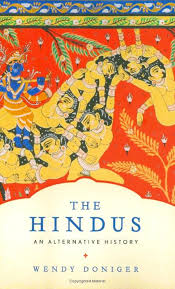
Penguin India and The Hindus: Do Self-Imposed Bans Sell?

Hindus

If anything sells a book more effectively than sex, it’s being banned. One knows that a book contains powerful ideas when someone goes to the effort to try to have it banned. Granted, the powerful ideas may or may not be good ideas–or true ideas, but thinking minds will demand to see for themselves. (I for one will be stopping by my local bookstore to see if they have a copy they’ll sell me for less than 1,000 rupee [$16USD], because I’ve got to know what has the thought Nazis up in arms.)

But does a self-imposed ban have the same effect? Penguin India settled a suit by agreeing to stop printing the book The Hindus: An Alternative Historyand to burn outstanding copies. This, after a protracted legal battle against a Hindu nationalist group called Shiksha Bachao Andolan. However, there may be more to it than simply trying to build sales on the four+ year old book (that likely would have been long forgotten in an environment of free speech.) Indian law makes it a criminal offense to offend Hindu sensibilities, and thus puts the publishers in physical as well as fiscal jeopardy. Of course, it’s already come and gone as a best-seller in India, so it couldn’t hurt to restoke global interest.

It should be noted that there isn’t overwhelming support for banning the book in India. There has been outrage against Penguin’s fold by Indians who read, who believe in freedom of speech, and who are terrified of the idea of a crime of hurting someone’s feelings by discussing their religion’s history. (The latter being a direct route to tyranny if ever there was one. )

As I said, sex sells and bans sell double; the book in question has both. One might be inclined to think that it’s some sort of porn novel churned out on pulp.  Actually,  the author is a Professor of Religious History at the University of Chicago, Wendy Doniger. The book does apparently focuses heavily on the role of sexuality in Hindu mythology. What some readers might not know–and might be surprised to learn–is that hardcore Hindu nationalists are two steps to the right of Jerry Faldwell on issues of sex.

Here’s are accounts by the LA Times and Galleycat.

One of the most extensive discussions of the forces who succeeded in getting the book banned is in the NY Times.

BOOK REVIEW: The Einstein Theory of Relativity by H.A. Lorentz

The Einstein Theory Of RelativityThe Einstein Theory Of Relativity by Hendrik Antoon Lorentz

My rating: 3 of 5 stars

Amazon page

It’s hard to complain about this book because: a.) it’s a free kindle book, b.) the author was brilliant, a Nobel Laureate, and a man whose work contributed to the discoveries of Einstein, and c.) it’s a very short book, clocking in at about 60 pages, and so it’s not a huge time investment–though for most it will be a bigger time investment than its page count would suggest.

All that being said, I’ll be upfront and tell you that his work is the product of a different era and doesn’t establish its audience clearly.

Science writing, particularly on subjects as arcane as relativity, is a challenge. One has to pick an audience and carefully write for that audience. If ones audience is broad (i.e. not well-trained in science), this means one has to accept a lot less precision in exchange for clarity. In other words, one has to write like Brian Greene or Michio Kaku do in their popular works. On the other hand, if you want to write for technical people, you should probably feel free to show your math and sling the technical jargon.

This book tries to walk a middle ground. It doesn’t lay the subject out in clear, simple, and entertaining analogies. (With the exception of a moving car analogy early on that gets bogged down.) However, there’re no equations or highly technical and jargon-suffused discussions. (Though the section on deflection of light does get into measurements and is bit technical.)

So the question the reader needs to ask themselves–provided they haven’t had physics since high school or their freshman year of college–is whether they are willing and able to grind through reading that will require them to think hard the whole way. One doesn’t need a big science vocabulary, and you aren’t asked to ponder any equations, but you do have to noodle out what the author is saying to get value out of the reading. As I implied earlier, this book (pamphlet) took me considerably longer to read than 60 pages normally would–and I read a fair amount of popular science works.

Of course, given that it’s free, it’s worth a try if you have a Kindle. If nothing else, you should come away with some basics– such as what differentiates special from general relativity. If you don’t like the book you can always buy a Greene or Kaku book to explain the subject in a more palatable fashion.

View all my reviews

Happy 237th, America

IMG_9111America is the product of a set of exceptional human beings. Some may wish to humanize the founding fathers and to deflate the mythology that has grown up around them, but deflate the myth and one still has impressive facts. Who turns down a salary for the most sleepless and thankless job in the universe? George Washington, that’s who. Who writes a political document so artfully that its turns of phrase still chime poetically  in the ear 237 years after the fact? Thomas Jefferson, that’s who? Who can invent the lightening rod and bifocals, convince the French to move toward the sound of the guns (just kidding, France), and get the chicks despite the most hideous comb-over ever? Benjamin Franklin, that’s who.

Now this may be Golden Age fallacy talking, but today’s ruling elite seem a bit… well let’s just say “pathetic” by comparison. Sure modern-day rulers still have charisma out the wazoo, but Franklin had charisma plus a world-class intellect. Jefferson had charisma, and he didn’t need a speech-writing team and focus groups to craft his words for him. Washington had charisma, and–quite frankly–he could scare the shit out of a grizzly bear. It’s the rare modern-day leader who is  qualified for any alternative career besides ambulance chasing.

Still, I will remain optimistic about the fate of the nation as long as great ideas prevail. Checks and balances is a great idea. The compromise to appease both populous and small states is a great idea. The Bill of Rights is a set of great ideas. I’m a little amused whenever I hear people say that America needs to revise its Constitution if it wants to keep up in the modern world. I heard this most recently from a scholar who said that because it was relatively difficult to make laws and spend money, America was going to fall ever behind the likes of Scandinavian countries? What? Really? Seriously?