Hae Kum Gang: Korean Food in Bangalore

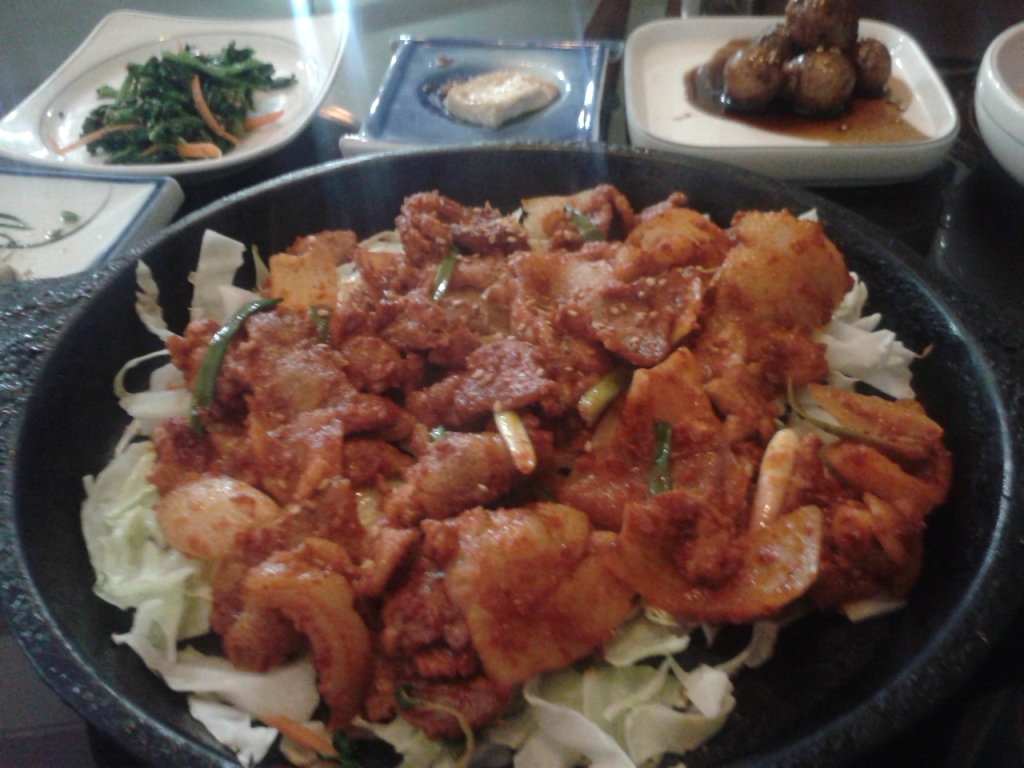
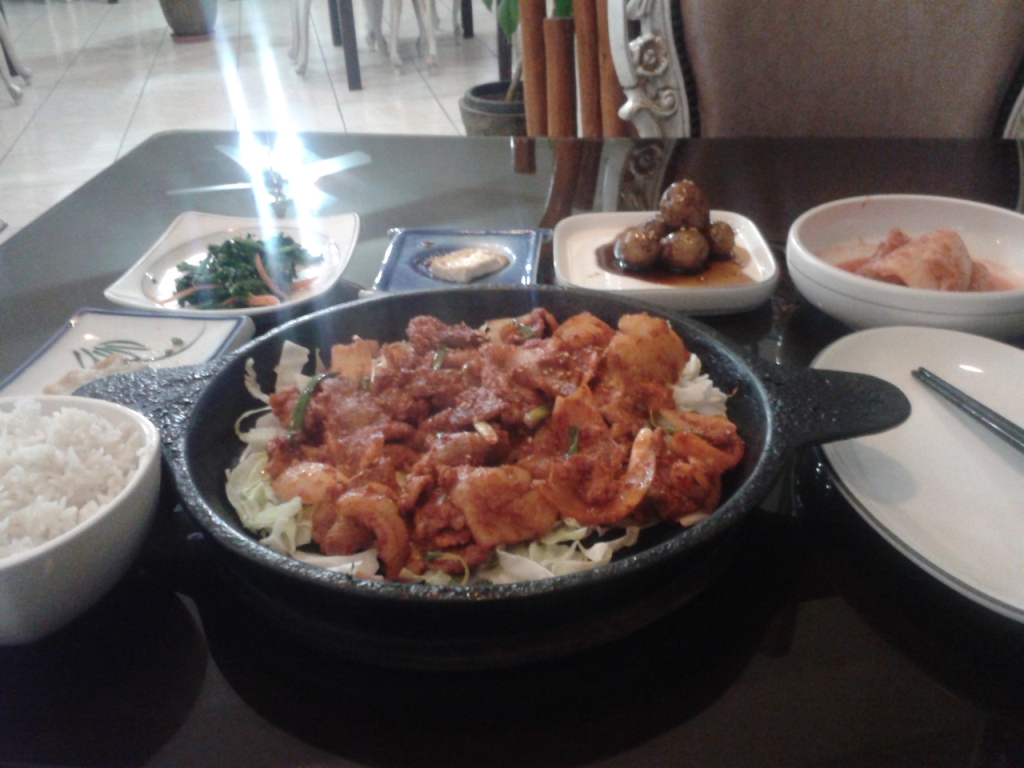
Jeyuk-Chulpan with assorted sides.

Jeyuk-Chulpan with assorted sides.

I’ve been eating a lot at restaurants since we moved to Bangalore, both because it’s (usually) cheap and for the experience of it. I’ve eaten at enough places to have developed some favorites, but I try to keep broadening my experience by eating at as many new places as  I can.

Today, I had a lunch experience that was new on two fronts. For one thing, it was a restaurant that’s new to me, but–for another–it was my first experience with Korean food as prepared in India. I’ve eaten at several Chinese restaurants in India, and, while the places I’ve tried were all pretty good, they were all distinctively Indo-Chinese. In other words, the dishes didn’t taste like they did in other places at which I’ve had Chinese food, e.g. China. On the other hand, the Bangalorean Thai restaurant, Lan Thai, seems pretty authentic to me, except perhaps the diminished use of fish sauce (which is incredibly popular in Thailand and almost non-existent in India.) I was, therefore, uncertain what to expect from Hae Kum Gang–other than that it had a pretty high rating on Zomato and so it likely had decent food.

I can’t say what Korean food tastes like in Korea, as I’ve not yet gotten outside of Inchon airport, but Atlanta had a pretty huge Koreatown and I ate at a variety of Korean restaurants there. (A Korean man once told me that Korean food in Korea tasted very different because of the taste of the vegetables–given the spice palette of Korean food, I wasn’t sure whether to dismiss this as nostalgia–e.g. tasting the difference between American cabbage and Korean cabbage through the kim chi chili seasoning and fermentation seems a bit of a challenge.)

At any rate, what I found at Hae Kum Gang was on par with what I’ve had in Duluth, Georgia.  This was a pleasant surprise because their menu states Korean, Chinese, and Japanese cuisine. While these cuisines have some overlap–particularly with Korea in the middle–they are each distinct. My concern was based on bad experience with “multi-cuisine” restaurants in India that try to do everything and end up doing everything in a mediocre fashion.  (Hampi was loaded with such places.) What I ordered was pretty typically Korean, I imagine if you had a Chinese or Japanese dish off the menu you might not find it authentic, but rather like a Korean interpretation of the dish. (Although, Duluth has some fine sushi places with Japanese names and advertising themselves as Japanese food, but clearly owned, run, and staffed by Koreans.)  

I ordered the Jeyuk-Chulpan, which was described as: “Stir-fried pork with vegetables, served in spicy chili sauce on a sizzler plate.” The description was spot on. The platter sizzled for about 15 minutes after it got to the table. The dish had a pleasant level of heat (spice) and was tasty.  This isn’t a dish for those watching their cholesterol. The pork was quite fatty, which, of course, made it sumptuous and delicious but higher in fat content than many might desire. For lunch it suited me. It’s not something that I would eat for dinner, both because I don’t sleep well if I have red meat immediately before bedtime and because one needs some active time to burn off some of those calories  before going to bed. 

I was told a bowl of steamed rice came with this dish, but was pleasantly surprised to find seven other sides were brought out as well. Getting a load of side dishes along with your main is not uncommon with Korean food and I’ve had similar experiences elsewhere. The first small plate to arrive was Yukhoe,–a spicy Korean answer to steak tartare. I was a little reluctant about eating a raw beef dish in India, but I forged ahead and found it delectable. It was spicy, and warmed through–though not enough to cook the meat. While it was tasty and I’m none the worse for wear, I don’t know if I’d recommend you partake of this dish unless you know your constitution to be caste-iron and you like to live a little on the wild side. In the US, where there are all sorts of regulations and health inspections in restaurants, there is still invariably a warning to consume at your own risk. The same could be said of Japan, where 4 people died (35 hospitalized) in 2011 from eating a batch of the Japanese version of this dish that was tainted with E. Coli.  The standard for raw beef dishes is less than a day between slaughter and freezing and less than a day between thawing and use. I can’t say what this restaurant’s practice is. It tasted clean and fresh, but exercise care.

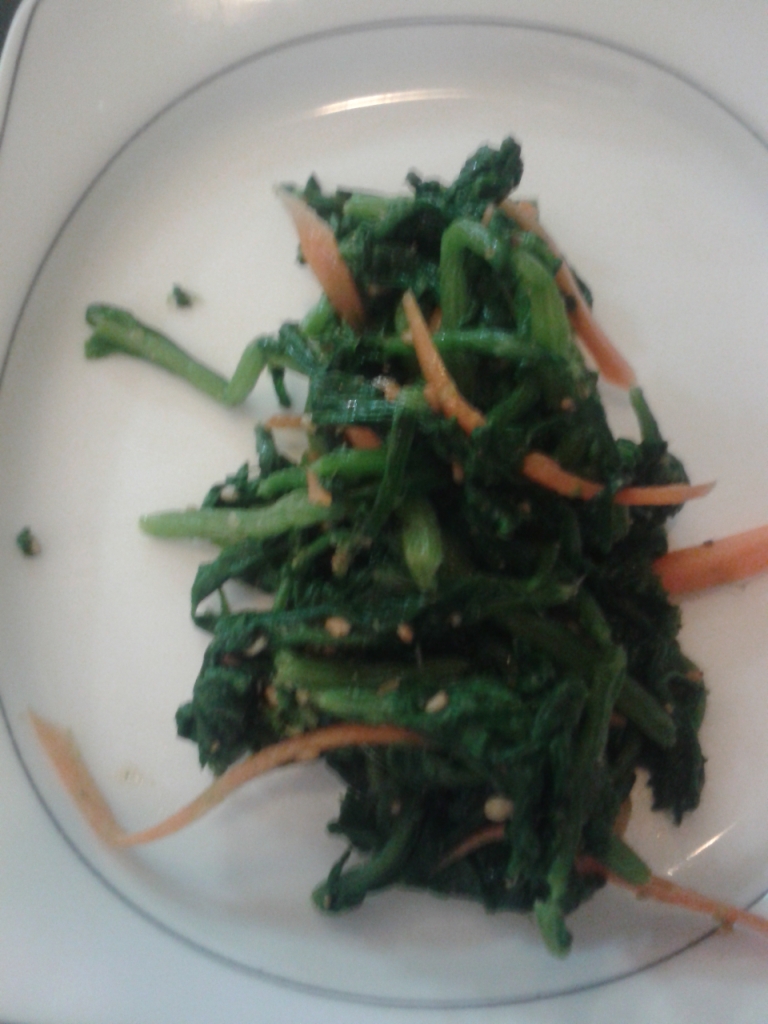
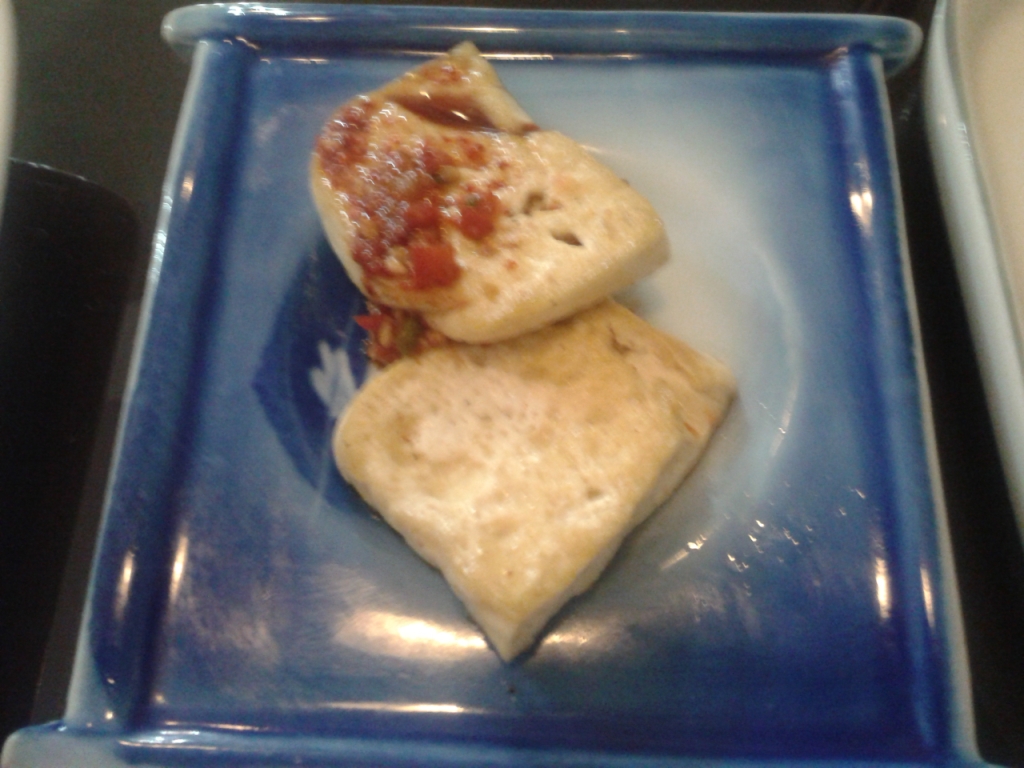
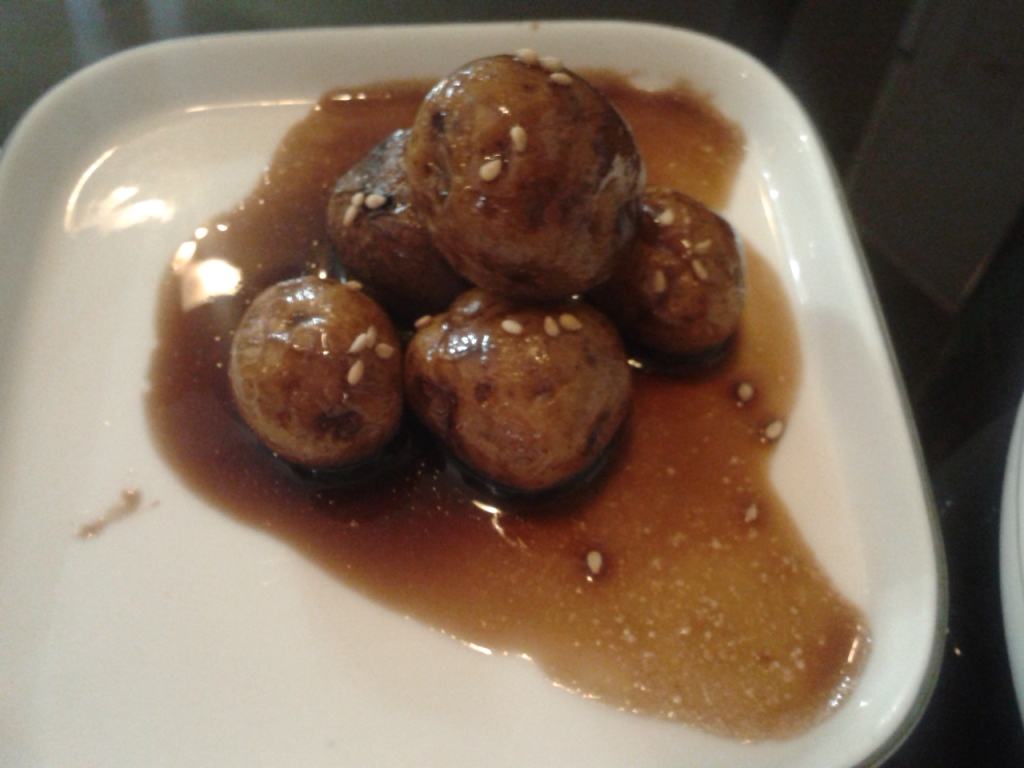
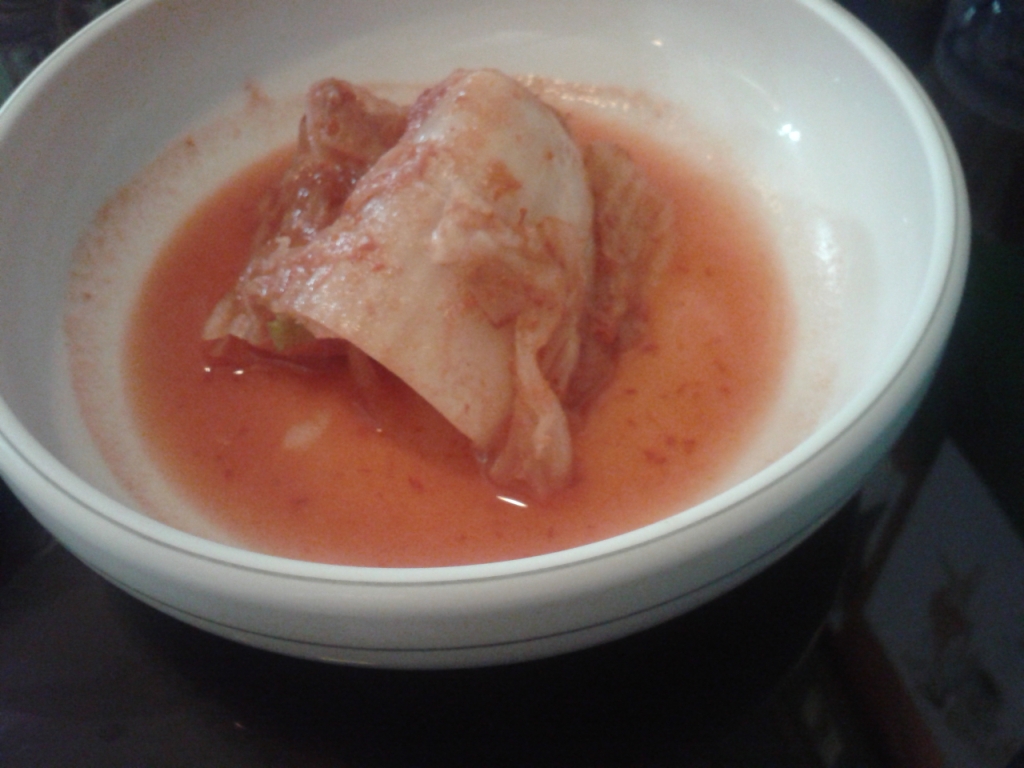
There was also a soup and a salad. The soup actually tasted more like something I’ve had on occasion in India than anything I’ve had in a Korean restaurant, except the vegetables were typically Korean. I believe the salad was a seaweed. There was also braised tofu, boiled baby potatoes in a teriyaki-esque sauce, and the Korean mainstay kim chi.  If you eat the Yukhoe, I’d recommend you eat your kim chi. Kim chi isn’t a personal favorite of mine, but its fermentation may offer you some assistance in digestion.

I’d recommend Hae Kum Gang.  My food was 480 Rs. (plus tax, tip, and a mineral water), which is pricey by Indian standards–but, as I always say, sushi and brain surgery are two things you don’t want a great deal on.

No, I don’t know if the name is supposed to register as “Hey, Come Gang!”
HaeKumGang2 HaeKumGang3 HaeKumGang4 HaeKumGang5 HaeKumGang6 HaeKumGang7

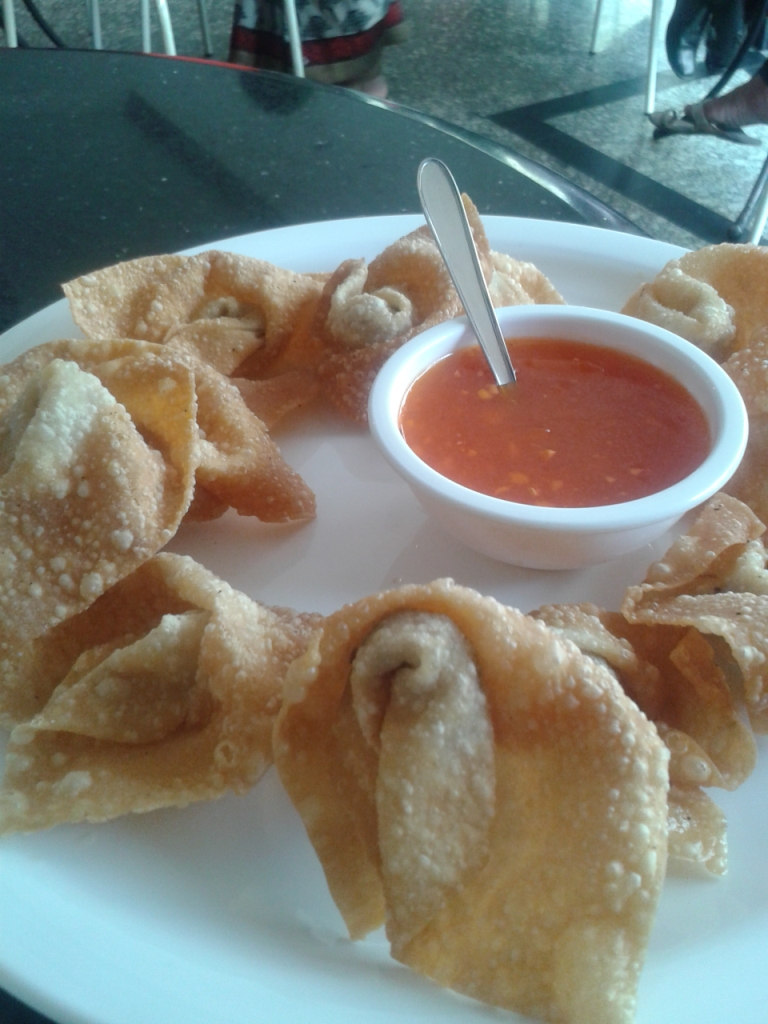
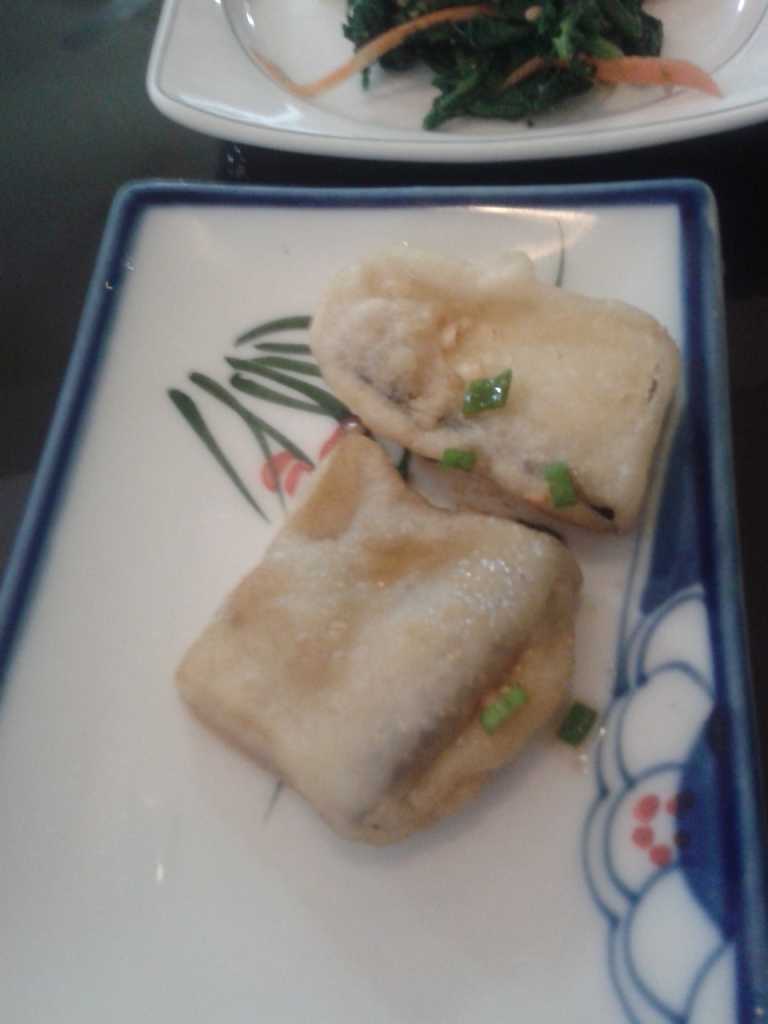
DAILY PHOTO: The Fried Wontons of Green Onion

Taken October 9, 2013

Taken October 9, 2013

I’m a hole-in-the-wall kind of guy. I like good food wherever I find it, but I find it particularly pleasurable at tucked away little places.

This week I ate at Citrus in Leela Palace. It’s one of the swankiest places in Bangalore. The food was excellent, but, of course, you know it’s going to be excellent. It’s expensive and has a French sommelier on staff. There’s great food, but no surprises.

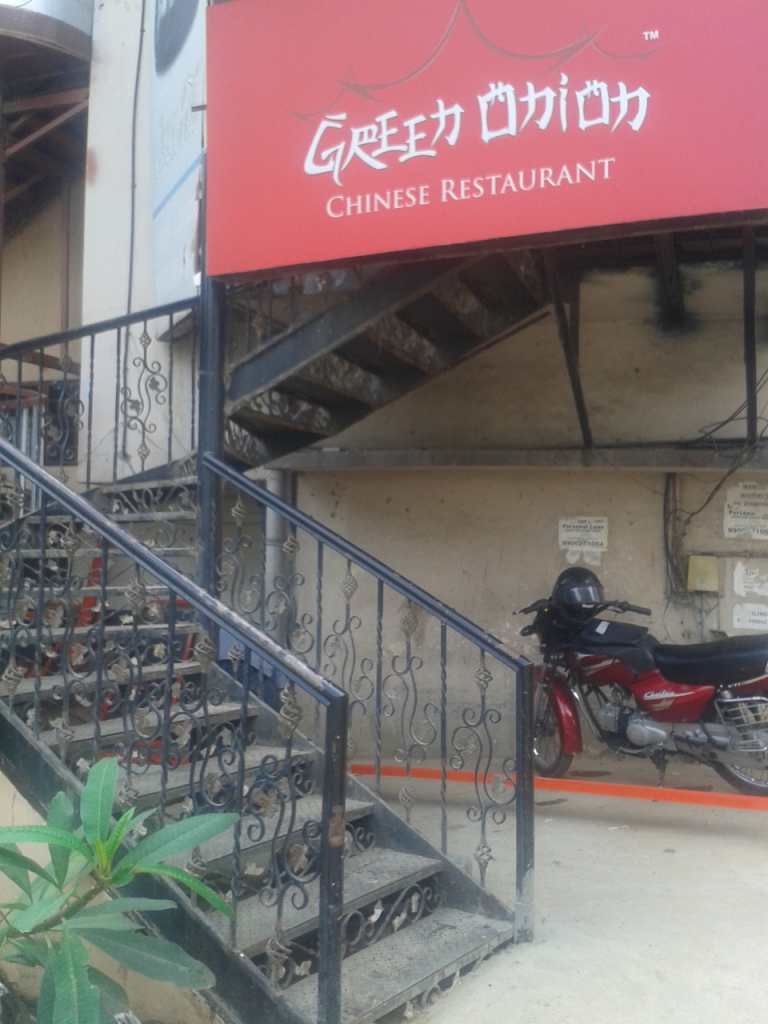
Green Onion is a little first floor (second floor to Americans) Chinese place on a short side-street off of MG Road. I’ve been there twice, and it’s been almost full both times. It’s good food at a reasonable price. Today, I had the above fried wontons  along with kung pao chicken (which I order as much because it’s fun to say as because it’s delectable.) As can be said of most any Chinese place in Bangalore, it’s Indo-Chinese. That is to say, dishes don’t taste like they would in Beijing. That doesn’t make them bad, just different.

I don’t know if it’s cultural bias or not, but I think good Chinese food in America mirrors Chinese food in China more closely than does good Chinese in India. (Of course, bad Chinese food abounds in the U.S. and probably outnumbers good Chinese restaurants.) It may be because American food doesn’t have the extensive and potent flavor palette Indian food does, or because the China and India have shared a border for long enough to have developed a third entity cuisine over time in the manner that Tex-Mex food is distinct from Mexican. All this being said, it’s still tasty, just not in the same way Chinese food in China is.

20120109_005927

TODAY’S RANT: The Lonely Omnivore

My salami has a first name, it's B-E-S-S-Y.

My salami has a first name, it’s B-E-S-S-Y.

I’m a member of a group that has long suffered the bitter pill of discrimination. How is it–you may ask–that a white, heterosexual, suburban, graduate-educated male knows the foul taste of discrimination? I love meat, but my wife is a vegetarian.  This makes me a lonely omnivore.  When I go to the market, I can’t find meat packaged for my kind. No individual could cope with such quantities of meat as packaged by supermarkets. Well, that is besides those not averse to contracting colo-rectal cancer from the rotting carcass wedged in his transverse colon, e.g. Adam Richman.

One option–the healthy option–would be for me to go vegetarian. Did I mention that I love meat? I love bacon and beef and poultry and pork and rabbit and reindeer. I would eat meat on a boat. I would eat meat with a goat, and then I’d make a stew out of the goat. Cut off the beak and the bung, and you’ve got yourself a customer. You say you got horse meat in my beef? Sounds tasty. So option one is a nonstarter. I’m out of the omnivorous closet. I’m here; I eat steer; get used to it.

Another option is to find the store butcher and ask him to wrap me a solitary steak.  The problem is two-fold. First, the butcher is never just hanging out at the counter, and so there will be a PA announcement. In the 1950’s, before computers with Facebook and solitaire, the butcher would hang out at the counter, but now he’s in the back–presumably goofing off like 90% of the workforce. The announcement will be quick and neutral, but it will sound enough like the following to garner widespread attention, “Attention in the meat department, there’s a pathetic soul with no one to love him who needs steak for one, I repeat STEAK FOR ONE.” Then everyone in the store has to take a peak at the lonely omnivore. Don’t stare, Johnny, it’s just a hobo.

The second problem is that, while the butcher is smiling and polite, I know he is thinking, We have half a mile of prepackaged meat, and you really want me to take a break from my hectic schedule of playing solitaire in the back office to cut you one steak? Haven’t you heard of a nifty invention called a “freezer?” It should be located somewhere in the general vicinity of your refrigerator  

The third option is, of course, the freezer. If you had any idea how disheveled my mind was, you wouldn’t even suggest this. Using the freezer would require that I anticipate that I will eat again in the future so that I can take the meat out to thaw. Here’s how it really works. I’m sitting here typing and think, That steak would really be good about now! However, presently it isn’t a steak, it’s a block of meatcicle. So I take it out of the freezer. I stare at it for a few minutes, hoping to use my ill-developed Superman-like powers of heat vision. Then I try running hot water on it, but it remains crystalline on the inside. Then I leave it and go back to typing. Then I check on it in three minutes. Then I go back to typing. Then I check on it after two minutes. Sensing the beef will never thaw, I break down and make myself some unsatisfying but filling Top Ramen. The next time I see the steak it’s a soggy and unappetizing lump hanging out in my sink.

Now if you’re an outline-and-note-card kind of writer, you may wonder how a writer could be so unskilled at planning. I’m not that kind of writer. If you haven’t guessed it, if it hasn’t shown through, I just make shit up as I go along. For me, writing is a process of paginated diarrhea, with an admittedly messy cleanup process.

My final option is to go to one of the huge “farmer’s markets” that we have in the area. (I use quotes because I’ve never seen an actual farmer there, and the food is as likely to be from Armenia as it is from Americus, Georgia.) These markets have heaped slabs of meat on ice, they’ll and cut it however one wants. I do this sometimes. There’s a very cool thing about these places. Because they serve such a diverse population, they hire a lot of immigrants.  However, while it’s cool that my butcher is a native Lao speaker, it can be problematic for me as a non-Lao-speaking English speaker. Inevitably, my desire for ONE PIECE of meat is translated into ONE KILO of meat or ONE CRATE of meat. I know, you’re saying that there’s one simple and obvious solution: learn the Lao language.  The problem is that the next time I go I might get the Urdu-speaking butcher.

I don’t like to complain about my plight [which is why I have a regular series of posts called TODAY’S RANT], but we should make room in our society for those of different meat needs.

A Dude’s Attempt to Master Pad Thai

On a trip to Thailand last fall, my wife and I did a one-day cooking class in Chiang Mai. That day I made the perfect batch of pad thai. (For the uninitiated, Pad Thai is “noodles Thai-style.” It’s one of the more popular dishes at your local Thai restaurant. If you don’t believe me, go check. I’ll wait.)

Anyway, I preceded at home to make 35 batches of pad thai that bore little resemblance to food. That’s not true. Only the first five dishes were fundamentally inedible, the next thirty were tasty enough– they just didn’t taste like pad Thai. A poor cook might blame the difference on the variation in ingredients between Thailand and home. However, I have a sneaking suspicion the cooking school staff was slipping good cooking into my dish while I wasn’t looking. They’d say, “Godzilla” and point, and I’d turn (because one can’t take a chance that close to the Pacific), and when I turned back around the contents of my wok would look and/or smell better.

If making mac-n-cheese from a box, microwaving a HotPocket, or grilling a burger aren’t counted as cooking, then you might say that my experience with cooking was nothing. However through an extensive process of error and error, I arrived at delectable pad thai.

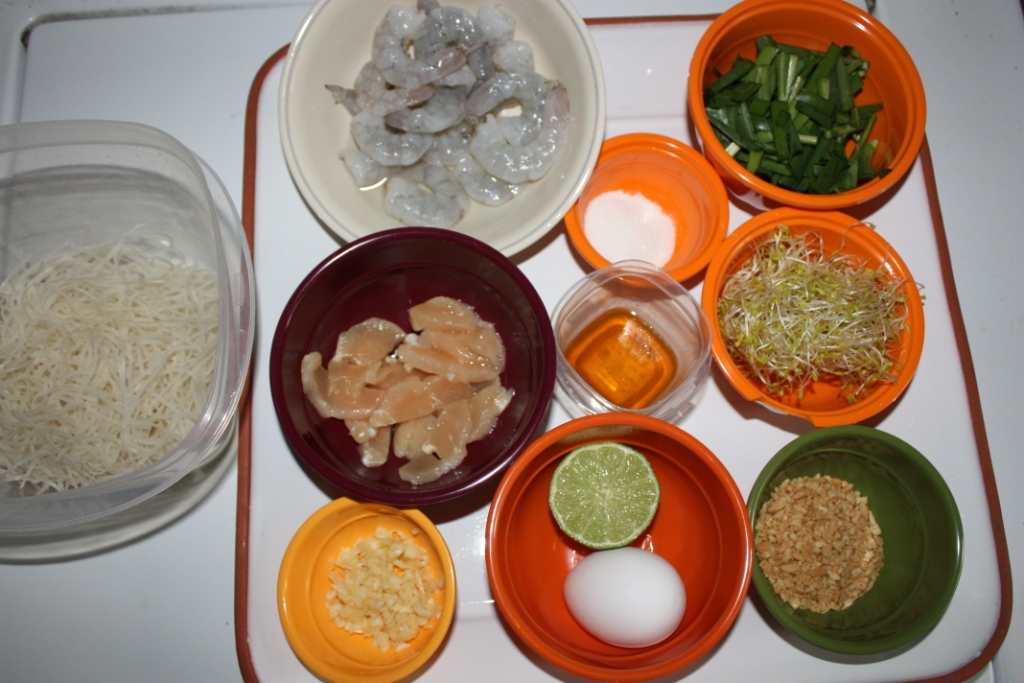
Below is what you’ll need.

Ingredients

Ingredients

First, for the anal retentive types who’ve noticed that I took this picture on top of the washing machine, that was solely for lighting purposes. This process in no way involves use of the washing machine. It’s not one of those clever recipes like cooking fish in the dishwasher. I’m serious, under no circumstances are you to attempt to use your washer in the making of pad thai.

In list form, what you’ll need is:
– 2 Tablespoons of oil (anything but olive)
– 4-ish cloves of garlic (more if you have a vampire-infestation problem)
– shrimp (several to many)
– chicken (one to two tenders’s worth; like the size of tender they give you at Applebees or Chilis– NOT McDonalds, i.e. a swanky tender)
(substitute tofu if you’re one of those quasi-vegetarians who count chicken as animal but don’t count shrimp/fish.)
– egg (1)
– 2 Tablespoons fish sauce
– 1-1/2 teaspoons sugar
– rice noodles (about 2 ramen packets worth, not that you should buy it that way)
– crushed peanuts (3 heaping Tablespoons)
– spouts (1 cup-ish. Normally this is soy or mung bean sprouts, but I’ve substituted Alfalfa sprouts because they work fine and last longer in the fridge.)
– spring onions or chives or something green and oniony (1-cup-ish)
– 1/2 a lime

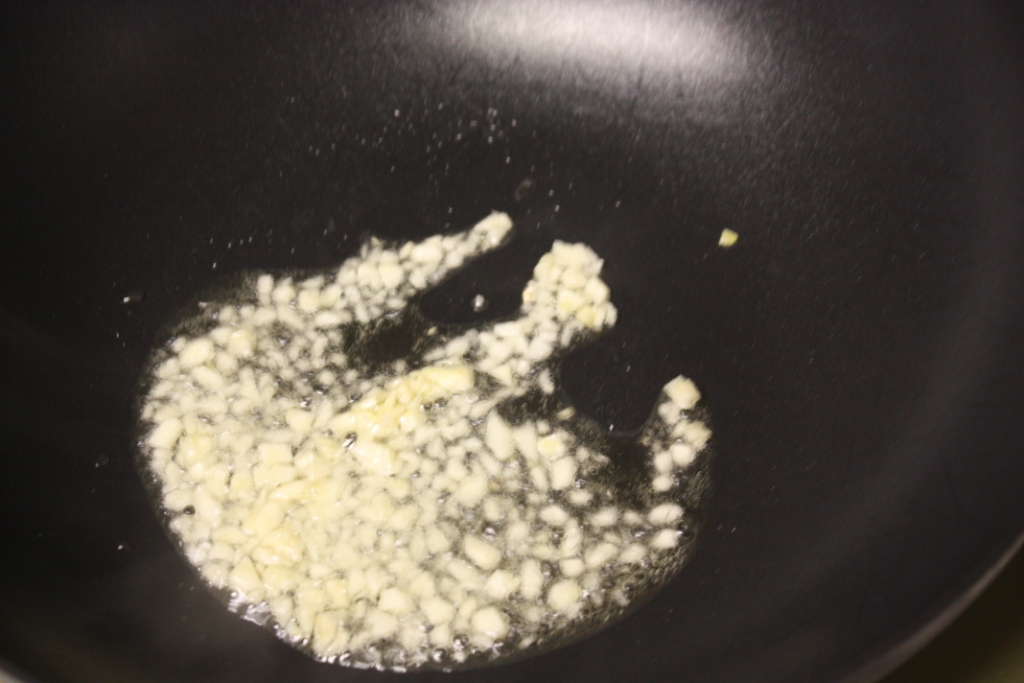
Step 1: Heat your oil in a wok. Get it hot enough so that when you throw the garlic in, it’ll sizzle. This will make you feel more chef-like.

Sizzling garlic

sizzling garlic

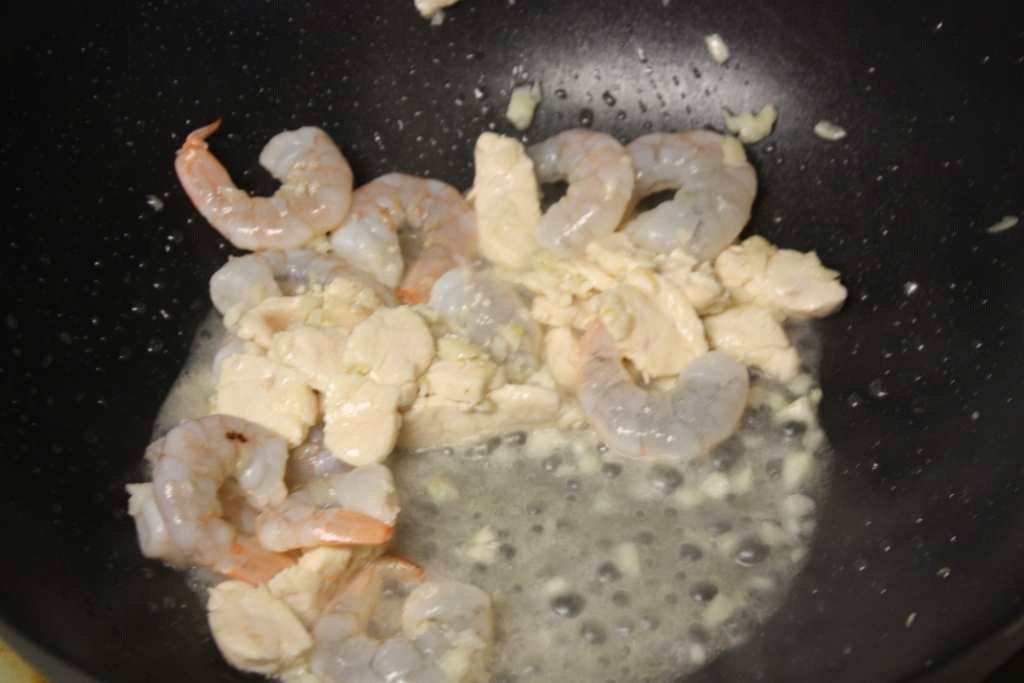
Step 2: Add the animal stuff. Put the chicken in first, it takes longer than the prawns.  If you’re using tofu, put it in after the shrimp (tofu won’t cause you severe debilitating diarrhea if it’s under-cooked. [I don’t think, but I have no idea what I’m talking about. Although I do suspect one shouldn’t refer to diarrhea at any point in a food blog post.])

chicken and shrimp (lamest superhero duo ever.)

chicken and shrimp (lamest superhero duo ever.)

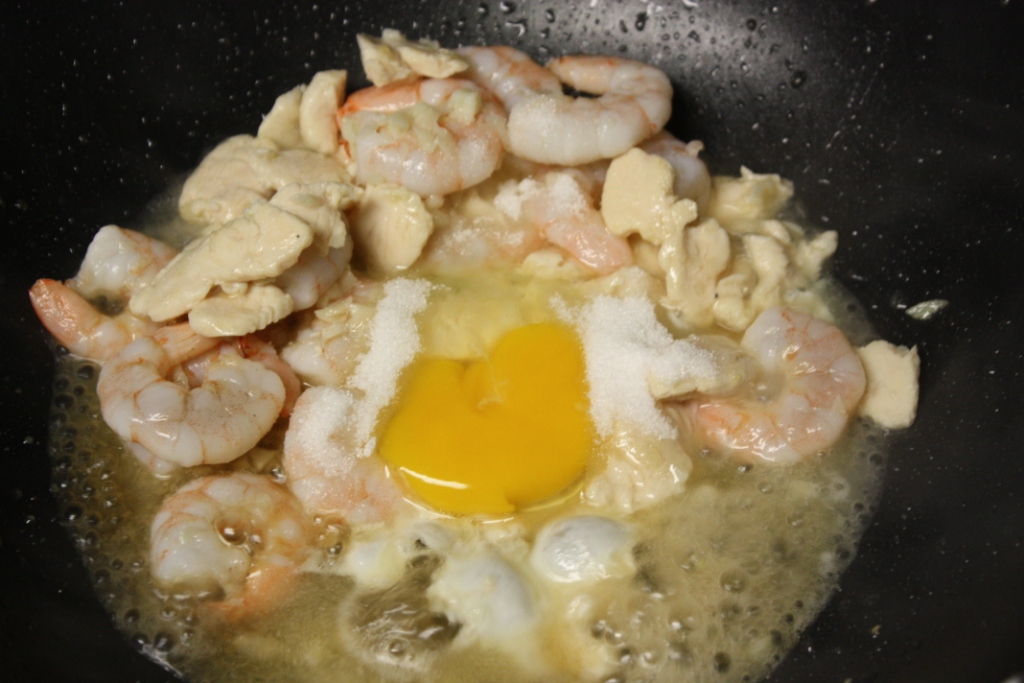
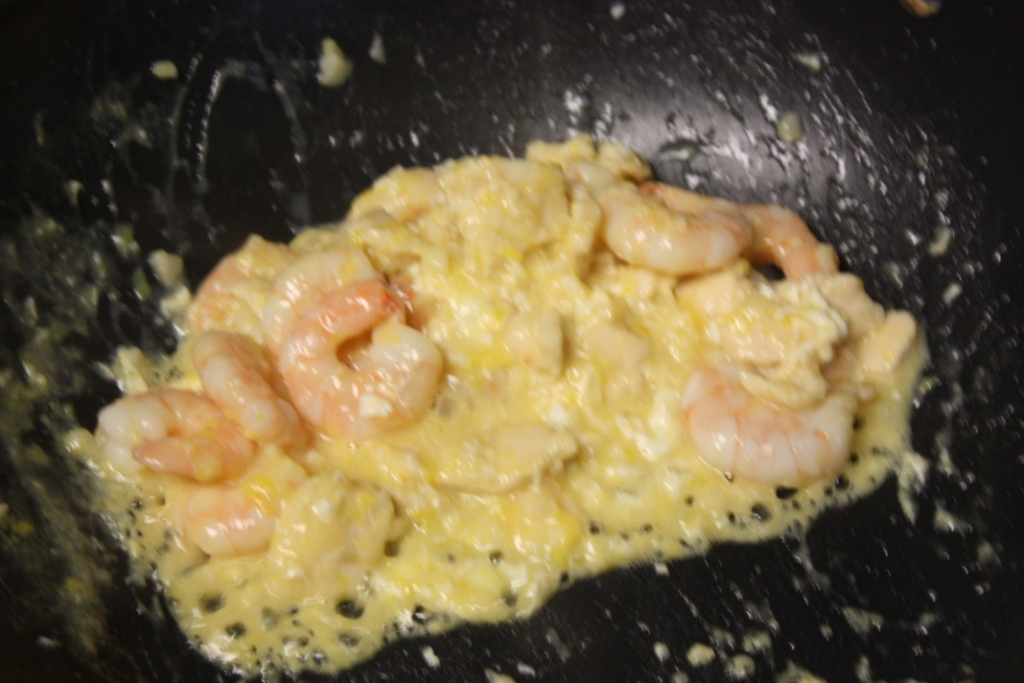
Step 3: Add the egg, fish sauce, and sugar. Scramble the egg up good, and mix everything together.

Egg, fish sauce, and sugar

egg, fish sauce, and sugar

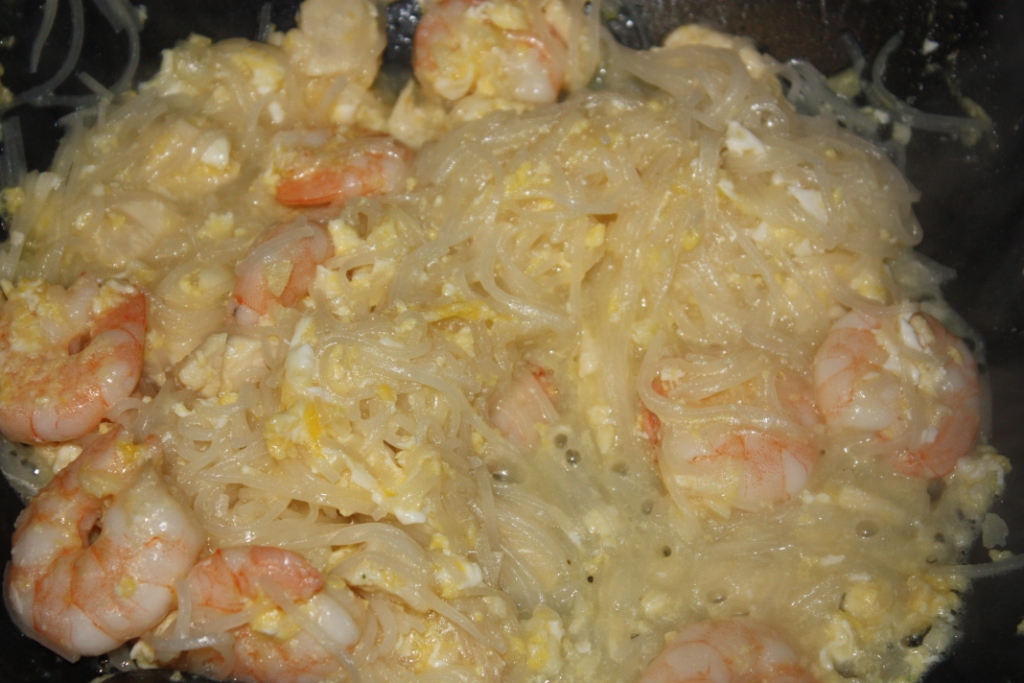
prawn scramble

prawn scramble

Step 4: Add the noodles. This is the trickiest part of all. First, they make a lot of different types of rice noodles in different dimensions and colors, and they all cook differently. I prefer thin noodles. I must admit the noodles are the weak part of my game. In the batch I’m showing, the noodles are overcooked, but I have done them just right. (You’ll have to take my word.) It’s preferable to have them slightly under-cooked when they’re mixed with the prawn scramble (There’s usually enough moisture that they’ll continue cooking.)

At the cooking school, we put pushed the prawn scramble up to the top of the wok and tilted the wok over and put dry noodles and a cup of water in the bottom of the wok. We then cooked the noodles, and then mixed them with the prawn scramble.  If you’re an octopus or a ninja, that method works great. I, however, pour boiling water over bowled noodles when I’m putting the chicken in the wok, then I tong them into the wok and mix them right together with the prawn scramble.

overcooked noodles this time

overcooked noodles this time, so sad

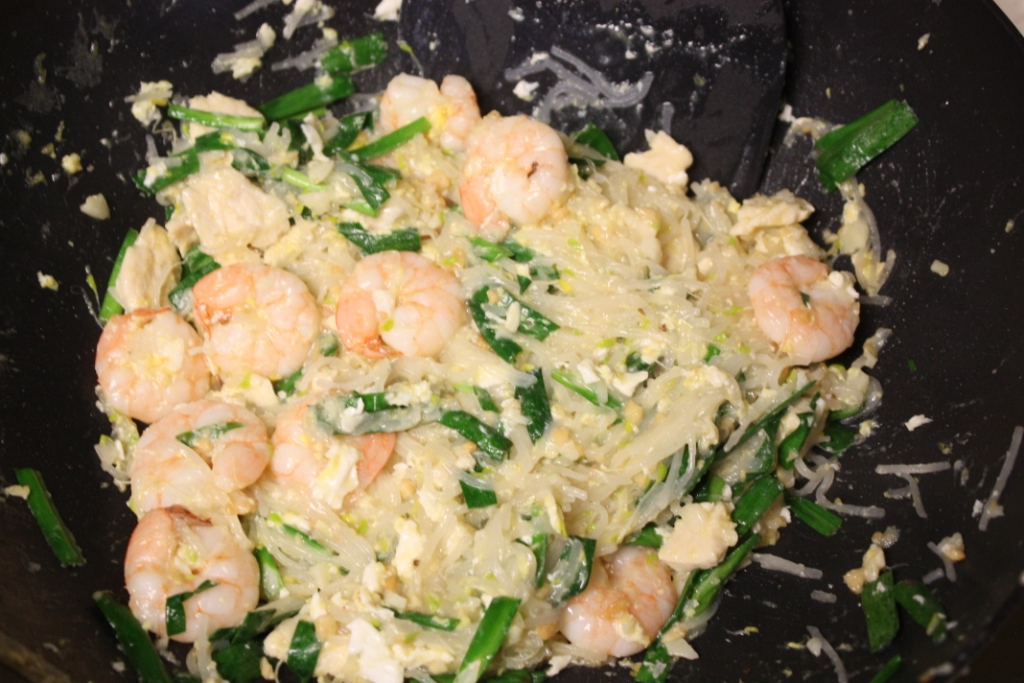
Step 5: Add the vegetable stuff. First, throw in the crushed peanuts. Then stir in the sprouts and the spring onion. (These are all done last, because you want them to provide a bit of crunch. i.e. You don’t want them thoroughly cooked.)

with the veges in

with the veges in

The penultimate step is to squeeze on the lime. This can be done into the wok after it’s removed from the heat or directly on top of one’s bowl.

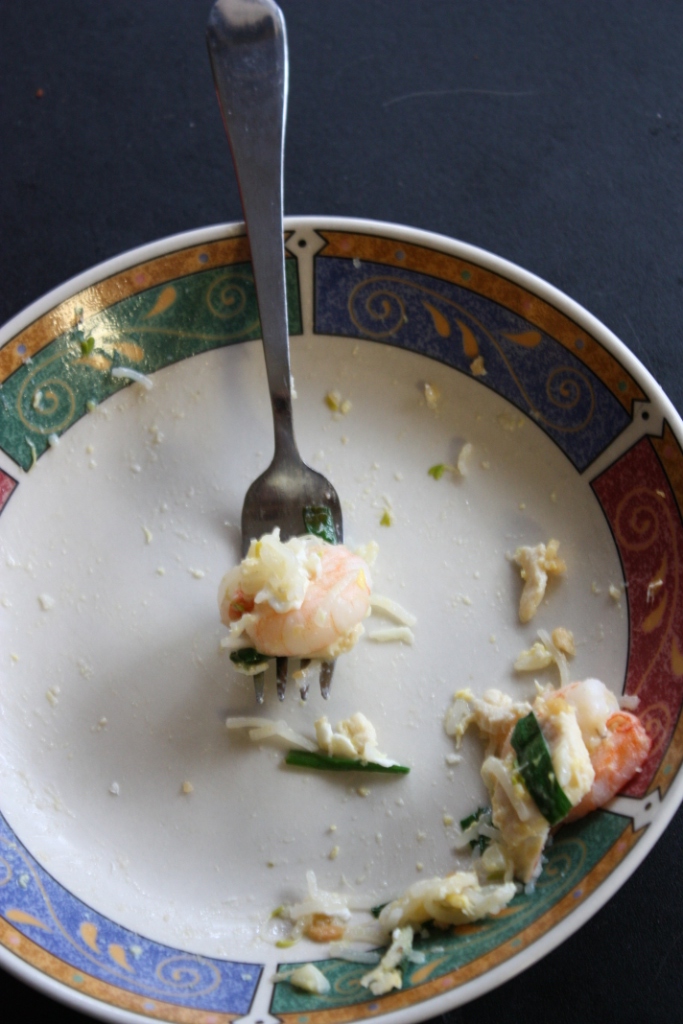
Step 6: Eat. I’ve included the following picture as proof that this was, in fact, edible.

last few bites

last few bites