

Black Cat by Rainer Maria Rilke [w/ Audio]

A ghost, though invisible, still is like a place
   your sight can knock on, echoing; but here
 within this thick black pelt, your strongest gaze
   will be absorbed and utterly disappear:

just as a raving madman, when nothing else
   can ease him, charges into his dark night
 howling, pounds on the padded wall, and feels
   the rage being taken in and pacified.

She seems to hide all looks that have ever fallen
   into her, so that, like an audience,
she can look them over, menacing and sullen,
   and curl to sleep with them. But all at once

as if awakened, she turns her face to yours;
   and with a shock, you see yourself, tiny,
 inside the golden amber of her eyeballs
   suspended, like a prehistoric fly.

NOTE: This translation by Stephen Mitchell. Originally titled, “Schwarze Katze,” the poem in German is:

Schwarze Katze

Ein Gespenst ist noch wie eine Stelle,
dran dein Blick mit einem Klange stößt;
aber da an diesem schwarzen Felle
wird dein stärkstes Schauen aufgelöst:

wie ein Tobender, wenn er in vollster
Raserei in Schwarze stampft,
jählings am benehmenden Gepolster
einer Zelle aufhört und verdampft.

Alle Blicke, die sie jemals trafen,
scheint sie also an sich zu verhehlen,
um darüber drohend und verdrossen
zuzuschauern und damit zu schlafen.
Doch auf einmal kehrt sie, wie geweckt,
ihr Gesicht und mitten in das deine:
und da triffst du deinen Blick im geelen
Amber ihrer runden Augensteine
unerwartet wieder: eingeschlossen
wie ein ausgestorbenes Insekt.

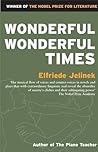
BOOKS: Wonderful Wonderful Times by Elfriede Jelinek

Wonderful, Wonderful TimesWonderful, Wonderful Times by Elfriede Jelinek
My rating: 5 of 5 stars

Amazon.in Page

If I said this book was A Clockwork Orange meets A Midsummer Night’s Dream it would be in some ways deceptive but in other ways, accurate. The book has none of the otherworldliness of those other stories and, instead, is set in a realistic 1950’s Vienna. Furthermore, those comparisons might confuse readers into not realizing this book is unambiguously a tragedy.

The book is set around four kids (Rainer, Anna, Hans, and Sophie) who like to beat up and rob adults, usually using a kind of catfishing scheme where they trick a middle-aged man into thinking he is about to have a getting lucky with Lolita moment before the other three gang up on the man in a moment of shock and awe. Here lies the “Clockwork Orange” comparison: youths enamored of violence as a means to combat the boredom and meaninglessness of their lives — possibly while passing on the abuse they receive in their own lives.

The “Midsummer Night’s Dream” part comes in with the book’s love geometry. Like that Shakespearean play, there are two boys and two girls and both boys are in love with the same girl (Sophie,) leaving the other girl (Anna) in a sad unrequited territory.

The book won’t be everyone’s cup of tea, and not only because it deals heavily in sex and violence. There are a couple factors that make the book feel strange. First of all, it is written in present tense. Secondly, it spends a lot of time in the minds of the characters and relatively little time with the action. Thirdly, the pacing of the conclusion and resolution of the book is abrupt and might feel forced — like the author was 245 pages in when the publisher told her that she had 250 pages, maximum, and that she’d better be wrapping it up. I didn’t find any of these factors to be problematic, but I can see how they would rub some readers the wrong way.

If the premise intrigues, you should definitely read this book – particularly if the previous paragraph’s warning didn’t turn you off.

View all my reviews