
Taken on November 24, 2018 in Udaipur


 Agriculture: A Very Short Introduction by Paul Brassley
My rating: 4 of 5 stars
This is another in my favorite series of brief guides to various topics and disciplines, Oxford University Press’s “A Very Short Introduction” books. These books typically take around 100 pages to cover the fundamentals of a given subject. The series offers a quick overview in a no-frills fashion. This book is no. 473, providing an overview of agriculture.
The book is divided into six chapters, and has an Introduction in the front and a “Further Reading” section at the rear. The first chapter is about crop farming and it discusses the major issues of concern, including: the best soils, essential nutrients, fertilizer, as well as discussing what kinds of problems are faced in crop cultivation. Chapter 2 explores the other major division of farming, raising animals. In it, one learns about basic issues of feeding, breeding, housing, and providing medical treatment.
The third chapter investigates the topic of agricultural markets and trade. Here the reader is reminded of their basic economics education, and how market forces result in the topsy-turviness of farming in which a bumper-crop year can be bad while a drought year not so bad. (i.e. Huge harvests mean unit prices drop and surpluses may be lost to waste, whereas shortages result in high unit prices.) The authors also discuss the issue of global trade which is unique for agricultural products because almost every country makes some portion of their own food (excepting nations like Singapore and Vatican City), they are resources no country can afford to be cut off from, and they are perishable on varying time scales.
The fourth chapter is about the inputs used in agriculture such as land, labor, and machinery and equipment. This chapter discusses these topics more generally than they are touched upon in the first couple chapters. The penultimate chapter compares modern and traditional forms of agriculture. As the author points out, this division could mean very different things depending upon what two periods one is comparing. However, it is a worthwhile topic to consider with respect to its relevance to sustainability and the effect on the environment.
The last chapter is nominally about the future of farming, but it considers a number of current issues such as GMO (genetically modified crops) and the effects of climate change. The chapter explores what changes will need to be made as the population approaches 9 billion. It doesn’t go into issues like urban farming, petri-dish grown meat, or insects as the future of protein as much as I’d have thought, but does raise some interesting questions.
There are many graphics, from photos to tables, used to more conveniently and concisely convey information.
I would recommend this for those looking to get an overview of how farming works. Like most books in this series, it is optimized to being concise, not to being interesting – so if one wants fun facts and narrative creative non-fiction this isn’t so much the book for you. But if you want the gist of agriculture fast, this will do nicely.
 When I Walk Through That Door, I Am: An Immigrant Mother’s Quest by Jimmy Santiago Baca
My rating: 4 of 5 stars
This is a narrative poem telling the story of an El Salvadoran woman who is separated from her child after illegally immigrating to the United States. It’s quite a timely topic, but as a work of literature and a “call to arms” it could have done much better.
This poetic novella is gripping to read, but is over-the-top in spots, and that does it a disservice in two ways. First of all, it takes the reader out of the story as they may become lost in the disbelief. Secondly, it takes a work that could have been a persuasive call for change, and turns it into an angry rant. To give a prime example, at one point early in the piece, the lead character has been (gang-)raped four or five times over the course of two pages, by varied factions including US law enforcement officers. Even if one were to accept the author’s presumed premise that American federal law enforcement agents are morally equivalent to the gangs of the drug cartels (a premise not likely to be accepted by the meaty-middle of society), one is left to ignore the fact that female prisoners, once in custody, aren’t left unsupervised with male guards. I know the reader may say, but this is a technical detail in a fictitious narrative poem. However, given the way the piece is presented (discussed more below), it reads like it’s telling us a story that is meant to move us through the proposition that this is the world in which we live. But once one reads one falsity, one is left wondering whether any part of the story is reflective of reality.
The idea that this woman is exploited by every male she comes into contact with, whether they are gang members or Immigration and Customs Enforcement (ICE) agents, has poetic merit. It’s pointing out that without legal status, she is in a perpetually vulnerable state. Yet, it seems lazy and sensationalist to make all such exploitation rape. When one morally equates gangs with agents of a democratic government, one isn’t just saying that the individuals are equivalent, you are casting aspersions against the entire system of rule of law. (Because, of course, protections should be in place, and — failing them — the means to lodge complaints. And I think most would argue that both are the case.) The bigger problem, one found throughout the political spectrum in the US, is that individuals vilify each other, pretending they are being persuasive, when in reality they are just more deeply etching an “us-them” divide. By this I mean to say, one can’t tell people how vile, despicable, and evil they are, and then expect them to see your perspective.
The narrative poem is delivered in a combination of free verse and poetic prose all of which verges largely on just plain prose. That is to say, the emphasis is on telling a story and not so much on the usual core components of poetry, i.e. sound, imagery, and metaphor. (Unless some of these fictitious elements, e.g. the astounding number of rapes, are meant to be metaphorical. Then my concern would be that one risks diminishing a horrible thing, if one throws around that word as metaphor.)
This is a quick read, and, as I mentioned, it’s presented in a gripping fashion – if hyperbolically so. I suspect that it will be mostly read by a demographic determined along political lines, which is a shame. It could have been so much more.

Taken on November 31, 2018 in Udaipur
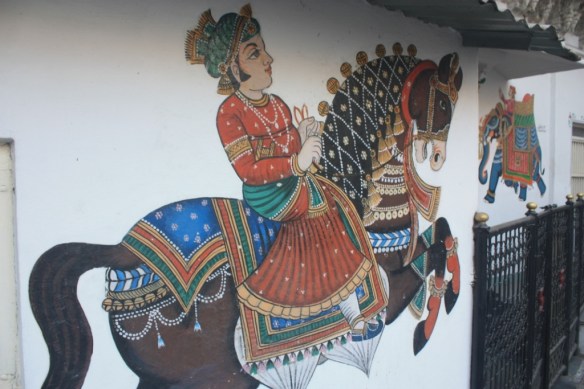
Taken on November 23, 2018 in Udaipur

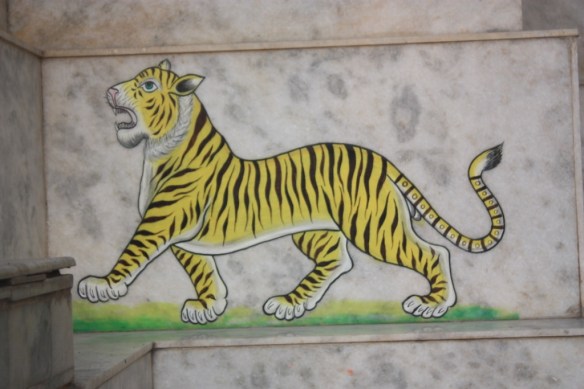
This post requires some explanation. First, miniature paintings, as a style of Indian art, aren’t necessarily small (though they can be.) Rather, the “miniature” refers to use of fine detail and the use very fine brushwork. (Sometimes involving one hair-width brushwork.)
The historical basis of all these paintings in Udaipur was that they used to be used to adorn houses involved with weddings. Not only did they lend festive decor, but they also made it easier to find the right house.
 A River in Darkness: One Man’s Escape from North Korea by Masaji Ishikawa
My rating: 5 of 5 stars
This tragic memoir tells the story of a man of mixed Japanese – Korean heritage who was, as a boy, moved to North Korea under a “repatriation” program that was designed to provide North Korea with laborers while conveniently reducing a minority problem for the Japanese. During the Second World War, Japan had imported labor from Korea for the war effort. As it happens, Ishikawa’s father was from South Korea, but – in the wake of the Korean War — it was North Korea that was looking for rank-and-file laborers.
The author’s father was eager to get out of Japan because he was treated as minorities frequently are – especially ones as rough around the edges as he, and so he swallowed the propaganda of Kim Il Sung’s regime hook-line-and-sinker. The author’s mother (and the author, himself) didn’t want to leave Japan because she didn’t speak the language and was ethnically Japanese (putting her in the minority shoes.) Little could any of them have known how bad life in North Korea would be, and how dire a mistake it was to agree to the move.
Life in North Korea was hard on everybody (except the party elite), but it was particularly hard on this family because: a.) they were discriminated against and could only attain the lowest-of-the-low in farm sector jobs; b.) they were accustomed to life in Japan and so they knew exactly how backwards North Korea was compared to its neighbors; and, c.) the wife’s family in Japan disowned them, and so even when other transplanted families began to be able to receive wealth from their kin in Japan, their family was cut off (but assumed by neighbors to be receiving packages.) From constantly having to game the system to get enough calories to survive to a series of tragic events that were largely tied to the country’s impoverished nature (e.g. inadequate healthcare,) the book features one soul-wrenching turn of events after the next.
Ishikawa grew to manhood in North Korea, married twice, and had children, but when the famine struck in the 1990’s he fled the country into China across the Yalu River, leaving his family behind. The book’s last chapter deals with Ishikawa’s challenges living in an expensive first world country – Japan – while trying to get his family back. It’s difficult to know whether Ishikawa ever serious could have thought he could get his family out once he was gone. Certainly, he proposes that he did think that, and he spoke to Japanese diplomats (who felt horrible about what had come of people like him) about it. Still, it’s hard to imagine how he could have thought so, being familiar with how the Kim dynasty operated. Still, one may have to grant a man his delusions when he makes such a hard decision while he is literally starving to death. Ishikawa was able to discover what happened to at least some of his family members, and that information is in an epilogue.
I found this book gripping and fascinating. It’s depressing reading throughout, there’s no getting around that, but it gives insight into how people live in the villages of North Korea that is not so extensively described elsewhere – not to mention what it’s like to be a member of a minority group, labeled a “hostile” and essentially relegated to a low-caste life. I would highly recommend this book for all readers. It’s one the best books of 2018 that I’ve read this year.
 Poems by Hermann Hesse by Hermann Hesse
My rating: 5 of 5 stars
If you’re like me, you may not have realized that this German author, known for short philosophical novels such as “Siddhartha,” “Steppenwolf,” and “Demian,” was also a poet. This bilingual edition consists of a selection of 31 poems picked and translated by the Pulitzer Prize winning poet, James Wright. The poems are short form poems that range from less than a page to three pages, and thus even with the inclusion of the original German verse, the book is only 80 pages.
It’s hard to imagine a more skilled editor / translator than James Wright, who was considered one of the best American poets of his time. When I was reading up on Wright, I saw that major themes in his poems were “loneliness and alienation,” and those themes are certainly seen in this selection, though I cannot tell you if they’re representative of Hesse’s poetry over all or not. The philosophical outlook of Hesse’s fiction certainly shines through in places, as does the sparse, imagery-centric approach seen in Eastern (e.g. Zen) poetry – a style that tries to keep the poet out of it by presenting scene devoid of analysis or judgment.
Though it didn’t do me much good, owing to my inability to speak or even properly pronounce German, I like that the original poems in German are included. An Italian proverb compares poetry translations to women — i.e. the more beautiful, the less faithful. So, it’s always nice for those with bilingual fluency to be able to look at them side-by-side (which is how they are printed.) Sometimes even hearing the poem without understanding meaning can give one insight into the musicality of the verse.
I enjoyed this selection of poems, and while I can’t say how much is Hesse and how much Wright, either way they were well-composed and pleasant to read. I would highly recommend this selection for poetry readers.


