The Puzzling Sexuality of India

India, land of the Kama Sutra, is prudish. America is known for being pretty puritanical–at least if you don’t compare it to Muslim countries. In the U.S., for some reason, we would rather a child see a human cleaved into eight individual pieces with a machete than to be witness to a nipple slip. Well, India censors the innuendo and sexual references  that sailed right past the FCC.

On the street, my wife and I can expect odd looks for holding hands and worse for a smooch. In the city, this rarely amounts to more than a sidelong glance, but we’re told in the countryside the people can be more vocal. (We’ll see, we’re planning our first trip into the countryside for next weekend.) On the other hand, young men routinely hold hands with other men, and the same is true of pairs of young women. Same-sex hand-holding is par for the course, but hand holders of the opposite sex are breaking mores. Some may say that the difference is same-sex hand holding isn’t sexually-charged, but I think it strains credulity to think both that different-sex hand holding is always inherently sexually charged and same-sex hand holding is never sexually charged.

Anyway, one would expect that a country that was so comfortable with same-sex public displays of affection (PDA) would have liberal views about homosexuality. No. Until 2009 homosexuality was a crime, and there is still rampant Ahmedinejad-style denial that homosexuality exists in this country. (Ahmedinejad is the Iranian president who– in an act of denial that was stunning, though in character–stated that homosexuality doesn’t exist in Iran.) To add another wrinkle, I’ve read that some men, who would be fighting-mad to be described as anything other than straight, routinely engage in behaviors that most would find indicative of homosexuality or bisexuality (we are talking well beyond hand holding or a kiss on the cheek here.)

There are a couple of reasons why young people who vehemently identify as straight might engage in sexual behaviors that are not. First, there are those who are homosexual and are either in the closet or in denial. One expects that there are many people who fit into this category in India because of the tremendous pressure to live a traditional family life–whatever else one may do on the side. In many countries, “denial” and “the closet” might cover the gamut of explanations for such anomalous behavior. However, in India there is a second reason that one might associate with places where men and women are strictly segregated over long periods of time (think a prison.) That is some of these the aforementioned people presumably are heterosexual, but have no sexual outlet because they don’t have any private interactions with people of the other sex who are not their blood relatives. So in an ironic twist, in society’s attempt to rigorously enforce and control a “traditional” paradigm of heterosexual familial units, more unions that do not fit that model are created than otherwise would be.

So you may be wondering whether I’ll be explicit about what I find “puzzling” about Indian sexuality. It’s a little puzzling that the culture that brought us the Kama Sutra and vast orgiastic bas reliefs on the temple at Khajuraho would have a problem with a couple hugging in the park or who choose for themselves with whom they are intimate. The overwhelming trend across most of the world is to become more tolerant of consenting adult’s freedom to exercise their sexuality as they see fit. Granted, there are certainly other examples where there has been a countervailing trend. Caligula’s Rome versus the Rome of today. Also, it should be noted that over a recent time span India seems to becoming more tolerant, and thus following the trend—if slowly.

Another thing I find puzzling is that by some measures the Indian approach seems to work. Following the incentives, I’d expect the Indian system of arranged marriage and limited premarriage intergender interaction to result in nothing but heartache. Indians will point out that their divorce rate is infinitesimally low. However, one then has to then consider other questions such as whether it results in more spousal murders, marriage related suicides, and vow-breaking. In other words, are there other means of marriage terminations that take place in a society that for all intents and purposes doesn’t allow divorce?

There is something particularly pernicious in Indian society called dowry murders. This is when a man and his mother set the man’s bride on fire so that they can erase the marriage and start all over in search of more bling. (That’s got to max out the bad karma.) Dowries were made illegal because of this, but both dowries and dowry murders continue. India does have a high suicide rate (though not as high as the US’s), but I have no idea whether any studies have been done to try to isolate the role of a bad marriage. I also can’t say whether there is evidence that “stepping out” on the marriage is higher in India. While there is plenty of evidence that this goes on, like anything related to sex, few Indians talk about it.

BOOK REVIEW: Secret Weapons by Cheryl Hersha, et al.

Secret WeaponsSecret Weapons by Cheryl Hersha

My rating: 3 of 5 stars

Amazon page

Secret Weapons is about two sisters who are trained in an MKULTRA-style behavior modification program to become femme fatales. This book was a rare find. I hadn’t heard of it before or seen it in my local bookstores, but I came across a copy at the Strand bookstore in New York (the “miles of books” place) on a trip several years ago.

Like Whitley Strieber’s Communion, this book leaves one engrossed but wondering what exactly one is reading. It is written as non-fiction, and not creative non-fiction that admits to blending elements of fiction into the fact. The writers are eager to convince the reader that this is not a hoax. About a quarter of the book is supporting documents to lend the book credibility. However, while I’m well aware of the “mind control” programs sponsored by the American government, this story doesn’t ring true to me. (In large part this is because we know the programs that operated were not nearly so successful as the one in Secret Weapons would have had to have been.) [I wrote a post about such programs that is available here. If you’d like to read some primary documents on the subject, this page at the National Security Archives has many of them.]

One might think that there are two possibilities: either it’s a true story or it’s a hoax. However, it’s a third possibility that makes this book so thought-provoking. What if the two sisters believe that the story is absolutely true, when–in fact–it wasn’t? How could this be? Their father is presented as an unsavory character. One possibility is that the father abused these girls and they created an elaborate backstory in their minds to cope with the fact that the one man who should have loved them, that they should have been able to trust, neither loved them nor was worthy of their trust.

Of course, another possibility is that it’s all true. While a lot of information did come out about Projects ARTICHOKE, BLUEBIRD, and MKULTRA, a lot was also shredded. The person working the shredder might have gone after the documentation of activities involving pedophilia first. If there is any activity that would have rightfully taken the situation from one of CIA employees being sent to country club federal prisons to them being strung up on the Capitol steps, it’s what’s depicted in this book.

Of course, it could all be a hoax as well. A story like this, if believed, elicits the publicity of the news media. That’s a powerful way to sell books.

I’ll leave the reader to decide which of the three possibilities they believe is most likely.

If you haven’t concluded this already, let me be explicit: This book contains disturbing descriptions (and even sketches.) It isn’t gratuitous to the story they are trying to convey, but if you have a weak stomach for such matters, I’d recommend you steer clear.

View all my reviews

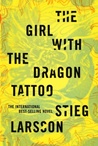
BOOK REVIEW: The Girl with the Dragon Tattoo by Stieg Larsson

The Girl with the Dragon Tattoo (Millennium, #1)The Girl with the Dragon Tattoo by Stieg Larsson

My rating: 4 of 5 stars

A disgraced reporter and an emotionally-troubled/intellectually-gifted ward of the state pair up to solve a forty-year old locked door mystery. In the process of investigating what happened to a young woman who vanished without a trace from an island estate, they end up solving a much bigger set of mysteries– and putting their lives in peril in the process.

Both of the lead characters are well-developed and sympathetic, if not necessarily likable in a conventional sense. Mikael Blomkvist is a bit of womanizer or at least a lady’s man– whatever you wish to call him, he sleeps with at least three major female characters over the course of the book. He is also rash (or, perhaps, aggressive) in his professional life. However, he is also pragmatic and kind. Lisbeth Salander is not just tattooed but also pierced, leather-clad, and goth. Her story of female empowerment may be largely responsible for the wild success of this book. When she finds herself abused and violated, she takes matters into her own hands. Her strength and intelligence, wrapped in a package that suggests neither trait, is beguiling.

The book is obviously highly readable, but it’s oddly structured. It climaxes early, leaving well over a hundred pages at the end to wrap up subplots. This includes the disposition of Blomkvist’s professional predicament and the question of with whom he will ride off into the sunset. These are threads that couldn’t be left hanging, but it begs the question of why one reads to the bitter end– though you certainly will.

I guess I should mention that this isn’t a book for the faint of heart or the puritanical– in case one hadn’t already grasped that. It is graphic and intense in spots.

I did see the Daniel Craig/Rooney Mara version of the movie. I’m told it was not as good as the first film, which was made is Sweden (I should have mentioned the book is set in Sweden.) However, I thought it was quite good, and fairly true to the book given the challenges of turning a 650 page novel into a movie.

View all my reviews