
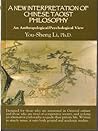
 A New Interpretation of Chinese Taoist Philosophy by You-Sheng Li
My rating: 4 of 5 stars
Google Books Page
By the author’s admission (and the title, for that matter) this is not so much an overview of Taoist philosophy as a philosophical rendering that attempts to not only be consistent with the Taoist tradition, but also with our present-day understanding of the world. This fact has positive and negative ramifications for readers, and results in a book that will be more useful for the purposes of some readers than others.
The biggest positive is that this interpretation of Taoism is consistent with a modern rationalist worldview. Taoism is a huge system of thought and includes a lot of magical, supernatural, and astrological thinking. In short, a book on Taoist thought could contain a great deal of woo woo, but this one does not. It has not much to say on demons, deities, magic, alchemy (in the narrow, original meaning,) etc., and to the degree these subjects do crop up they do so in a way that is not arcane and doesn’t insist on belief in unsupported ideas. I think this makes this book important, as it fills a niche. Most of the central texts of Taoism were written in times that were different from our own and in which magic and the supernatural were taken for granted. So, if you want a text that draws on major ideas of Taoism but presents them in a way that is consistent with science, you may want to give this book a look.
The biggest negative is that when the book is not explicitly describing the teachings of historical figures, one doesn’t necessarily have a good way of knowing how much Li’s ideas are or aren’t consistent with Taoist tradition. There are extended discussions of ideas such as evolutionary biology and existentialism, and — unless one has a great depth of knowledge of Taoism to begin with — it can be hard to see whether Li’s views on these subjects are in line with Taoist philosophy or whether twists are being made. The most extensively discussed / cross-cutting idea of the book is that of differentiating primary from secondary society and proposing a primacy of primary society in Taoist thought. I can’t say I’ve read much elsewhere that would suggest this was a core idea for Taoists, but the political philosophy of Taoism is not an area with which I’m at all well-acquainted.
I found this book interesting and thought-provoking. I also felt it was much needed to have a scientifically consistent approach to Taoism. If you are looking for such discussion, I’d recommend this book.
View all my reviews


 Tiger Riding for Beginners