BOOK REVIEW: Regarding Ducks and Universes by Neve Maslakovic

Regarding Ducks and UniversesRegarding Ducks and Universes by Neve Maslakovic

My rating: 4 of 5 stars

Amazon page

As one might guess from the title, this is a lighthearted–dare I say whimsical–science fiction novel set around parallel universes. The light tone works to discourage one from being too much of a stickler about logical consistency and scientific validity. Parallel universes can raise almost as many troubling questions as time travel; but when the tone is comedic, it’s easy to set the these concerns aside and take it as a simple plot device. This isn’t to suggest that Maslakovic neglects the issues altogether. She is, after all, an engineer by training. Having the universes split a relatively short time in the past is likely an attempt to deal with the fact that the two universes are extremely similar, but recognizably different (a cliché among sci-fi parallel universes.) But she does avoid getting bogged down in the minutiae of consistency. There may be some happenings that leave one a bit befuddled, given there is obviously different decisions and behaviors occurring in the alternative universes, so events in one universe shouldn’t be a predictor of events in the other.

The backdrop is that a technical writer and aspiring novelist, Felix Sayers, finds out that he has an “alter.” In Sayer’s world, there are two San Franciscos. He is from what’s considered the original Universe, A, and there’s an alternative Universe B that one can cross over to if one is willing to follow a number of rules–mostly set in place to prohibit interacting with one’s alter. Everyone born before the schism of the two universes has an alternative version of themselves in the alternate universe unless that person has passed away. Like identical twins, “alters” look alike, but because of chains of different decisions and experiences, they may lead considerably different lives. Felix thought he was alter-less, but when he finds out about a discrepancy in his birthdate, he realizes he does.

Felix decides to go to Universe B, to spy on and possibly interrogate his alter—in contravention of the rules. Specifically, Felix of A wants to know if Felix B is working on a novel, and, if so, if the alter is ahead of him. He doesn’t want his to be relegated to writing the novel by “the other Felix Sayers.”

As the story progresses, the novel crosses genres again, adding a mystery component. When Felix crosses over, he draws much more attention than he wants or expects. This includes several failed (and sometimes comedic) attempts on his life. Felix immediately suspects one person, but it wouldn’t be much of a mystery if the initial suspect turned out to be the villain. Actually, it’s not much of a murder mystery because there are few characters who we can believe would be credibly wicked.

However, there’s still the mysterious question of whether Felix engaged in an activity that resulted in the split. Of course, there’s a scientist who creates the conditions in which the schism can happen, but Felix nonetheless worries whether he “caused” the split through some inadvertent act as an infant. This may not be so much a critique as it is insight into what makes the lead likable, if hapless. Incidentally, this is where the duck comes in.

If you like light sci-fi, this is a good read. It’s not side-splitting like Douglas Adams, but it’s laid back and has a dry sense of humor.

View all my reviews

BOOK REVIEW: Cabinet of Curiosities by Preston & Child

The Cabinet of Curiosities (Pendergast, #3)The Cabinet of Curiosities by Douglas Preston

My rating: 3 of 5 stars

Amazon page

Cabinet of Curiosities features many of the hallmarks of a Preston and Child novel. First, the lead is FBI Agent Pendergast. Special Agent Pendergast has three things that no FBI Special Agent in the history of the FBI has ever had: 1.) a fortune, 2.) the ability to pick and choose both his assignments and the jurisdiction he works in, and 3.) about 200 vacation days a year to learn things like ikebana and to read random scholarly publications in disparate fields such that he is an expert on the known Universe.

Regardless of the incredulity his character may inspire, Pendergast is a fascinating character. He has a New Orleans accent and an almost albino complexion, which intrigues–and puts him outside the New York / Chicago/ LA nexus in which cop fiction frequently gets stuck. (Don’t worry; the NYPD quota is still met.) Furthermore, his encyclopedic knowledge of everything allows him to constantly get the better of any and all unlikable characters in the book—and, in these books, you are either likable or loathable. It also features other Preston & Child familiars, including Nora Kelly and William Smithback Jr.

Second, it features the supernatural, preternatural, or at least the appearance of the aforementioned. This is all part of a dark and mysterious tone they have down to an art. This goes back to their first book Relic.

Third, one of the likable characters gets killed off.

The title, Cabinet of Curiosities, refers to collections of natural anomalies that were all the rage in the 19th century, and which served as mini museums of natural history. These cabinets (sometimes also called “wonder rooms”) might feature genuine exhibits, fakes, or some combinations thereof.

The novel begins with Agent Pendergast seeking Nora Kelly’s expertise to assist him in investigating a 19th century mass murder. The remains of the deceased were found in a building that’s being torn down to put up a high-rise, but it used to be the basement of a cabinet of curiosities.

We don’t get any clue as to why an active duty FBI agent would take an interest in 19th century murders until late in the book. [Of course, we never find out why Pendergast is allowed to investigate it.] I’ll leave it to readers to determine whether the ultimate explanation makes any sense or not. Needless to say, the murder and mayhem come to the present day over the course of the novel.

While I might sound down on both this book and the series, I’ve read seven of the books jointly authored by Preston and Child (and one or two from each as solo authors.) It’s, therefore, unreasonable to say that I dislike their work. However, I will say that I didn’t like this one as much as some others (e.g. Relic and Still Life with Crows.) I’m not entirely certain whether this one was just not as good, or whether I’ve become a bit jaded from over exposure to their formula. (Maybe doing so many book reviews of late has made me over analytical, and commercial fiction—like popular movies—are easy pickin’s for criticism.)

That said, I have three major criticisms of this book:

First, there’s a critical happening that requires someone so brilliant (yet unknown and working solo) that they could invented a technology in the 19th century that modern scientists couldn’t even fathom duplicating. This is sort of a common theme in some steampunk works (e.g. the Will Smith Wild, Wild West movie). However, steampunk creates its own world, distinct from the world as we know it. I can buy some kinds of “lost knowledge” lines, such as the idea that some plant-based medicinal compounds have been lost due to deforestation and loss of the experience of native peoples (this was the premise in Preston’s solo work, The Codex). However, in Cabinet of Curiosities there is a scientific discovery critical to this novel which is of a complex nature. It’s impossible to believe that it could be done by someone without modern equipment or access to the vast scientific literature of the intervening century.

Second, while I don’t want to sound like someone who poo-poos cross-genre novels, there’s a problem with this book not knowing whether it’s a mystery/thriller or supernatural/horror. In general, I love cross-genre work. However, a thriller needs some sort of realism to pull us in and mysteries call for some sort of rules or the game. If anything can happen (or if we don’t know the rules of what can happen) it’s a bit unsatisfying to try to noodle out whodunit.

Third, the reveal of the villain seems a bit forced. It’s not quite Scooby-Doo because they create several despicable characters to choose from—and not just one grumpy old man who you know is going to be the guy. However, it seems a little like they rolled dice to determine which detestable character would be the villain. In retrospect one can find foreshadowing, but no more for the actual villain then for the others one might suspect.

If you’re willing to suspend a truckload of credulity this is a good read for beaches, airports, and trains. The authors know how to pique your interest and build tension. It’s not their smartest book, but it’s a fast and fun read.

View all my reviews

Why I’m a Slacker Lately: or, Mysterious India

What's this India I hear so much about?

What’s this India I hear so much about?

I haven’t been writing, editing, or conducting research much as of late. This has probably gone unnoticed in the vastness of the cyberspace, but in the spirit of blogging I thought I’d answer a question that no one asked. I recently learned that my wife and I will probably be moving to Bangalore, India later in the year. This has kept me physically occupied with home repair and boxing up the house. In my non-labor moments, my mental faculties are largely devoted to understanding the country in which I will be living. I’ve never been there before.

India is a harder nut to crack than one might think. Yes, there is the obvious. At 1.2 billion people, it has the world’s second largest population and is screaming up on China for number one. It’s the seventh largest country by land area. It’s the birthplace of that most excellent yoga that keeps all the twisty people twisty. It’s home of tandoori chicken and naan bread, both of which I love.

However, that’s all superficial. I must sadly admit that–until recently–my in-depth knowledge has come from three sources:

1.) The Jungle Books by Rudyard Kipling

2.) A junior high school field trip to see the film Gandhi, which I had been under the impression was six hours long, but, according to Wikipedia, is only a little over three hours long. I guess that, just as kids think everyone is taller, a kid’s perception of Oscar-winning motion picture run times is greatly distorted.

3.) A ton of reading about the Indo-Pakistani rift and its strategic implications as a graduate student studying International Affairs with a focus on Strategic Studies.

With respect to number 3, the amount of study of this region was not commensurate with the fact that the Indo-Pakistani border region is generally voted “Most Likely Point of Origin for Global Nuclear Winter.” I’m not suggesting that the relationship between India and Pakistan is any more dysfunctional, unstable, or rooted in irrationality than other relationships between nuclear powers. However, the adjacency of the two countries is a problem from the perspective of strategic stability.  When alarms went off in the U.S. or the U.S.S.R. back in the day, there was at least a little time to evaluate and communicate. Being next-door neighbors makes the Indo-Pakistani conflict particularly troubling. That said, they’ve had some pretty big strain tests on their relationship without blowing up the world, so that’s a positive sign.

So why does this country, which should be so front and center in the global consciousness, remain so mysterious? One way we know countries is by those grand competitions through which nations–friends and enemies alike–interact.   In this domain, India really hides its light under a bushel. India has won 26 Olympic medals in 23 games, this is fewer than either Kenya or Jamaica–and both of those countries did it in fewer games. Yesterday, in a post about a book by Nobel Prize-winning Hungarian, Imre Kertész, I may have mentioned that Hungarians have won 12 Nobel Prizes–that’s more than India by a large margin.  Now, while India has had its problems, it’s 100 times more populous than Hungary, and has a history of publishing scientific literature in English (an undeniable advantage in this domain.) Depending upon which country Rudyard Kipling is counted toward, India has either eight or nine Nobel Prize wins. Of course, it would be ridiculous to think that India doesn’t have the human capital to excel in such domains.  While I realize it may not be a representative sample, I think almost every Indian I’ve met in person has had an advanced degree and has been smart as a whip. So it’s certainly NOT true that this is a country that undervalues education.  With a third of the world’s population, statistically speaking, they must be home to physical and mental specimens of humanity that are as impressive as any, but somehow either the will or ability to convert that human capital into winners on the global stage is missing.

I do know a little more about India. It’s the birthplace of both Hinduism and Buddhism, as well as a bunch of other religions. As a martial artist, I’ve heard that  many believe most Asian fighting systems could trace their origins back to India. I don’t know how much truth there is to this belief. Martial arts always evolve into optimization with the local conditions and culture, and, therefore, a lack of superficial similarities doesn’t discount the possibility of such a connection. One of the origin myths the Indo-centric martial arts is the story that Bodhidharma brought a fighting style to China that would be the stepping off point for most of the myriad Asian martial arts. The current consensus among historians seems to be that this part of the Bodhidharma story is not true (See: Meir Shahar’s The Shaolin Monastery.) However, that being said, there is an odd but clear connection between this most pacifistic of world religions, Buddhism, and some of the world’s most kick-ass martial arts. Whether one is talking about China’s Shaolin monks or Japan’s legendary warrior-monk Benkei, it’s clear that some exceptional martial arts have developed in tandem with the spread of Buddhism. Of course, even this just creates more questions, namely: Why should a pacifist religion have legendary fighters sprouting up anywhere near it?

I’m looking forward to getting to know more about India than that it’s huge and its Chicken Vindaloo is scrumptious. It’s a country with a long and intriguing history. I want to see its jungles, its deserts, its mountains, and its beaches. I want to visit its temples and learn from its sages. I’m eager to see its vivid colors and smell [at least some] of its pungent scents. At some point I expect to have some awesome posts about my time there, and hopefully some bold pictures as well. In the mean time, please forgive my slacking.

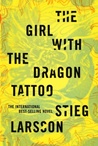
BOOK REVIEW: The Girl with the Dragon Tattoo by Stieg Larsson

The Girl with the Dragon Tattoo (Millennium, #1)The Girl with the Dragon Tattoo by Stieg Larsson

My rating: 4 of 5 stars

A disgraced reporter and an emotionally-troubled/intellectually-gifted ward of the state pair up to solve a forty-year old locked door mystery. In the process of investigating what happened to a young woman who vanished without a trace from an island estate, they end up solving a much bigger set of mysteries– and putting their lives in peril in the process.

Both of the lead characters are well-developed and sympathetic, if not necessarily likable in a conventional sense. Mikael Blomkvist is a bit of womanizer or at least a lady’s man– whatever you wish to call him, he sleeps with at least three major female characters over the course of the book. He is also rash (or, perhaps, aggressive) in his professional life. However, he is also pragmatic and kind. Lisbeth Salander is not just tattooed but also pierced, leather-clad, and goth. Her story of female empowerment may be largely responsible for the wild success of this book. When she finds herself abused and violated, she takes matters into her own hands. Her strength and intelligence, wrapped in a package that suggests neither trait, is beguiling.

The book is obviously highly readable, but it’s oddly structured. It climaxes early, leaving well over a hundred pages at the end to wrap up subplots. This includes the disposition of Blomkvist’s professional predicament and the question of with whom he will ride off into the sunset. These are threads that couldn’t be left hanging, but it begs the question of why one reads to the bitter end– though you certainly will.

I guess I should mention that this isn’t a book for the faint of heart or the puritanical– in case one hadn’t already grasped that. It is graphic and intense in spots.

I did see the Daniel Craig/Rooney Mara version of the movie. I’m told it was not as good as the first film, which was made is Sweden (I should have mentioned the book is set in Sweden.) However, I thought it was quite good, and fairly true to the book given the challenges of turning a 650 page novel into a movie.

View all my reviews