
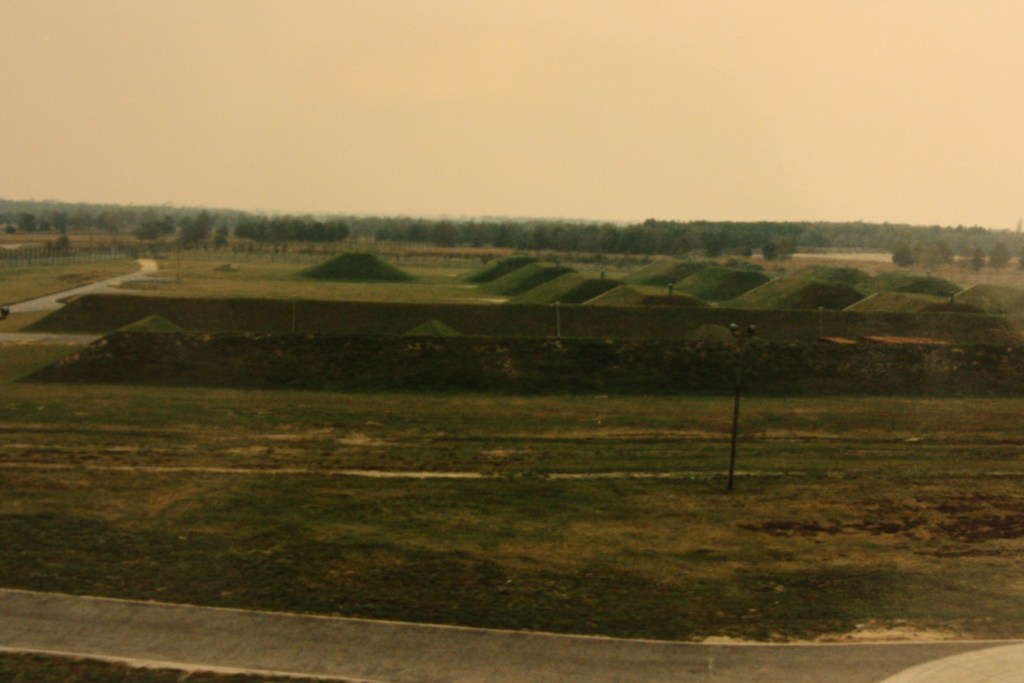
DAILY PHOTO: Munition Storage Area at RAF Woodbridge

Taken in 1988 or 1989 at RAF Woodbridge.

Taken in 1988 or 1989 at RAF Woodbridge.

This is the Non-Nuclear Munition Storage Area at RAF Woodbridge. Those berms are the backside of storage bunkers where munitions were stored. Apparently, long before I was stationed here, they had had a small tactical nuclear storage area whose boundaries (not shown) were easily discernible in my time by the decaying remnants of  doubled fences, razor wire, a concrete guard bunker, and a tower.

Anyway, it was a source of great hilarity / headache that the local anti-nuclear groups refused to believe nuclear weapons were no longer present. They would occasionally try to break in to show that security was inadequate for (the non-existent) nuclear weapons. Occasionally, they would succeed–because there weren’t nuclear weapons  and so one airman–often on foot–provided security for the whole area, and nothing was line of sight because of the ubiquitous berms. It would take either a long time or a lot of noise to  bust into one of the bunkers and one would probably gain access to nothing more than small arms ammo or bomblets for A-10s. So the security risk was not particularly great (compared to tactical nuke storage.)

I preferred the “ghost hunters” that regularly came around over the anti-nuclear crowd, the former were a little more willing to accept evidence than the latter.

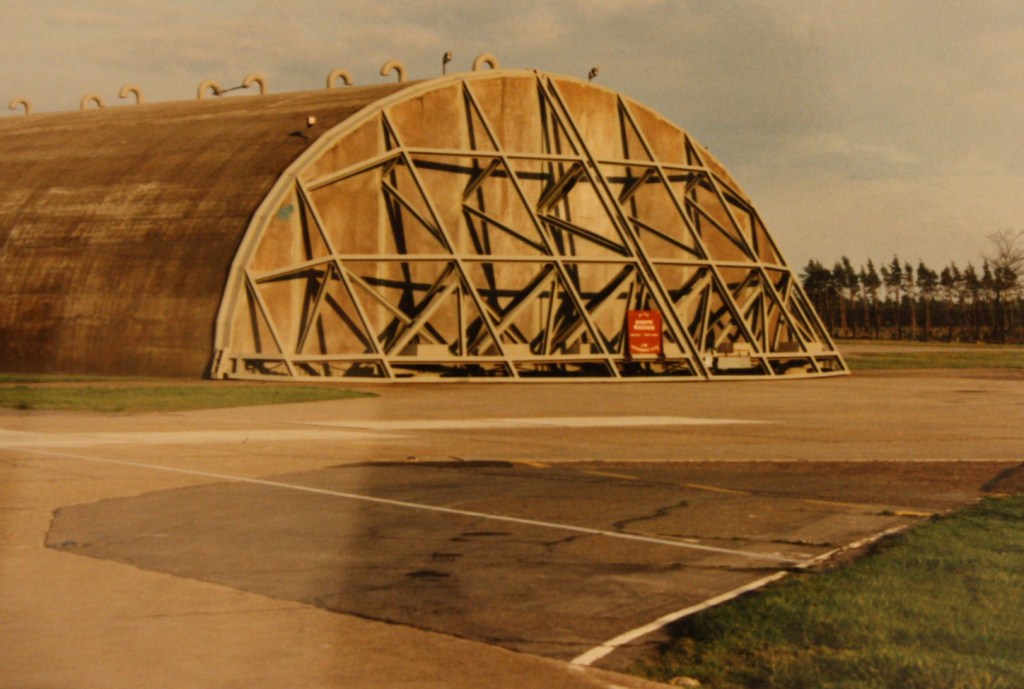
DAILY PHOTO: Hardened Aircraft Shelter

Taken in 1988 when I was  stationed at RAF Woodbridge.

Taken in 1988 when I was stationed at RAF Woodbridge.

Hardened Aircraft Shelters (HAS) are heavy-duty aircraft hangers designed to prevent the wholesale destruction of planes as witnessed in the movie Independence Day at Marine Station El Toro. However, I think the Soviets were considered a more urgent concern than aliens at this particular time. (Oh, how times change.) This particular HAS contained A-10 “Warthogs”– a slow ugly plane that was built around a Gatling gun and that we were about to scrap until we started getting into wars that showed that if one wasn’t fighting dogfights with the Soviets–but rather fighting ground troops and armor of militaries devoid of operational air forces, e.g. in Iraq or Serbia– the A-10 was pretty much the most useful combative plane in the inventory.

I guess there were plenty of sunny days like this, but somehow my memories of England only come when it’s raining.

DAILY PHOTO: 1989 RAF Mildenhall Airshow

Taken in 1989 or possibly 1990 at RAF Mildenhall

Taken in 1989 at RAF Mildenhall

I heard that this was the biggest military airshow in Europe that year because a horrible crash at the 1988 Ramstein Air Show shut down that show and maybe some others in 1989. (I stipulate “military” airshow because there is huge airshow in Paris each odd year that features military aircraft but also   commercial craft, and that show is not exclusively a Ministry of Defense or Department of Defense endeavor.)

Oddly enough there was also a crash at the 1989 Paris Airshow, but it resulted in no loss of life (the 1988 Ramstein crash caused 70 fatalities and several times that number injured.) There was no crash at Mildenhall in 1989 though. I remember the F-18 being about the most impressive thing that flew that year. This, I believe, is a Panavia Tornado, but I’m not that familiar with planes–particularly non-US models–so I could be wrong.

BOOK REVIEW: Matterhorn by Karl Marlantes

Matterhorn: A Novel of the Vietnam WarMatterhorn: A Novel of the Vietnam War by Karl Marlantes

My rating: 5 of 5 stars

Marlantes gives one insight into what it was like to be a soldier, in particular a young officer, during the Vietnam War. For those confused by the name, “Matterhorn” is the name of a fictional encampment in central Vietnam in the book.

In Matterhorn, war is as it has famously been defined, “long periods of intense boredom punctuated by brief instants of sheer terror.” The author builds his characters such that the periods of intense boredom are informative. We see how the tension of the war boils over into fresh hell that interrupts the boredom.

Racial issues play a major part in the drama of the book. The main character, Waino Mellas, is white and of the variety who are almost apologetic in the presence of blacks. However, within the unit there are both black-power movement types as well as good ole boys, making for one powder kegs that erupts during the course of the book.

Race is not the only fault line we see in Matterhorn. There is also a tension between “lifers” and draftees. However, the bigger tension is between the front line troops and those who direct them from afar. The most intense section of the book involves a raid on a hill for which the men are undernourished and under-supplied.

The author was a Marine in Vietnam, and this experience no doubt contributed to the book’s authenticity.

I highly recommend this book as a powerful examination of the role that valor and vice play in war.

View all my reviews

Book Review: We Are Soldiers Still

We Are Soldiers StillWe Are Soldiers Still by Harold G. Moore

My rating: 3 of 5 stars

This book is a mix of the story of meetings between American and Vietnamese military men a couple of decades after the war and a treatise on leadership and war –plus some filler material. It’s a follow-up to a book written by the same authors on the Battle of Ia Drang, We Were Soldiers Once… and Young. That book was the subject of a movie starring Mel Gibson.

Both parts of the book are interesting, but this book is at its best when it discusses the meetings with Vietnamese officers. General Moore (Lt. Col. at the time of Ia Drang) gets to meet with the opposing commander at Ia Drang, Lt. Gen. Nyugen Hu An, and get his perspective on the battle. While the meetings go from being tentative to cordial with changing political winds, one gets a feel for the tension and the melting away of those tensions. With the latter meetings, additional U.S. fighters from Ia Drang are present, and not all have as easy of a time letting bygones be bygones as Gen. Moore. The group of U.S. soldiers spends the night on the Ia Drang battlefield (in an area that was near the border and not entirely settled at the time of their return.)

I don’t wish to suggest that the second part, which talks about leadership strategies and views on war, is not worthwhile, but it very much felt like padding to get the book up to a salable thickness. Gen. Moore is obviously quite competent to address these subjects, but the shift in the book is glaring and jarring.

This is very different kind of book than its predecessor. If you are expecting a tale of war, that’s not what you’ll find. If you are interested about how mortal enemies can be come close friends, you’ll find this book intriguing.

View all my reviews