
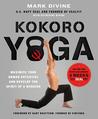
BOOK REVIEW: Kokoro Yoga by Mark Divine

Kokoro Yoga: Maximize Your Human Potential and Develop the Spirit of a Warrior--the SEALfit WayKokoro Yoga: Maximize Your Human Potential and Develop the Spirit of a Warrior–the SEALfit Way by Mark Divine
My rating: 4 of 5 stars

Amazon page

Like many yoga practitioners, I’m never sure whether to be dismayed, amused, or pleased by the explosion of new styles of yoga. It’s nothing new. Yoga has been branching out since its early days. But today’s flavors tend toward the frivolous, usually involve shoving yoga together with something else generally likable, and said two things are in some cases largely inconsistent. There’s marijuana yoga, dog yoga, karaoke yoga, and tantrum yoga. I wouldn’t be surprised if there was a Häagen-Dazs Yoga. Hell, if I was a bit less lazy and more unscrupulous I’d have made a mint from my patented SELFIE YOGA (™ -pending), which involves modifying impressive looking poses so that an individual can take their own pics for FaceBook. (You’re welcome; to whomever the driven sleeze-bag is that turns that idea into a thing.)

I, therefore, tend to approach books like Mark Divine’s “Kokoro Yoga” with a measure of skepticism. That said, I found that this book offered a respectable vision of yoga that might even succeed in bringing a new demographic into the fold. Divine is a former Navy SEAL who developed a fitness empire called SEALFIT, a system that combines fitness ideas from the famous Special Operations unit with ideas from civilian sports and exercise science, such as high intensity interval training (HIIT.)

Incidentally, “kokoro” is the Japanese word for heart / mind (heart and mind were inexorably entwined for Japanese in the era in which the term came into being.) Divine mentions that “Warrior Yoga” would have been his first choice, but that was already taken. The author appeals to warriors with this approach to yoga. He does this in several ways. Firstly, and encouragingly, he doesn’t neglect the mind, but rather puts it front and center by emphasizing the need for mental strength and clarity. My biggest problem with the plethora of new yogas is that they usually forget that it’s ultimately about calming the mind, and instead of providing an environment conducive to looking inward, they embrace or create all sorts of distractions (loud pop music, mirrors everywhere, nudity, animals, ice cream, circus clowns, etc.) Divine doesn’t just make a new fitness fad, he argues for the need for all of the eight limbs of yoga—not neglecting yama and niyama—and emphasizes how yoga served as a calming and clarifying tool for him and not just as a means to be more bendy.

Second, he adds components to balance out the dimensions of fitness. If you are a yogi / yogini, and you want a yoga body; yoga is all you need. However, if you are a martial artist, cop, or soldier, you also need strength, speed (then, by definition, power), and cardiovascular endurance, as well as those aspects yoga offers (e.g. breath control, flexibility, core strength, posture, and mental clarity.) Again, I’m often dismayed by attempts to round out yoga with functional strength building and cardiovascular endurance. I understand the desire to combine them into one workout. Besides the fact that some people need a more balanced approach to fitness, not everybody has time to do multiple workouts multiple times a day. Still, one can’t just ram these components together willy-nilly because if one needs to be in a space to observe one’s breath while being still and one is coming out of having done 100 burpees, it’s probably not going to work so well. I haven’t yet done any of the sequences from the book, but it looks like this shouldn’t a problem, at least not for individuals who are moderately fit. I’m less confident about the value of mixing in elements of chi gong and “cardio kickboxing,” which is suggested by the system. It’s certainly not that I’m opposed to either chi gong or functional martial arts training, but there’s a lot of important detail in those activities and this format risks some horrible half-assery. (Yes, sometimes you get chocolate in peanut butter and get a Reese’s cup, but more often you get sausage in the pudding. Two things being great, by no means ensures they will be great together.)

Finally, Divine puts his approach in the language of soldiers, using concepts like “strategy” and “tactics” and eschewing Sanskrit terminology. The book begins with an anecdote about going into a combat zone as a Reserve officer, which describes his use of yoga to help him get his mind in the right place. He also talks extensively about his practice of martial arts.

There are eight chapters and three appendices to the book. They proceed from the aforementioned story through a look at the general approach, looking at the eight limbs of yoga, before getting into the details. The penultimate chapter sums up research on some of the benefits of yoga, and the last chapter offers advice about how to set up one’s sadhana (personal practice) with the Kokoro Yoga approach in mind. The appendices offer information about functional conditioning exercises, combat conditioning, and module building.

Overall, I think this is a useful book that provides some interesting thoughts on yoga. You may or may not find that it’s the approach for you, but it’s worth checking out. The photos are well-done—though some readers may wish there were more related to the functional conditioning exercises (but he’s got other books for that, it seems.)

I’d recommend this book for those interested in how a yoga practice might be integrated with other aspects of fitness without losing track of the core yogic objectives.

View all my reviews

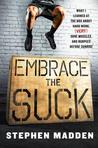
BOOK REVIEW: Embrace the Suck by Stephen Madden

Embrace the Suck: A Crossfit MemoirEmbrace the Suck: A Crossfit Memoir by Stephen Madden
My rating: 3 of 5 stars

Amazon page

Embrace the Suck is one man’s account of his experience with Cross-fit and other high intensity fitness regimens, including SEALFIT 20X. While Madden comes across as a regular Joe, i.e. not one of those crazed individuals who wreck their bodies through lack of rest, failure to heed the body’s warnings, or by way of starvation diets pursued to get that perfect cut, he’s a cheerleader for Cross-fit. If one is looking for an unbiased account of the strengths and weaknesses of Cross-fit, there are probably more objective accounts of the system’s pros and cons. This book is for someone who’s trying to psych themselves up for high intensity interval training. In that regard, the book does a good job because Madden always portrays himself as a human with the unique set of strengths, weaknesses, and limitations that condition entails. He succeeds because he guts it out in the company of the people around him who are portrayed as being more fit (at least in some dimensions) and driven than he.

Still, Madden’s account does give one a taste of the ugly side of the notoriously cult-like fitness system. For example, there is the trainer who refers to orange juice as poison–because it’s a high glycemic index carbohydrate. Even more disturbing is the wife who chastises him upon seeing a photo of him smiling as he crossed the finish line in a marathon–because it showed he hadn’t pushed hard enough. [Come on, it’s not as if, even if he’d died upon crossing the finish line from exhausting all bodily resources, that some Kenyan wouldn’t have been hours ahead of him.] Madden does include a chapter about pain and injuries, but it just suggests one should know what is run-of-the-mill fatigue and what is an actual injury. He mentions an example of a shoulder injury from his own body that he “should probably get checked out.” Furthermore, the final chapter seems to be a cautionary tale about packing too much training into too few days.

The book lays out the Cross-fit approach to exercise, and explains why it is so successful without getting deeply into the research. For those unfamiliar with high intensity interval training (HIIT), the general principle is that one constantly varies one’s workout, and that said workouts are done at maximum intensity with short and regimented rest breaks (though the core workout—i.e. the so-called WOD, workout of the day, is often quite short, i.e. 15 -20 minutes.) The track record for increasing fitness for this approach is good. Studies have indicated that one can get about the same level of cardiovascular benefit as one does from traditional cardiovascular exercise while building muscle (endurance activities like running pursued in isolation tend to result in muscle wastage) and reducing risk of repetitive stress injuries (because one is always changing one’s workout / movement.)

It sounds like there’s no down-side. The workouts are short (granted you may puke, but you’re out the door in an hour or less.) The benefits are high, and it doesn’t seem to be deficient in cardio—the one area in which one might think it would be. The jury is still out on the injury risk. Cross-fit puts out guidelines (which Madden explains) on how frequently one should take a rest day and on the need for perfect form. Those who follow the guidelines may not have any higher risk than other exercisers (the science remains insufficient.) However, the problem may be that it’s hard to maintain the aforementioned perfect form when a trainer is shouting, “faster, faster, faster” in one’s face. Furthermore, moderation and following rest suggestions has apparently not proven the strong suit for many Cross-fitters, some of whom come down with rhabdomyolysis (a deterioration of skeletal muscle from over-exertion / insufficient rest.)

Diet is, of course, an essential topic for any book on fitness, and Madden touches on the two diets that are popular with Cross-fitters. One of the diets, The Zone, is quickly dismissed as being of little use to him because it requires weighing out one’s food portions, and that level of anal retentiveness is beyond his capabilities. The other diet popular in Cross-fit is the one that Madden practices and addresses in the chapter on diet. It’s the so-called Paleo diet—in which one is supposed to eat like one’s pre-agrarian ancestors–except if it involves a high glycemic index food that our ancestors ate, in which case, no. Madden stresses the 80% rule that other Cross-fitter put him on to. That is, follow the diet in a strict way 80% of the time, but allow for a cheat here and there of no more than 20%. Madden’s approach to diet, like his workout drive, seems more moderate and approachable than that of other individuals one sees in the book.

The most fascinating chapter was his description of completing the SEALFIT 20X challenge. This is a one [long] day program in which one trains like a Navy SEAL. It’s part of a fitness and mental toughness conglomeration headed by former-SEAL Mark Divine. This training is a bit different from the Cross-fit workouts in that endurance is a major challenge, and the mind is challenged as much as the body. I don’t just mean that will is important, but the SEALFIT program tests one’s ability to use one’s brain under the pressure of intense physical training.

I’d recommend this book for those interested in learning about the Cross-fit and SEALFIT 20X experience. If one is trying to get an unvarnished view of Cross-fit, you may want to start with another book before getting to this one. It’s readable and thought-provoking.

View all my reviews