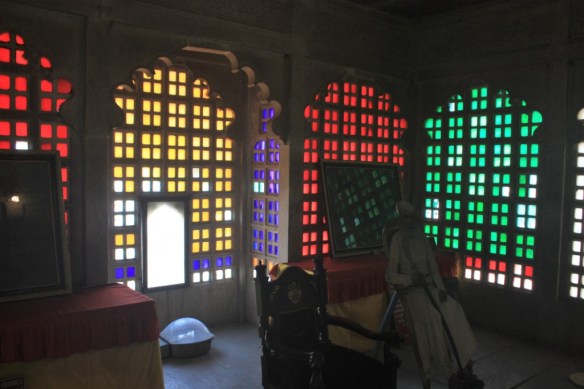
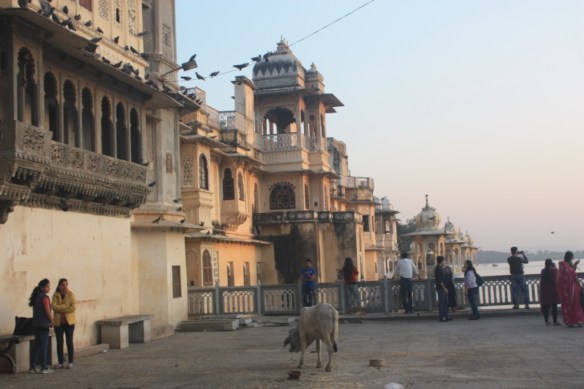
Taken in November 24, 2018 in Udaipur




Taken on November 23, 2018 in Udaipur
That stubble, once a forest full of trees,
now rides the hills down to the turd brown sea.
I’d heard the drumming coming from the banks.
An army of axe men formed into ranks.
Firing up engines of desolation,
scarring the earth in ragged ablation.
And down the river, those drums went silent.
Modern man wondered where the tribes all went.
In ancient temples they’d preached mysteries.
Lost to the burning of the histories,
by purists who’d gathered in mankind’s flanks
to massacre all of the mainstream cranks.
And they sang their songs of faith and nation
to the tune of engines of desolation.

Taken November 26, 2018 in Udaipur

Taken on November 25, 2018 in Udaipur
 Biocentrism: How Life and Consciousness are the Keys to Understanding the True Nature of the Universe by Robert Lanza
My rating: 3 of 5 stars
Amazon page
This book argues for an understanding of the universe in which consciousness is key – the sine qua non of reality, i.e. without which there’s nothing. While Lanza emphasizes biocentrism is a scientifically-based conception, his argument will likely find more immediate traction with people of faith than with the scientific community. Skepticism is likely to arise among the scientific community because the history of science from the Copernican Revolution onward has indicated that we are a bi-product of the universe in action, and not the reason for its existence. Humanity, with our brilliant brains that are the most complex systems we know of in the universe, is neither the geographic center of the universe nor are we its center of meaning or purpose either. Looking at it another way, our annihilation wouldn’t even register as a blip to the universe. Lanza (along with his co-author Bob Berman), fairly uniquely among men of science, argues otherwise.
Lanza and Berman present seven principles of biocentrism over the course of the book. I won’t list these, but they essentially say that in the absence of an observer the world exists only as an unresolved probability function, and that time and space are meaningless in the absence of consciousness. Not to oversimplify the authors’ case, but the heart of their biocentric argument is that it’s consistent with, and could arguably solve, two of the biggest mysteries in science.
The first mystery is the nature of quantum weirdness that has been shown true repeatedly through experiments such as the double slit experiment (which the authors discuss in some detail, but I will not.) I will mention a thought experiment designed make this subatomic strangeness clear in the world at our scale. It’s called Schrödinger’s cat. The idea is that a cat is in a box with a vile of poison that is released by a radioactive trigger. One can’t know when the radioactive decay will release the poison. (This is a bit of subatomic strangeness that can only be reconciled in the face of an observer.) It’s said that the cat would have to be thought of as being in a superposition, simultaneously both alive and dead, until the observer enters the picture. The reader also may have heard of Heisenberg’s Uncertainty principle, which states one can’t know both of a pair of measurements (e.g. position and momentum) with perfect accuracy. All of this says that at the infinitesimally tiny scale of the quantum, particle behavior seems erratic, baffling, and is influenced by observation. While it’s hard to relate to through the lens of our macroscopic experience of the world, it’s a notion that is completely accepted by physicists because it’s been validated by countless experimental observations.
The second truth that science struggles to make sense of that biocentrism presumes to eradicate is the conundrum of the “Goldilock’s universe.” Taken from the fable of finding the porridge that was “just right.” We live in a universe whose actions comply with a series of equations and constants that – were they slightly different – would make life in all the forms we can fathom completely impossible. Starting from the fact that our universe is so mathematically consistent (a feature that it’s commonly argued needn’t be) to the fact that turning the dials a little would make intelligent life impossible, it’s easy to start wondering whether the creationists aren’t on to something. Religion doesn’t have a problem with the Goldilock’s Universe because it presumes the universe was made this way purposefully. Biocentrism doesn’t have a problem because the universe can only exist where there are conscious beings. Of course, science hypothesizes its own solutions to the conundrum. These varied solutions generally revolve around the anthropic principle (we exist in a universe capable of supporting life because if we didn’t we couldn’t) and a multiverse of parallel universes (because the anthropic principle applied to a single universe isn’t intuitively superior to assuming a god, goddess, or gods magically “poofed” us into existence.) Under this idea, which appeals to the Copernican Revolutionary mindset, there will be many more universes where life doesn’t exist, and perhaps even ephemeral bubble universes that can’t even exist as a universe – let alone as a life supporting universe.
There’s a major challenge to biocentrism that results from the fact that we are fairly certain that the universe is 13+ billion years old and our planet didn’t come into existence until about 9 billion years after that (i.e. Earth is about 4.5 billion-years-old.) Even if one assumes the conscious life grew up elsewhere before us, it’s hard to imagine it having happened instantaneously with the beginning of the universe. Lanza’s end run around this can be found in his sixth and seventh principles of biocentrism which state that time and space are illusory in the absence of an observer. Of course, this raises questions of how this could be so and why we might believe it is so — because “it’s essential to my case” isn’t a good reason to believe anything. To be fair, there are all sorts of theories out there – many more mainstream than Lanza’s – that propose time and space aren’t what they seem – starting with Einstein’s well-proven idea that time and space are relative.
This book is oddly composed. It describes the principles of biocentrism largely in the first half to two-thirds of the book, with a few random digressions, and then it really goes off the rails. Most of the digressions are little biographical stories about Robert Lanza, many of which are interesting but completely irrelevant to the book’s proposed topic. I’m unsure which of three competing explanations account for these erratic digressions: a.) the publisher said, “this manuscript must be 200 pages or we aren’t publishing it.” b.) the author is getting up there in age, realizes there is no market for his memoirs, and thinks he can sneak the highlights into this book which is sure to have a following if a controversial one. c.) the author was concerned about being taken for a kook and wanted to establish his bona fides (note: many of the biographical digressions consist of name-dropping.) I should point out that these digressions are the main reason for my mediocre rating of this book, and not disenchantment with the case for biocentrism. (I think we know too little about consciousness and about it’s odd interactions at the quantum level to draw any firm conclusions in that regard.)
I found this book to be fascinating – even some of the digressions were interesting, though not helpful to discussion of the topic at hand. It’s a thought-provoking work. I have no idea whether it will prove to have merit as a description of how the world works. I’ll leave it to readers to determine whether they think it is a sound interpretation of observed reality or a physics-envy based attack on the stronghold of physics as the heart of science or an attempt to reduce the fear of death in a way consistent with science (i.e. time as we perceive it being an illusion makes us all immortal.) If you are interested in the big questions of why the universe exists and what is the nature of reality, you may want to give this book a read – not that it’ll answer all your questions, but it will provide an alternative to mainstream views that you may find useful.
 Agriculture: A Very Short Introduction by Paul Brassley
My rating: 4 of 5 stars
This is another in my favorite series of brief guides to various topics and disciplines, Oxford University Press’s “A Very Short Introduction” books. These books typically take around 100 pages to cover the fundamentals of a given subject. The series offers a quick overview in a no-frills fashion. This book is no. 473, providing an overview of agriculture.
The book is divided into six chapters, and has an Introduction in the front and a “Further Reading” section at the rear. The first chapter is about crop farming and it discusses the major issues of concern, including: the best soils, essential nutrients, fertilizer, as well as discussing what kinds of problems are faced in crop cultivation. Chapter 2 explores the other major division of farming, raising animals. In it, one learns about basic issues of feeding, breeding, housing, and providing medical treatment.
The third chapter investigates the topic of agricultural markets and trade. Here the reader is reminded of their basic economics education, and how market forces result in the topsy-turviness of farming in which a bumper-crop year can be bad while a drought year not so bad. (i.e. Huge harvests mean unit prices drop and surpluses may be lost to waste, whereas shortages result in high unit prices.) The authors also discuss the issue of global trade which is unique for agricultural products because almost every country makes some portion of their own food (excepting nations like Singapore and Vatican City), they are resources no country can afford to be cut off from, and they are perishable on varying time scales.
The fourth chapter is about the inputs used in agriculture such as land, labor, and machinery and equipment. This chapter discusses these topics more generally than they are touched upon in the first couple chapters. The penultimate chapter compares modern and traditional forms of agriculture. As the author points out, this division could mean very different things depending upon what two periods one is comparing. However, it is a worthwhile topic to consider with respect to its relevance to sustainability and the effect on the environment.
The last chapter is nominally about the future of farming, but it considers a number of current issues such as GMO (genetically modified crops) and the effects of climate change. The chapter explores what changes will need to be made as the population approaches 9 billion. It doesn’t go into issues like urban farming, petri-dish grown meat, or insects as the future of protein as much as I’d have thought, but does raise some interesting questions.
There are many graphics, from photos to tables, used to more conveniently and concisely convey information.
I would recommend this for those looking to get an overview of how farming works. Like most books in this series, it is optimized to being concise, not to being interesting – so if one wants fun facts and narrative creative non-fiction this isn’t so much the book for you. But if you want the gist of agriculture fast, this will do nicely.
 When I Walk Through That Door, I Am: An Immigrant Mother’s Quest by Jimmy Santiago Baca
My rating: 4 of 5 stars
This is a narrative poem telling the story of an El Salvadoran woman who is separated from her child after illegally immigrating to the United States. It’s quite a timely topic, but as a work of literature and a “call to arms” it could have done much better.
This poetic novella is gripping to read, but is over-the-top in spots, and that does it a disservice in two ways. First of all, it takes the reader out of the story as they may become lost in the disbelief. Secondly, it takes a work that could have been a persuasive call for change, and turns it into an angry rant. To give a prime example, at one point early in the piece, the lead character has been (gang-)raped four or five times over the course of two pages, by varied factions including US law enforcement officers. Even if one were to accept the author’s presumed premise that American federal law enforcement agents are morally equivalent to the gangs of the drug cartels (a premise not likely to be accepted by the meaty-middle of society), one is left to ignore the fact that female prisoners, once in custody, aren’t left unsupervised with male guards. I know the reader may say, but this is a technical detail in a fictitious narrative poem. However, given the way the piece is presented (discussed more below), it reads like it’s telling us a story that is meant to move us through the proposition that this is the world in which we live. But once one reads one falsity, one is left wondering whether any part of the story is reflective of reality.
The idea that this woman is exploited by every male she comes into contact with, whether they are gang members or Immigration and Customs Enforcement (ICE) agents, has poetic merit. It’s pointing out that without legal status, she is in a perpetually vulnerable state. Yet, it seems lazy and sensationalist to make all such exploitation rape. When one morally equates gangs with agents of a democratic government, one isn’t just saying that the individuals are equivalent, you are casting aspersions against the entire system of rule of law. (Because, of course, protections should be in place, and — failing them — the means to lodge complaints. And I think most would argue that both are the case.) The bigger problem, one found throughout the political spectrum in the US, is that individuals vilify each other, pretending they are being persuasive, when in reality they are just more deeply etching an “us-them” divide. By this I mean to say, one can’t tell people how vile, despicable, and evil they are, and then expect them to see your perspective.
The narrative poem is delivered in a combination of free verse and poetic prose all of which verges largely on just plain prose. That is to say, the emphasis is on telling a story and not so much on the usual core components of poetry, i.e. sound, imagery, and metaphor. (Unless some of these fictitious elements, e.g. the astounding number of rapes, are meant to be metaphorical. Then my concern would be that one risks diminishing a horrible thing, if one throws around that word as metaphor.)
This is a quick read, and, as I mentioned, it’s presented in a gripping fashion – if hyperbolically so. I suspect that it will be mostly read by a demographic determined along political lines, which is a shame. It could have been so much more.