[A sestina consists of six-and-a-half six-line stanzas. It generally follows a metrical pattern, though there is no consensus agreement on a particular meter. (In English language poetry, pentameter is common but not universal.) Sestinas don’t rhyme, but instead use a pattern of repetition of the end-words. So the last word of each line in the first stanza becomes the last word of a line in the other stanzas, but in a rotated order. In this poem, I’ll be using the most common rotational scheme. The envoi (i.e. the three line stanza at the end) must use all six end-line words — three are set as end words and the other three can appear anywhere in its designated line.]
The fluid dynamics of fear:
spreads like fire, but rolls like water.
Through contact or its lack, it creeps.
There’s fear of what is and what’s not —
fear of loud noises and the dark,
of nightmares that seep into day.
Some feel it at the end of day —
that looming specter, rising fear,
as if strength were leached by the dark —
vigor melting; salt to water.
But it’s what lies unseen, and not
the darkness, that gives one the creeps:
-the monster men and lurking creeps
-not today, but some future day
-that those you love might love you not
-the stealth beasts you don’t know to fear
-whether your roof will shed water,
-and your lamp banish all the dark.
When you hear a sound in the dark
and up your spine a tingle creeps,
like the rill of flowing water.
But it can’t hold ’til break of day.
It’s too fluid a form of fear.
It dives where your conscious cannot.
Go. Seek those cloaked fears but you’ll not
see more than shadow in the dark.
Fear is shadow and shadow, fear.
It’s mind myths that give one the creeps;
fears can’t survive the light of day.
They flow and are still — like water.
In my dream, I’m in flood water,
near a plane the pilot could not
save. Hoping to float ’til the day
arrives to free me from the dark.
But I hear something swims or creeps.
It must. Unseen motion is fear.
Treading water in seas so dark
that not a soul can see what creeps
from timeless void to day of fear.
Category Archives: Poetry
POEM: Sense of the Meadow [Day 19 NaPoMo: Idyll]
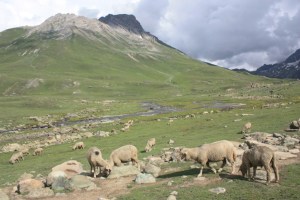
The clang of bells is all the din allowed
high within this remote mountain meadow.
Perhaps, a shepherd’s shout or a dog’s bark,
but only when a sheep has strayed too far.
So silent you smell flowers on the wind —
as senses seek some sign of life’s embrace.
Moreso, if you shut your eyes to the green
whose verdant rug stretches to azure skies.
Buttercups feather hillsides in yellow,
bare granite shoulders the grassy valley,
and cumulus clouds drift, low and lazy,
breaking up the cartel of blue and green.
POEM: Perpetual City [Day 18 NaPoMo: Prose Poem]
The day drizzled on and off into the night. Dreariness seeped to a cold-soaked bone. And I was schlepping down that saturated sidewalk, feeling like I was being watched. That cloud rides overhead when one haunts a city that hasn’t another soul in sight. The denizens must be somewhere, and some must be outward-facing. They might be in the shadowy maw of an alleyway or watching from the warmth and anonymity of a darkened room, but the city never went without eyes.
This was the throbbing heart of the city — if, also, the darkened heart of the city. Within a two-hundred meter radius hemisphere of my position who knew how people were seeking heat? Some would be wrestling away from dank recessed pits in the backrooms of minds run amok. While others were in the act of surrendering — plummeting into that dim pit with abandon. Who knew what was happening? But — for some reason — I had to believe that something was. As I pressed a palm to a wet stone wall, feeling for the trace vibration of hyper-living, I had to believe that the perpetual city was still wound.
POEM: All Hail, Warhol! [Day 17 NaPoMo: Doggerel]
[With doggerel the only way to be “good” is to be ironically bad.]
Being a true genius must be hard work.
Is there a less laborious path to the perks?
I’m so glad you asked:
Just convince the right person you’re a genius,
and you’ll be in like porn star penis.
Just stack some boxes of Brillo pads,
reprint some old burger joint ads,
slather color on portraits — Tammy Faye Bakker-style —
(just make sure to showcase the subject’s creepiest smile.)
Lest you think I’m just being snarky,
I say this without a trace of malarkey,
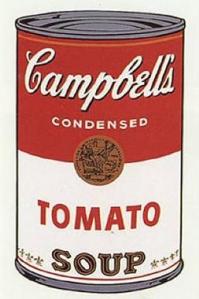
if you can buy mansions off a soup can label you didn’t design,
genius is too meek of a word, you stink of the divine.
[Like Odysseus being dropped in the lap of goddesses
who were ready & eager to pop open their bodices.]
Do you think the Campbell’s marketing artist has a mansion?
He probably retired with a meager pansion.
I say this without derision,
to be great artist you don’t need to show in galleries, Parisian
you simply need to showcase your vision
of some poor shmuck’s labors
to the person who can get you a better class of neighbors.
POEM: The Philosopher [Day 16 NaPoMo: Narrative]
Said a man, standing on a crate,
“Thought and comfort are species that cannot mate.”
This philosopher continued:
“An idea unchallenged can’t claim merit. Sacred stories are paper tigers.”
“Anything sanctified may lead to murder. For one person’s sacred object will bump into that of another, and it’s only by brute force that such conflicts are resolved. ”
The mayor was captivated by the philosopher’s words, and thought:
The youth are lumps, existing free…
-of challenge
-of thought
-of dignity
-of power
So the mayor invited the philosopher to his town.
The townsfolk were not pleased.
The philosopher’s first act was the erection of a sign that read,
Your god is the wrong God!
One resident said, “How can you make such a statement?”
“I’m not here to offer instruction about how language works, but — rather — about how a thoughtfully lived life can be achieved.”
The first man kicked the philosopher in his left shin, and stormed off.
The second shouted, “But what gives you the right?”
“The right to what? To write a statement? To expose it to public scrutiny?”
“To make claims about which god is the true God.”
“I make no such claims.”
“But your sign says so.”
“Do you claim the sign is wrong, or that I have no right to make the comment — regardless whether it is true or false?”
“Well, mostly, the first one. The sign is not right,”
“Perhaps the sign IS untrue, and if proven so, I would certainly have to remove it. So tell me, is your counter-claim that your god is truly God?”
“It most certainly is,”
“Then tell me, how can I know that your claim is the correct one?”
“It is written in the scriptures.”
“So anything that is written in a religion’s scripture is true?”
“No. Not just any religion’s scriptures, just ours.” said, the man, thinking he’d anticipated the philosopher’s argument about how mutually exclusive statements can be true.
“And why just yours?”
“Because ours were written by the hand of God,”
“And how could a person such as myself be convinced of the truth of such a statement?”
“Because it is written…”
“So the scriptures of other religions don’t say they are the truth from God?”
“They may say it, but it’s not true.”
“So do you have more of an argument than that you believe something written centuries before your birth must be true and statements contrary to it must be false? If not, I must maintain that the statement on the sign has as much validity as your counterclaim. Both statements may or may not be true and with unassignable probabilities.”
And so the second man punched the philosopher in his right eye, and walked off in a huff.
A third man, a missionary, said, “That man was wrong,”
“I agree,” said the philosopher holding his palm over his eye, “violence is not a winning argument,”
“No,” said the third man, “not about punching you. He was wrong that what matters is the scriptures. I know my god is the God because I feel it’s true.”
“I had vertigo once. It felt like the room was spinning and like I would fall over, but neither was true. So, I can’t say that I put much faith in what I feel as arbiter of truth, but I definitely don’t have any feeling about the existence of your god — one way or the other. Are you saying he might be god to you — who feel this presence — and not to me, and to all those others, who don’t have such a feeling?”
“I’m not saying that…”
“Oh, good, because I was going to ask why you make so much effort to convert people to a subjective god?”
The third man kicked the philosopher in the right shin, shook his head, and walked off.
A fourth man approached and said, “Your sign is wrong because I have no god. I don’t believe in such hokum.”
The philosopher took out a marker and made some editorial changes. He wedged a large “V” in between the word “Your” and the word “god” and wrote “lack of” above it. He then crossed out the words “the” and “God.” The edited sign read:
Your lack of god is wrong!
“Surely, you aren’t going to attempt a proof for the existence of god after what you told your previous conversant?”
“I am not. You watched the previous discussions and should realize that I claim no more than that my statement holds as much validity as yours. Unless, that is, you are more successful at proving the non-existence of a god than the previous individuals did at proving its existence.”
“I cite Occam’s razor,” the fourth man said smugly, adding, “are you familiar with it?”
The philosopher said, “Indeed I am. But I wonder, why is it not called ‘Occam’s Law?’ Is it always the case that the simplest explanation is invariably true? Could we not find in the natural world instances in which the explanation for an observed phenomena was more complicated than an explanation we could theoretically imagine?”
“Not invariably, but a good rule…”
“So you base an absolute conclusion on a ‘good rule of thumb?’ Isn’t there potential for…”
The fourth man socked the philosopher in his left eye.
The philosopher, blinded with two swollen eyes and with a knob under each knee, sat by his sign, awaiting more takers.
The mayor came by and said, “I’m afraid this hasn’t worked out as I’d hoped. I’ve gotten so many complaints. Perhaps, it would be best if you move along.”
So, the philosopher grabbed his meager possessions, and limped one painful step at a time out of town.
***
Two weeks later, a colonizing army invaded.
The officers told the residents that they must convert.
The townsfolk all said that they would never convert.
The generalissimo said, “Convert or die. Those are your options.”
“That’s unfair,” said one man.
“What gives you the right?” said a woman.
The generalissimo then said, “OK. OK. If any of you can give me a sound reason why your religion cannot be supplanted by our own, I will reconsider…”
POEM: Spanish Flu Elegy [Day 15 NaPoMo: Elegy]

I
The known world died, made sick with Spanish Flu.
Flu made War look clumsy at dealing Death.
The Dead piled for the corpse cart to come through.
Trash stacked with kin who’d expelled their last breath.
II
What masters passed in those tens of millions?
Could we’ve faster mastered tech and science?
Might we’ve lost heroes that matched our villains?
Could the good have formed a grand alliance?
III
They say a forest without any fires
is a place of Death that doesn’t know it yet.
Disease isn’t just some fast-track to the pyre;
it’s a force of nature; an unpayable debt.
POEM: Bee Flow [Day 14, NaPoMo: Pantoum]
[A pantoum is a Malay form built in quatrains, and which uses repetition of lines. The second and fourth lines of one stanza become the first and third of the next. The final stanza can, but doesn’t necessarily, revisit lines from the first stanza.]
She bends a moment writ in iron time,
while concentrating on a hov’ring bee.
Its undulation hushes a turbid mind.
Entranced, there’s nothing else to feel or see.
She concentrates on the hov’ring bee.
It becomes the sum of all things in her world.
There’s nothing else to feel or hear or see.
Only the bee alighting, body curled.
The bee is all that resides in this world.
Its undulation lulls her into trance.
She sees it flit and hover, its body curled.
The moment slows to show her its wee dance.
A Few Senryu [Day 13 NaPoMo: Senryu]
[Senryu is a Japanese style of poetry that’s identical to haiku in form, but different in content. While haiku rely on images (usually natural and often seasonal) and the juxtaposition of such images — devoid of analysis, commentary, or judgement — Senryu poetry explores human nature. In other words, while humans appear rarely in traditional haiku (and, when they do, it’s as a part of nature;) Senryu are always about humans and they do present commentary — often intended to be humorous.]

two dodge bird poop
the missed credits himself,
the struck curses birds
when floors must be swept,
some needn’t be told, some must,
and some told they can’t
extroverts
having virtual parties,
while I read
Blake said,
“The cut worm forgives the plow.”
What of the plowman?
boredom exempt:
creatures who use their teeth, feet,
or their brains
the hungry snake
doesn’t begrudge the winning
chameleon
POEM: I’ve Seen Sunsets [Day 12 NaPoMo: Rondeau]
[A rondeau is a closed poetic form of French origin. It uses tetrameter, a half-line refrain, and rhyme schemes of aab and aabba. The first poem I ever learned by rote, “In Flanders Fields,” is among the best known English-language examples of this type of poem.]
I’ve seen sunsets in colors bright.
I climbed Phnom Bakheng for the height
to peer above the canopy.
Fire orbs dip to Andaman Sea,
and I crossed isles to beat twilight.
Hues: royal purple to blazing fire light
I’ve watched Midwestern skies fade to night
from a tower above the trees.
I’ve seen sunsets.
Seven ridges of varied might,
were stacked from tree- to snowcapped-height,
and a different scene for each degree —
as painted clouds flared windward to lee,
and I watched from an idyll campsite
I’ve seen sunsets.
POEM: Train of Sleep [Day 11 NaPoMo: Free Verse]
waking in a train car
at the rail yard
slouched in the darkness —
but not pure darkness
because the lights are always on at the railyard
and the pale light shines in at strange angles
slapping the window makes your palm hurt,
bruising the bone of your thumb,
but gets you no closer to being free
trying to wedge your fingers between
the rubber ends of the sliding door panels
proves useless
the door doesn’t give way — weakly —
as it does when a running rider
slips a hand in at the last second during rush hour
nothing to do but to try to go back to sleep
but your mind races with what you’ll say
how it’s “a funny story”
or
indignantly, “isn’t someone supposed to check each car?”
of course, they are, and they did,
but the driver, eager to get home,
just peeked through window into that last car
and didn’t see the person huddled
in the backward-facing first row of that last car
mind-racing, and butt feeling the hard seats
you can’t fall asleep,
and you wonder how you ever did
but, eventually, you do
you wake in the train car
still at the railyard
but without the darkness
because a bright light shines in your face
as someone says,
“What are you doing here?”