The Legend of Nai Khanomtom: Hero of Muay Thai

?????????????

Muay Thai Institute in Rangsit, Thailand

In 1767 the Ayutthaya Kingdom of Siam fell to the Burmese. Burma occupied Siam only briefly because Burma’s king, King Hsinbyushin (a.k.a. King Mangra), was forced to withdraw his troops to combat a Chinese invasion to his homeland. The Thais were fabled to be valiant fighters and even had a numeric advantage, but they were easily put into disarray by Burmese forces. Even King Mangra was said to have declared that he couldn’t have taken Ayutthaya had the leadership of the opposition been more effective. [Keep in mind that even if he did say this, it might have been more a dig at his Thai counterpart than an expression of his true feelings.]

The Burmese captured a many prisoners during their Thai campaign and true warriors were particularly coveted as prisoners. One such fighter was Nai Khanomtom (fyi: it’s also written Nai Khanom Tom.) Nai Khonomtom was renowned for his skill in Muay Boran, an early Thai fighting style related to Muay Thai. This made him a logical choice to headline for the Thais in a tournament that would pit Muay Boran against Thiang–i.e. the indigenous martial arts of Burma (e.g. Lethwei and Bando.) The tournament would be part of King Mangra’s seven day festival in honor of Buddhist relics, the festivities of which would also include plays, comedians, and sword fights.

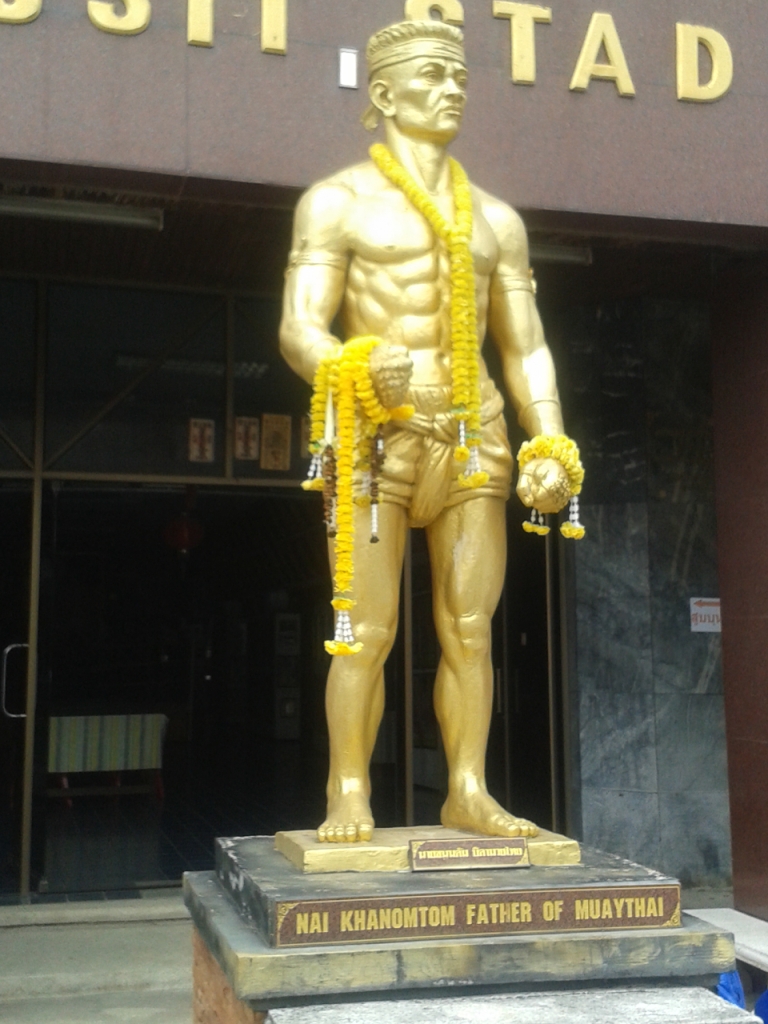
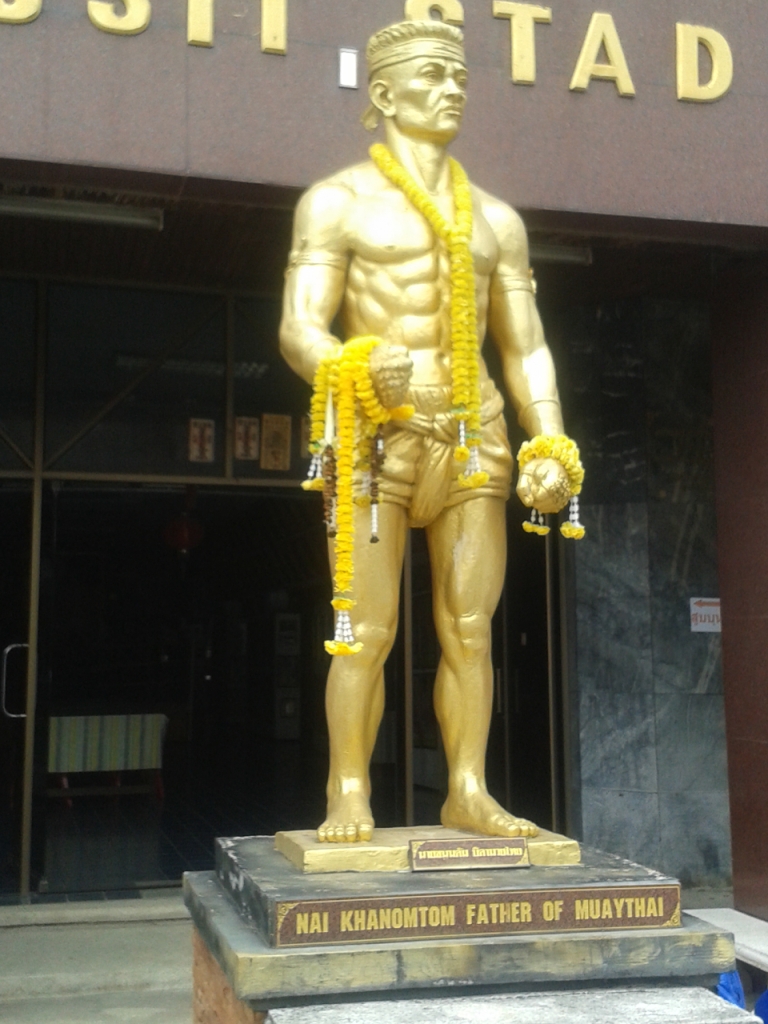
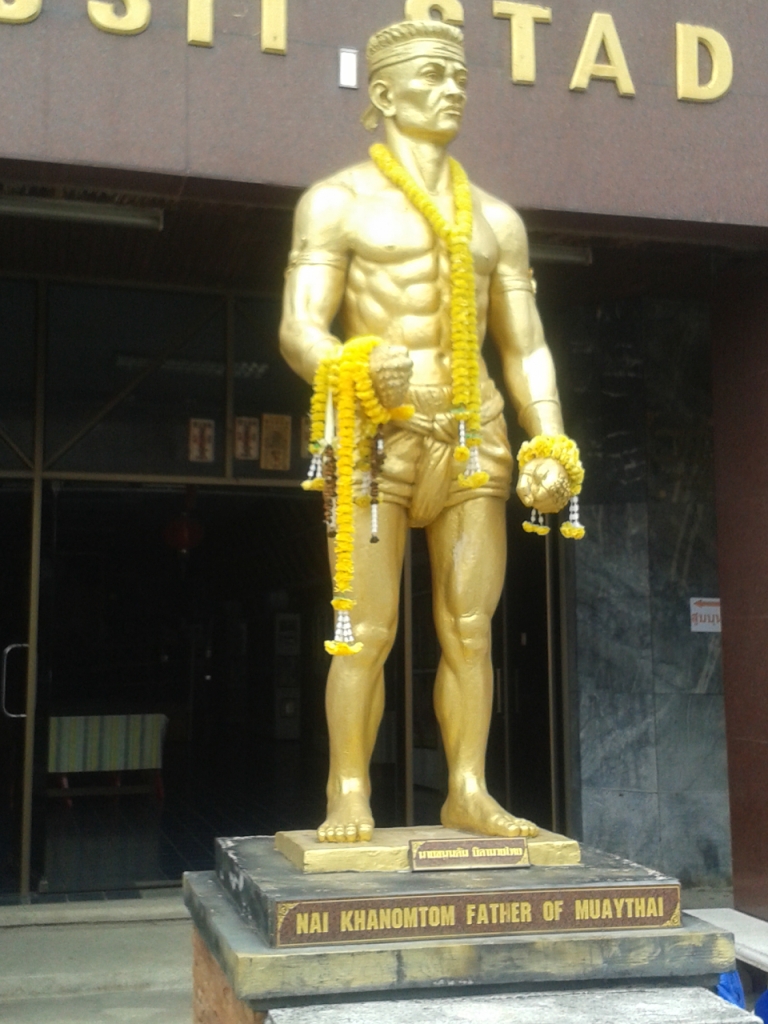
Nai Khanomtom was pitted against a Burmese champion, a man who was clearly the audience favorite. Timed rounds didn’t exist in those days. Fights stopped when one of the fighters was physically unable to continue, and not before. The Burmese fighter wore a kind of sarong that was the usual attire for the men of Burma, and Nai Khanomtom wore a loin cloth tied up in the traditional Thai style (see the statue pic above.) Each fighter wrapped only ropes on their forearms and hands, and each may have had some padding over the groin–though not as insurance against an accident, but because crotch kicks were fair game.

Nai Khanomtom began with a Wai Kru, which perplexed the Burmese. Wai Kru is a pre-fight ritual that has several purposes, the most important of which is to show respect for one’s teachers, deities, and the audience. The practice can take several minutes and some variants of it can be physically demanding.

When the fight started, Nai Khanomtom charged over the fight space taking the fight to his opponent and laying down a barrage of kicks, knees, elbows, and punches. By some accounts, his victory was declared invalid by a judge, who’d been distracted by other festival events (and who–no doubt–wasn’t pleased by the swift defeat of the Burmese champion.) The decision was made despite the fact that the Burmese fighter had been knocked unconscious.

The King was thrilled by the fight and offered Nai Khanomtom his freedom if he could fight nine more Burmese fighters. Nai Khanomtom didn’t get breaks between these fights, and as soon as an opponent went down the next was queued up to come after the Thai fighter. And so it was that Nai Khanomtom took on the Burmese fighters in an ironman fashion. The last of his opponents was a famous martial arts master teacher from Rakhine, a coastal region in Burma’s southwest. Nai Khanomtom went after the Rakhine master with flurry of kicks. It’s worth noting that in those days Burmese fighters were said to have relied much more heavily on hand strikes than kicks, and so the kicks may have given Nai Khanomtom a range advantage while presenting his opponent with attacks that the Burmese fighter was less practiced at defeating.

At the fight’s end, King Mangra honored his agreement, and Nai Khanomtom was granted his freedom and provided safe-conduct back to Siam. There are varying accounts that say that Nai Khonomtom returned home with either two Burmese wives or a number of his fellow prisoners as an additional payment for providing a spectacle that the Burmese king found gripping. In these accounts, Nai Khanomtom is usually said to have turned down a cash payment.

There’s a quote that’s often attributed to King Mangra that goes, “Every part of the Thai is blessed with venom, even with his bare hands he can fell ten opponents.” [FYI-It should be noted that seeing the same words quoted by several sources isn’t proof of truth, because the quotes could have a common (and false) point of origin.  So take it all with a grain of salt.]

[Note: The details of this story vary. So you may hear–or have heard–a slightly different version of events. The exact details are likely lost to history and–when that happens–embellishment may creep in. That said, the variations that I’ve heard are neither great nor particularly significant. It’s also worth noting that these events are celebrated in Thailand every March 17th on what is called Boxer’s Day or National Muay Boran Day.]

DAILY PHOTO: Golden Nai Khanomtom

Taken in August of 2014 at the Muay Thai Institute in Rangsit, Thailand.

Taken in August of 2014 at the Muay Thai Institute in Rangsit, Thailand.

As the placard states, Nai Khanomtom is considered the father of muaythai (Thai boxing.) He lived during the 18th century, and is most famous for his defeat of between 9 and 12 Burmese Lethwei (or Let Whay, the Burmese style of boxing) fighters–depending upon the retelling of the story.


One account states that the Burmese king had Nai Khanomtom kidnapped after watching from afar as the Thai legend devastated one Burmese soldier after another in close quarters combat. Other accounts hold Nai Khanomtom was one of many Thai prisoners captured. By all accounts, Nai Khanomtom was pitted against multiple Burmese opponents–some of the best the country had to offer–in a boxing match and defeated them one after another without [significant] rest periods.

I probably should have posted this on March 17th, which is Thailand’s “Boxer’s Day” (not to be confused with the post-Christmas Boxing Day recognized in much of the Western world.)

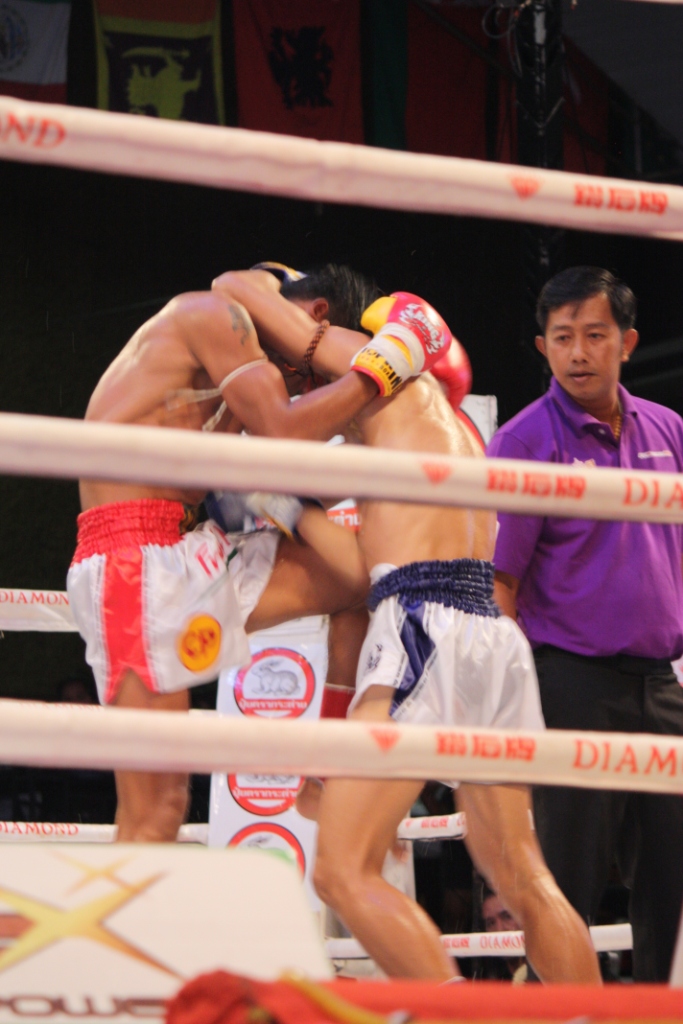
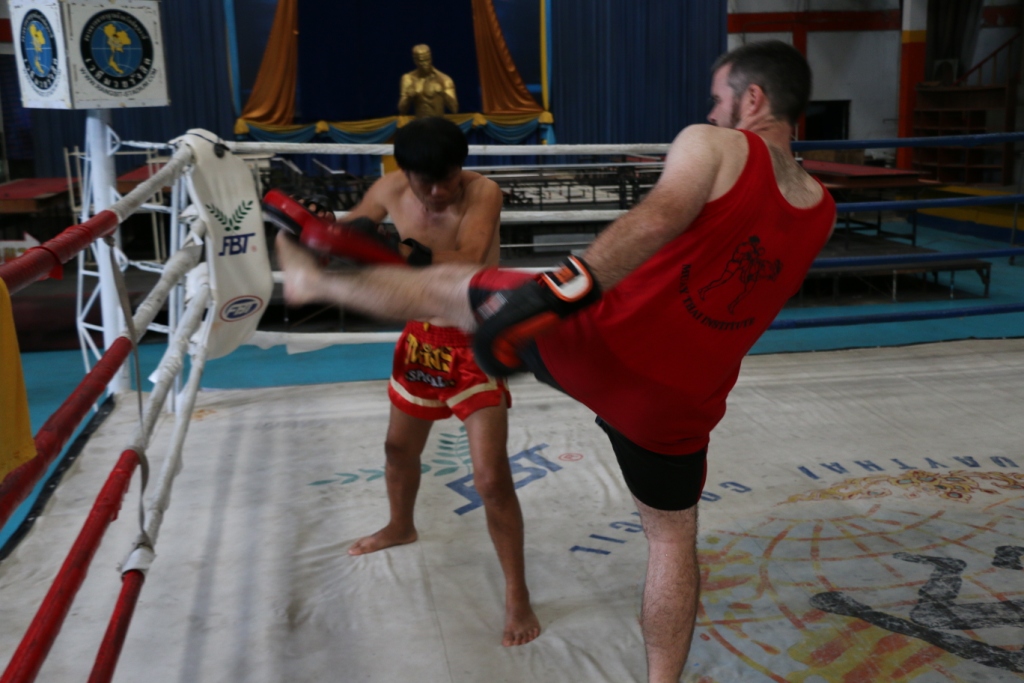
DAILY PHOTO: Muay Thai Face Off

Taken in August of 2014 in Rangsit, Thailand

Taken in August of 2014 in Rangsit, Thailand


IMG_1434

DAILY PHOTO: Thai Boxing

Taken in August of 2014 in Rangsit, Thailand.

Taken in August of 2014 in Rangsit, Thailand.

This photo was taken at the Rangsit International Boxing Stadium, which is located in a Bangkok suburb to the north, during the August 31, 2014 fights.

BONUS DAILY PHOTO:

Taken at the August 31, 2014 fights.

Taken at the August 31, 2014 fights.


Muaythai Training in Thailand for Certificate or Freestyle?

20140821_140754

The Muay Thai Institute (MTI) in Rangsit, Thailand is uncommon in that it offers two different approaches to training. The first option is a program that will allow one to test for a certificate showing that one mastered the skills required at one’s respective level (Beginner, Intermediate, Advanced, Professional, and Teacher.) The second option is daily/weekly/monthly training, which the teachers refer to as the “freestyle” tract.


MTI’s website covers details of pricing and timing, but one may not be clear about what the differences will be with respect to actual training. I’ve trained at MTI on two occasions–the first time for one week and the second time for two weeks–and have trained in the freestyle track on both occasions. The majority of students at MTI seem to pursue the rank certificate approach.  This is probably in part because there aren’t many gyms at which one can get a certificate and transcript recognized by Thailand’s Ministry of Education. There a vast number of places to train Muaythai in Thailand, but few at which one can build rank that has some recognition beyond one’s own teacher.  (Which is not to say that certification is the only reason to train at MTI versus elsewhere; I’ve been back for training without certification.)


 A QUICK COMPARISON OF CERTIFICATE v FREESTYLE TRAINING

Advantage Freestyle Advantage Certificate
PriceBroader training experience

No need for planning

No minimal time investment

Focus on fighting skills

CertificateGreater perfection of fundamentals

Doors open to progress

Systematic approach to learning

Learn Wai Kru (respect) in detail


Before I elaborate on some of the differences, it should be noted that at least one’s first few days (and perhaps more depending upon one’s physical acumen) as a freestyle student will be spent training with the Level I (Beginner) certificate students. If your stay is short or if you have trouble grasping the basics, your whole training period may be identical to a Beginner certificate student. However, after a few days the training a freestyle student receives is likely to be different from the Level I student.


I’ll elaborate on the notations made in the above table:


PRICE: It’s a little cheaper to train freestyle. As of the time of this writing, it cost 8000 Baht for the Level I certificate program, which involves 10 training days (i.e. 20 sessions, or 40 hours). So if one trains the usual twice a day schedule without many (or any) days off, one can do this in two weeks. At the weekly training rate, one will pay 5000 Baht for two weeks. Note: CHECK THE WEBSITE as pricing details may change over time.


CERTIFICATE:  In the certificate program, one gets a handsome certificate, plus a transcript that breaks down how one did on all of the requirements so that one knows what items one kicked butt upon and which ones one eked by upon. As I mentioned, this is recognized by the Thai Ministry of Education, and so holds a little more gravitas than one’s teacher saying, “Hey, you can move over to the Intermediate ring now.” If one wants to teach Muaythai, it might not even be a question of what track you will pursue.


Sadly, for those in the Western world rank tends to hold a great deal more importance than it does throughout much of Asia, where one is either the teacher or one is a student and the respect others  grant one is based more upon what one can do and how hard one trains than what color belt one wears.


IMG_4914BREADTH OF TRAINING EXPERIENCE: Freestyle students usually spend more time doing pad work, unrestricted shadow boxing, and sparring than (Beginner or Intermediate certificate students. Freestyle students will also be exposed to a range of techniques from the Beginner through the Advanced levels. A Level I certificate student will focus on mastering the material for one’s level, and that will mean mostly doing footwork drills without and with punches /basic defenses, as well as bagwork.


DEPTH OF TRAINING EXPERIENCE: The flip-side of the previous entry is that certificate students will likely develop better technique because they’ll drill the basics more and will be corrected on smaller errors than will freestyle students. Which of these approaches is better is a personal question that depends on the student’s background and what they hope to get out of training.


THE NEED FOR A PLAN: A freestyle student just needs to show up every session and do what the teacher tells one, when he tells one.  If one decides to take a session or even a day off, there’s no issue other than personal nagging guilt (not that one shouldn’t take a day off once a week or so—depending on how long one is training for.) However, if you are in it for a certificate, you need to be conscious of the effect that dropping classes will have on having the minimum number of classes needed to take the test.


The certificate student may also need to put in time outside of the training sessions. Beginner students must show they know the Wai Kru, which involves an elaborate sequence of moves that one will usually practice in class at most once per day. While one usually has plenty of free time, if you haven’t experienced training Muaythai for four hours a day, you may not be aware of how much energy it takes to go practice even the relatively slow moves of the Wai Kru outside of training sessions.


PROGRESS: For those who want to be able to teach Muaythai eventually, it’s important to start checking off the intermediate steps. That requires progression through ranks. If one has no intention of working toward a high level, the certificate my hold little value. Also, be cognizant that Level 4 and the teaching levels require that one have a certain number of professional fights under one’s belt. That may or may not be feasible for some.  So don’t think you will work your way through to the teacher levels without fighting.


MINIMUM TIME INVESTMENT: The first time I attended MTI, I had only one week and I couldn’t have done the certificate program if I wanted to. If one wants to do the certificate, again, one needs to make sure one has adequate time to get in the minimum number of sessions.  If one has only a week or even a few days, one can get value out of training freestyle.


SYSTEMATIC APPROACH TO LEARNING: If one is new to martial arts (and to movement related activities in general), it may be beneficial to begin sticking solely to a small set of the most basic techniques—as per the certificate program.  The freestyle approach could be frustrating if one doesn’t have some experience using one’s body fluidly and adjusting to changing conditions. While the details of techniques vary considerably from one martial art to the next, there are a set of skills related to bodily awareness that people who’ve practiced movement arts for many years develop that can translate to relatively smooth and rapid acquisition of other approaches to movement.


FOCUS ON FIGHTING SKILLS: For a Beginner certificate student, the Wai Kru is the single most challenging item on one’s list to learn. The Wai Kru is very important, as it’s how one shows respect to one’s teachers and lineage. However, if one is primarily interested in picking up skills to apply to self-defense or to one’s mixed martial arts stand-up game, spending lots of time on getting the entire sequence perfect may not be the best use of one’s time.  (As opposed to if one wants to fight in Muaythai bouts or teach the art one day, in which case it’s worth taking the time to perfect this activity early.) [I should point out that freestyle students do get the opportunity to learn and practice the Wai Kru. It’s usually how one of the day’s sessions is finished each day. However, I will say that in two weeks I was nowhere near fluid in having memorized the full sequence, hence the suggestion that one be prepared to put in some overtime on it if one wants to earn a certificate and get high marks. ]


LEARN WAI KRU AND OTHER “ANCILLARY” SKILLS: There are skills like the Wai Kru that one will probably not master going about the freestyle tract. This may or may not matter to one, and whether it does or doesn’t matter is an important consideration in one’s decision.


These are my views on the difference between training freestyle or for rank at MTI. If you decide to train there, I hope it will be of some value.

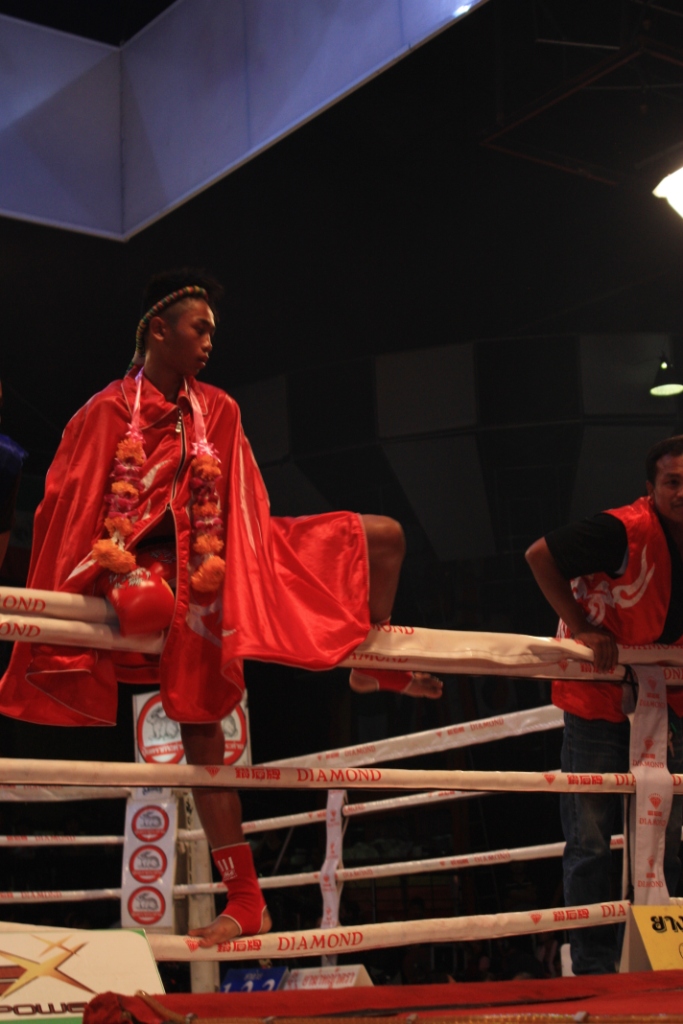
DAILY PHOTO: A Fighter’s Exit

Taken on August 31, 2014 at Rangsit International Boxing Stadium.

Taken on August 31, 2014 at Rangsit International Boxing Stadium.

How to Choose a Muay Thai Gym in Thailand

Tiger MT Beginner's Area. (The mats are up for cleaning to prevent Staph outbreaks.)

Tiger MT Beginner’s Area. (The mats are up for cleaning to prevent Staph outbreaks.)

So you’re going to Thailand and you want to learn a bit of Thai Boxing. Where do you go to train? This is the question under consideration in this post.

I just got back from two weeks of training at Tiger Muay Thai & Mixed Martial Arts on Phuket. This was my second experience training Muay Thai (MT) in Thailand. In October of 2012, I spent 6 days at the Muay Thai Institute (MTI) in Rangsit (a suburb of Bangkok.) The training at both places was awesome, but quite different. This got me thinking about what type of student would find each of these two places ideal. Both of these schools has a niche of students who would find it better suits their needs than the other.

First let me point out a factor that one might think is crucial that really isn’t so much, and that’s price. While I’ve only attended the two schools, I did quite a bit of web research and found that prices don’t range that widely. Particularly in Phuket, where there is a saturation of the market, everybody seems to charge around 3,000 Baht ($91USD) per week—give or take 500Baht. While 2,500 to 3,500 Baht ($76 to $106 USD) might seem like a big gap, there could be very reasonable explanations for why a gym is at the high or low end. Low cost gyms may be more remote, and thus have fewer customers. One should take into account that if one has to rent a scooter or take taxis or pay exorbitant rates for food, one might not be so happy with tuition savings. A gym at the high-end might offer more training opportunities beyond MT, may have more facilities, or may have more prestigious trainers (or just more trainers–period.) [Note: For what you pay you can probably get 24 to 28 hours of classes in per week.]

Now I suspect there are some who will say, “Hey, stop relying on the internet. Find out where locals train. There are gyms that produce winning fighters, but that just aren’t as fancy/web-savvy but are much cheaper.” This may be true, and– if one speaks Thai–that may be the way to go. However, the places that have glitzy English-language websites, usually also have trainers and staff that speak English and that can be a big advantage if one doesn’t know more than Su-was-dee-krap and Kob-Kun-krap.

Note: What I’m saying about price doesn’t necessarily apply to lodging and food. Some gyms offer accommodations and meal plans that may not be competitive with what one can do at local guesthouses and restaurants. Web research should tell you whether you are getting a decent deal staying at the gym. If you don’t mind Spartan accommodations (and I don’t) the baseline gym rooms often offer great savings. I stayed at the gym at both MTI and Tiger, and found it was a good deal (but, again, I don’t need TV, AC, or other luxuries–a bed, a fan, and my Kindle pretty much have me covered.)

Tiger had a meal plan, but I didn’t use it. However, I can’t say that I even looked at its price. I like to try as many different places as I can, and I ate at most of the restaurants and cafes on that strip. I will say there are a lot of cheap, tasty, and nutritious places to eat within walking distance of Tiger. My experiences with the restaurants on the strip were overwhelmingly positive.

So this brings us to what does matter. Some questions you should ask are:
-What is the typical student/trainer ratio?
-What styles are taught at the gym? (i.e. Only Muay Thai or other disciplines as well?)
-Are classes mixed abilities or are there skill level divisions?
-What does the typical class consist of for the level at which you will be training?
-What are the trainers like and how does that jibe with what you need?
-Where is the gym located, and how close is it to the services you’ll need?

Of course, the central question that undergirds five out of six of the questions above is, “What do you want to get out of the training?”

The MTI Gym from my room.

The MTI Gym from my room.

Student/Trainer ratio: How important this is varies radically depending upon what one wants from training. If one is going to class primarily for fitness, having a low student/trainer ratio may not be important. However, if you are looking to improve your technique, it matters greatly because you need attention to the minutest details.

I attended Tiger in peak season and MTI just before peak travel season. That said, I think I can safely say MTI probably always offers lower student/ trainer ratio. (I don’t think MTI’s student attendance is as tourism-cyclic as it has more Thai and expat students and relatively few foreign visitors at a given time. Tiger MT is probably very tourism-centric at the beginner level.) In Rangsit, there was often one trainer to every one or two students. The beginner’s class at Tiger had many students per trainer. However, Tiger offers four separate classes of Muay Thai (Beginner, Intermediate, Advanced, and Fighter), and as one moves up there are fewer students per trainer. So if you “test out” of the beginner’s class your ratio gets better.

One should note that at the extremes one may find a low student/trainer to be more a curse than a blessing. First, one will not have many different people to train with, and diversity of training partners is important to growth. Second, having eyes on you every second may become overbearing, particular if the trainer is fixing every tiny error. In such situations, one may never get into the grove.

What do they teach? The two schools I’ve attended were at opposite ends of the spectrum on this issue. MTI taught Muay Thai–that’s it and that’s all. If you just want to improve your Muay Thai, MTI is a great place for it. There’s not the distraction of tons of people coming through doing other things.

Tiger MT, on the other hand, taught about everything there is to teach. If you want to get into Mixed Martial Arts (MMA), they’ve got you covered with classes on MMA tactics, Brazilian Jujutsu (BJJ), and Boxing in addition to Muay Thai. On the other hand, if you’re a martial arts wonk, who likes to get into the evolution of the arts or understand the combat aspects, they also teach Muay Boran and Krabi Krabong. Muay Boran is the unarmed ancestor to Muay Thai, and Krabi Krabong is a weapons system.

Mixed abilities v. Tiered classes: If you are a rank amateur, an advanced practitioner, or a competitive fighter, you may be pleased with multiple tiers of classes. A beginner may be intimidated or uncomfortable training with advanced students. Advanced student may have a lackluster training experience when working with a lot of people who are well below their skill level. On the other hand, if one has a bit of confidence and fitness, one may find a mixed abilities class enjoyable because one gets an opportunity to pit oneself against more skilled or experienced training partners.

In reality there was not much difference between Tiger and MTI here, though it might look like there was. As mentioned, Tiger MT had four different classes for MT and these were held in distinct areas, but all the other courses (e.g. MMA and BJJ) were mixed abilities. At MTI, everybody was taught in one big gym. However, because there was a low student/trainer ratio, there were usually at least three or four distinct groups (sometimes groups of one or two) training concurrently and the gym was big enough for these small groups to not be in each other’s way.

Class schedule: There’s a widespread standard approach to Muay Thai teaching that goes: running laps, other warm-up exercises, drills / shadowboxing, rounds of bag work, rounds of focus mitt drills, rounds of sparring, and cool down exercises. However, the emphasis can vary tremendously from one gym to another. In particular, some schools will make great efforts to drill the basics before putting a student into sparring or teaching more complex tactics. Other schools have their beginners hit the ground running to a greater degree. Each of these approaches will appeal to a certain type of student. Some want to get into the meat of training by sparring as soon as possible even if their fundamentals are a bit shaky. Others are concerned about having solid foundations before building upward.

Of course, this is all a matter of degree. At every gym, beginning students are going to spend more time drilling than sparring—and that’s as it should be. One needs to learn the techniques well before one can have any hope of applying them in a quasi-competitive / competitive environment effectively. Usually the emphasis for beginners will be on getting the basic mechanics down, and intermediate students will spend more time pumping up the power and working on application.

Of the two places I trained, MTI took a like more time and attention with the nitty-gritty details of form and technique, and Tiger gave one a pretty broad experience from the get go, i.e. they got student into light free sparring right away.

What are the trainers like? I’m not just talking about their fight records or whether they were champions or not. Both of the places I trained at had trainers with very impressive fight careers. Also important is the trainer’s disposition. If you’re just trying to get fit and learn a move or two, an intense, scar-faced task-master who works you till you puke and kicks you till you collapse may not be for you. On the other hand, if you’re preparing for a fight or are just deadly serious about your training, the smiling old softy may leave you disheartened. Some students may want someone who is a stickler for detail, and others may want someone who will focus on getting them in better shape. Unfortunately, while you can probably get information about a trainer’s fight history online, you may only be able to get information about their disposition by visiting, trying the place out, or by talking to people who’ve trained there.

It should be noted that a common complaint about many MT gyms is that the trainers don’t seem to care. Students need to understand that they may have to be a little proactive to get the best relationship out of their trainer. Keep in mind that trainers are overwhelmingly extremely driven individuals. Often a trainer has had 200+ fights in their Thai-boxing career, and they still do their own training every single day even if they’re 40 or 50 years old. Plus, they have their own young fighters to train for competition. They will often have a very low interest in–or tolerance for–tourists who just want to half-ass the training as an alternative to jazzercise class. If you want to get their respect and prove worthy of their attention, you’ll need to gut it out day-after-day.

To put this more clearly, don’t whine about the trainer not giving a damn if any of the following apply to you.
-You join laps 20 minutes into class to avoid all the running.
-You leave early so you don’t have to do all those dreadful push-ups at the end of class.
-You take a water break right in the middle of a round of bag work.

Your trainer is someone who has probably:
a. trained until he puked
b. exercised until his muscles literally gave out
c. used the ropes to climb to his feet
If that was you, would you have a lot of enthusiasm for the half-assers?

Keep in mind, the most gregarious trainer may not be the one who’ll give you the best training experience. The guy who doesn’t say a word and seems mean as hell may take the greatest efforts to develop your skills. At MTI there was a trainer who smacked my arm every single time my guard was not perfect.

Location: I’m not just talking about whether it’s beach-adjacent or not. (Some may find nearby beaches or nightlife too tempting or distracting, while others may be into that.) There are a range of services you’ll want ready access to such as laundry, ATM, food of variety, taxi services / scooter rental, the occasional Thai Massage, and massive amounts of bottled water.

MTI was located in a Bangkok suburb. If you don’t mind a good walk, pretty much everything one might need or want was within walking distance via shopping malls, 7-Elevens, and even hardware stores. Tiger was in a less developed area, but it was on a stretch of road that was littered with MT gyms and fitness centers, and so all the essential businesses a foreign student would need were plentiful on that strip of road, and it was a short ride to Phuket Town for those things that long-term visitors might unexpectedly find that they needed.

If you are interested in martial arts, I’d highly recommend putting in some time at a MT gym while you’re visiting Thailand. It’s exhausting, but worth it. I hope this post will give you some food for thought about what to consider in picking a gym.