BOOK REVIEW: Menexenus by Plato

MenexenusMenexenus by Plato
My rating: 4 of 5 stars

Amazon.in Page

“Menexenus” is unique among the Socratic dialogues in that there is very little dialogue and a great deal of speech. (“Phaedrus” has a couple of short speeches in it, but they inform the philosophical discussion.) “Menexenus” does begin and end with a dialogue between Menexenus and Socrates. In the opening niceties, Menexenus reveals that there has been a disruption in finding someone to make a funeral speech. Socrates replies that it shouldn’t be hard, anyone – even he – could deliver such a speech. While Socrates usually takes care to display humility, one must remember that he tends to be unimpressed with rhetoricians who use pretty words to be convincing without having philosophical understanding to withstand close scrutiny or questioning.

Socrates says that he has been taught by Aspasia, and learned a speech from her that would easily do the job. Menexenus insists upon hearing it. Socrates is reluctant because he has not been granted permission from Aspasia to deliver her speech, but – ultimately – he agrees to deliver the speech – just between the two of them. The speech proposes that the virtue of those who passed in service of the state is only as great as the state that they served, and thus jingoistic praise of Athens’ fine qualities is unleased. There is also discussion of the importance of moderation and composure.

The end dialogue involves Menexenus praising the speech, and [with more than a little misogyny] especially in light of its composition by a woman. I didn’t find this as beneficial a read as most of the Socratic dialogues. It doesn’t provide the same kind of food for thought, but is more a lesson in how to build a rousing funeral oration. That said, there is something to be learned about rhetoric.

View all my reviews

BOOK REVIEW: Lysis by Plato

LysisLysis by Plato
My rating: 5 of 5 stars

Amazon.in Page

This early Socratic dialogue addresses friendship and love — philia to the Greeks. In it, Socrates questions Lysis and Menexenus (two young friends) on the basis of friendship, whether it can be unrequited, and whether like or different individuals are better matched. The interrogation of Lysis illuminates Socrates view of the basis of friendship, wisdom. He questions Lysis about those things the boy’s parents won’t allow him to do, and those things for which they’d seek him out, ultimately suggesting that one’s wisdom is what attracts others to one, as friend or otherwise.

Later, Socrates questions Menexenus about whether the good befriend the good or are better suited to befriend the neutral individual. [The presumption that the bad are friends to no one takes them out all equations.] Socrates, with Menexenus’ consent, briefly concludes that friendships develop best between good and neutral individuals, but the dialogue ends with Socrates being skeptical of his own conclusion – perhaps feeling the weight of problems that a listener might contemplate (e.g. the idea that there are good, bad, and neutral people – rather than all of us being a melting pot of good, bad, and ugly.)

It’s not dissatisfying that the dialogue ends without an answer. Its value lies in triggering readers to contemplate the question. For my part, I considered the poor analogy between how people view relationships between doctor and patient, versus between friend and friend. The doctor isn’t put off by a patient seeking a practical benefit from them (improved health,) but many a friendship has died from one side seeking personal gains. [And yet, I still draw no conclusion because clearly there is some benefit each half of a friendship perceives, if not one as coldly rational a Socrates describes.)

This dialogue is worth a read to trigger contemplation of friendship.

View all my reviews

BOOK REVIEW: Phaedrus by Plato

PhaedrusPhaedrus by Plato
My rating: 5 of 5 stars

Amazon.in Page

“Phaedrus” is one of the middle Socratic dialogues of Plato (experts propose that the middle dialogues increasingly contain Plato’s own ideas [versus those of Socrates, himself.]) The subject of the dialogue is love and whether it is worth pursuing. Phaedrus has a speech by Lysias that he’s is quite excited about, one which claims that it’s better to have a “platonic” relationship than a loving one. As Phaedrus and Socrates walk, they debate about the speech. Phaedrus presses Socrates to deliver his own speech on the subject. Socrates delivers two; the first aligns with Lysias’ view and the second takes the opposing side.

Socrates concludes that, while love is a form of madness, it’s not the madness of human infirmity. Instead, it’s a form of divine madness, and – as such – should not be poo-poo’d too quickly. Socrates proposes that there are four varieties of divine madness (theia mania): prophetic, ritual, poetic, and erotic, and – of these – the latter is best and (again) shouldn’t be dismissed lightly.

After Socrates’ second speech and conversation that summarizes and clarifies it, the philosopher discusses how one can be led astray by elegantly formulated words, and how a philosopher should evaluate what is said to determine whether the speaker is wise or whether he (or she) just sounds sage by virtue of his (/her) poeticism.

While this dialogue can be a bit ethereal and mystic for my taste, it has some fascinating things to say. While I don’t necessarily believe in the “divine” part of divine madness, I do see that there are some people who are able to become unyoked from custom and convention, and to do so in a way that is not anxiety-riddled. I think this is a useful state to understand, and this dialogue is an excellent place to start.

View all my reviews

BOOK REVIEW: Hippias Major [a.k.a. Greater Hippias] by Plato

Hippias MajorHippias Major by Plato
My rating: 5 of 5 stars

Amazon.in Page

Socrates questions the arrogant sophist, Hippias, about the nature of beauty. The dialogue begins, as do most, with a meeting and pleasantries. This involves Socrates’ seemingly sarcastic praise of Hippias (we’re given no indication that Hippias sees the sarcasm, but – given the degree to which the sophist is in love with himself – that’s no surprise.) It’s possible Socrates is being sincere, but given the views attributed to him elsewhere, it seems uncharacteristic that Socrates should truly think Hippias wise because the sophist rakes in cash for making eloquent speeches.

The dialogue plays out with Hippias offering a range of unacceptable “definitions” of beauty. Hippias first presents a set of examples of things which are beautiful. This, of course, is unacceptable because if there is some common property of these varied entities, Socrates believes that property should be definable such that a person could see how the trait applies to other things. There are a series of other false starts involving goldenness, goodness, usefulness, popular agreement about what is beautiful, and a combination or two of the aforementioned.

Finally, Socrates suggests a definition of that which is pleasing to the eyes or to the ears. The discussion peters out after this definition is shown to be incomplete because pleasantness to eyes and to ears still begs the need of a common characteristic, as well as the fact that there are many concepts that are called beautiful that aren’t sensory experiences at all (e.g. a beautiful idea.)

This dialogue is more satisfying than Lesser Hippias, but is by no means one of the best. However, it does encourage thought about beauty, as well as about how both members of a set can have a characteristic that each does not have individually. If you’re interested in aesthetics, check it out.

View all my reviews

BOOK REVIEW: Lesser Hippias [a.k.a. Hippias Minor] by Plato

Lesser HippiasLesser Hippias by Plato
My rating: 5 of 5 stars

Amazon.in Page

Also known at “Hippias Minor,” this isn’t one of the better Socratic dialogues, but it’s amusing and somewhat thought-provoking. It’s one of two dialogues which feature the exceedingly narcissistic Sophist, Hippias, as Socrates’ philosophical sparring partner. The crux of the matter is Hippias’ claim that Achilles is fundamentally truthful while Odysseus is a liar. Socrates takes issue, showing that both heroes tell both truths and lies over the course of Homer’s works.

When Hippias is challenged on his oversimplified classification scheme, the Sophist claims that Achilles’s falsehoods are involuntary, whereas Odysseus’s lies are committed on purpose. This brings the dialogue to the issue that will play out to its end. While Hippias claims that involuntary falsities make Achilles the more virtuous man, the Sophist is led through a series of examples showing that the person who does bad voluntarily is invariably the better man. To give one of the countless examples (not countless, but I’m too lazy to count them,) Socrates suggests that the musician who plays badly on purpose is considered the better musician than one who plays badly because it’s all he or she is capable of.

While most of the dialogue is about whether it’s better to be bad voluntarily or involuntarily, it doesn’t seem that’s really Socrates’ point. In the end, when Hippias last says he doesn’t agree with Socrates, Socrates says that he’s not sure he agrees with himself. Socrates’ point might be that Hippias is full of untested claims because Hippias thinks himself smarter than everyone else.

It’s true this isn’t among the best, but it’s worth reading for this one lesson: don’t be like Hippias.

View all my reviews

BOOK REVIEW: Ion by Plato

IonIon by Plato
My rating: 5 of 5 stars

Amazon.in Page

In this early Socratic dialogue, Socrates converses with a Homeric rhapsodist (i.e. performer of Homer’s stories) who shares the dialogue’s name, i.e. Ion. Socrates leads Ion to the conclusion that the rhapsodist is really a conduit of divine inspiration – as opposed to being an artist. To a large extent Socrates achieves this by showing (somewhat brutally) that there are experts infinitely more competent to comment on Homer’s epic poems that is Ion. For the most part, Ion accepts that expert artists would be more qualified to comment on the correctness of Homer’s words than is he – e.g. an expert on horsemanship would be more qualified to comment on the parts which reference horses. [The only point at which Ion offers a challenge is with respect to military general, where he believes himself equally competent to discuss military campaigns as would be a commander. (Though Socrates tries to disabuse him of this notion.)]

And despite this, no one would argue that Ion offers a special value that those various artists and experts cannot, a unique connection to Homer’s works. For Socrates that value lies in inspiration. The poet, too, Socrates argues isn’t so much a crafter of verse as one capable of receiving inspiration. The rhapsodist allows the intense emotional experience to transfer from the muse / poet intersect onward to the audience member. In less mystic terms, Socrates is trying to make sense of the artistic process and its largely unconscious process and its focus on the experience of emotional resonance, rather than on rational thought. One can see a bit of overlap with a later dialogue, Phaedrus, which discusses divine madness and its virtues.

This short and to-the-point Socratic dialogue is worth reading, even if does come down in needlessly otherworldly territory.

View all my reviews

BOOK REVIEW: Euthyphro by Plato

EuthyphroEuthyphro by Plato
My rating: 5 of 5 stars

Amazon.in Page

This is one of the early Socratic dialogues of Plato. I mention that because the early dialogues are believed to more truly reflect the ideas of Socrates (whereas the mid to late dialogues include many more of Plato’s ideas – just using Socrates as a mouthpiece / pedagogic medium.) It’s notable as one of the dialogues that happens around the trial of Socrates, and, while not as famous as “The Republic” or “Symposium,” it’s among the more well-known and accepted of Plato’s 35 Socratic dialogues.

Socrates meets Euthyphro on the courthouse grounds. Socrates is waiting to be tried; Euthyphro is bringing suit against his own father. Thus begins a conversation on piety and impiety. Euthyphro counts himself an expert in the subject and is utterly confident in his charge of murder — despite confounding issues: (i.e. it’s more death by negligence than outright murder and there is the question of dishonoring one’s own father.) Being on trial (in part) for impiety, Socrates is eager to learn what he can from Euthyphro.

Using his eponymous method, Socrates boxes Euthyphro into a corner from which the self-declared master can no longer defend his iron-clad confidence in his own piety. [The Socratic method employs questions to uncover ignorance and logical inconsistencies.] After answering that something is holy because it’s loved by the gods, Euthyphro is queried about whether the gods are a unitary actor (i.e. do they all love the same things?) The dialogue ends with Euthyphro high-tailing it, unable to work his way out of the philosophical trap into which he has fallen.

All of the Socratic dialogues around the trial of Socrates are worth reading. The translations are readable, and offer great insight into – at least what Plato interpreted as – Socrates’ process.

View all my reviews

MASTER WORKS: Apology by Plato

ApologyApology by Plato

My rating: 5 of 5 stars

Amazon page

Apology is Plato’s account of the trial of Socrates. This brief work presents Socrates’ defense of himself as well as his reaction to the death sentence verdict against him. Of course, it is all through the lens of Plato, as Socrates left us no written works.

Socrates was charged with impiety and corruption of the youth. He acknowledged both that he was eloquent and that he was a gadfly of Athens (the latter being a role for which Socrates believes he should be valued.) However, he denied both of the formal charges.

Socrates refuted the charge of corrupting the youth first by denying that he had taken money in exchange for teaching. Taking money was a component of this charge. Socrates’ claim is supported later when Socrates tells the court that he can only afford a very small fine, even in the face of the alternative–a death sentence.

Socrates says that he sees nothing wrong with taking money for teaching–if one has wisdom to share. Socrates says that he has no such wisdom, and suggests the philosopher/teachers that are taking money aren’t in error for taking money, but rather because they really don’t have wisdom themselves.

This is summed up nicely by this pair of sentences, “Well, although I do not suppose either of us knows anything really beautiful and good, I am better off than he is–for he knows nothing and thinks he knows. I neither know nor think I know.”

While Socrates raised the ire of the Athenian leaders with what they no doubt believed to be his arrogance, in fact it wasn’t that he thought himself wiser than they, but that he thought they were deluded in thinking themselves wise.

Socrates’ lesson remains valid today. It is the scourge of all ages to think that have finally attained true understanding of the world. Our posterity may know more, but we know all of the essentials and are rapidly converging on a complete picture of our world. We think our generation to be humanity’s sage elders, when, in fact, we are the impetuous teen whose growth spurt has made him cocky. I would propose to you that in all likelihood, even today, the sets of “that which is true” and “that which humanity ‘knows'” form a classic interlinking Venn Diagram. That is, some of the body of knowledge that we take to be proven true is, in fact, false. This occurs because we cannot accept that there are things we are not yet prepared to know, so we use sloppy methodology to “prove” or “disprove.” This one reason we have all these conflicting reports. E.g. coffee is good for you one week, and carcinogenic the next.
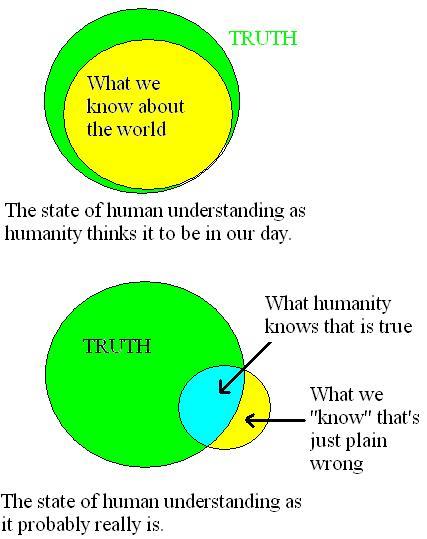
VennDiagram_WhatWeKnow

Socrates uses the method that today bears his name, i.e. the Socratic method, to challenge the arguments of Meletus, the prosecutor. The Socratic method uses questions as a device to lead the opposition to a conclusion based on premises they themselves state in the form of their answers. Socrates proposes that if it is he alone who is intentionally corrupting the youth, they would not come around–for no one prefers to be subjected to evil rather than good.

Socrates denies the suggestion that he does not believe in the gods, and in fact indicates that the very suggestion by virtue of the charges against him is a contradiction. What Socrates is guilty of is encouraging those who come around him to develop their own thoughts on god, and not to subordinate their thought to anyone–an idea the leaders found disconcerting.

Socrates goes on to say why he is unmoved by the death sentence. He wonders why it is thought he should beg and wail, when he doesn’t know for sure that an evil is being done against him.

The moral of the story is that those in power fear and will attempt to destroy advocates of free thinking.

This book should be read in conjunction with a couple other Platonic Dialogues, Crito and Phaedo.

View all my reviews

Wisdom in 5 Simple Lessons

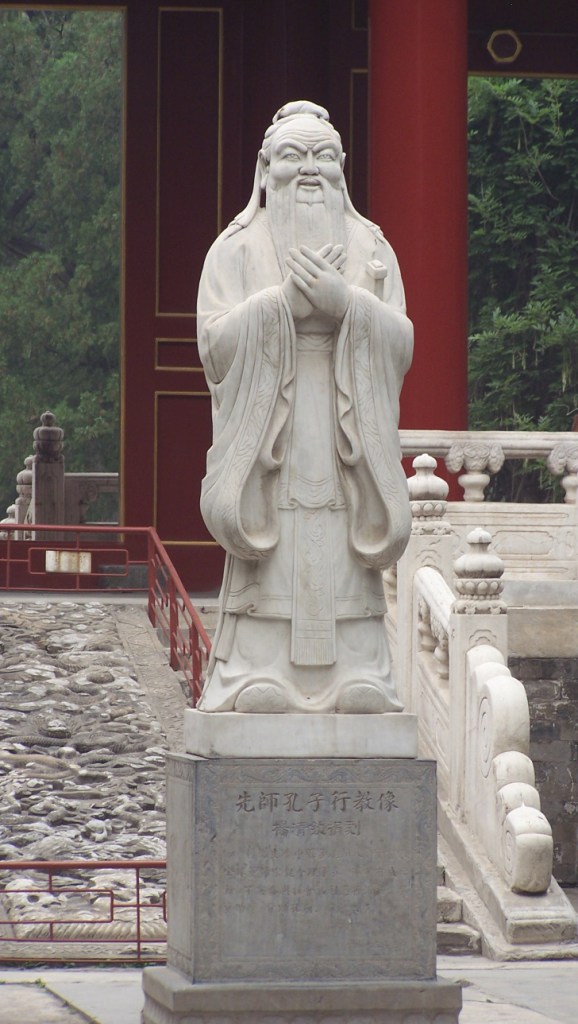
Confucius statue at the Confucian Temple, Beijing

Confucius statue at the Confucian Temple, Beijing

1.) Be kind, everyone you meet is fighting a hard battle –Plato

2.) If you choose, you are free; if you choose, you need blame no man.  –Epictetus

3.) …the greatest carver does the least cutting.  –Lao Tzu

4.) If it falls to your lot to be a street sweeper, sweep streets like Michelangelo painted pictures.  –Martin Luther King Jr

5.) A gentleman wishes to be slow to speak and quick to do.  –Confucius