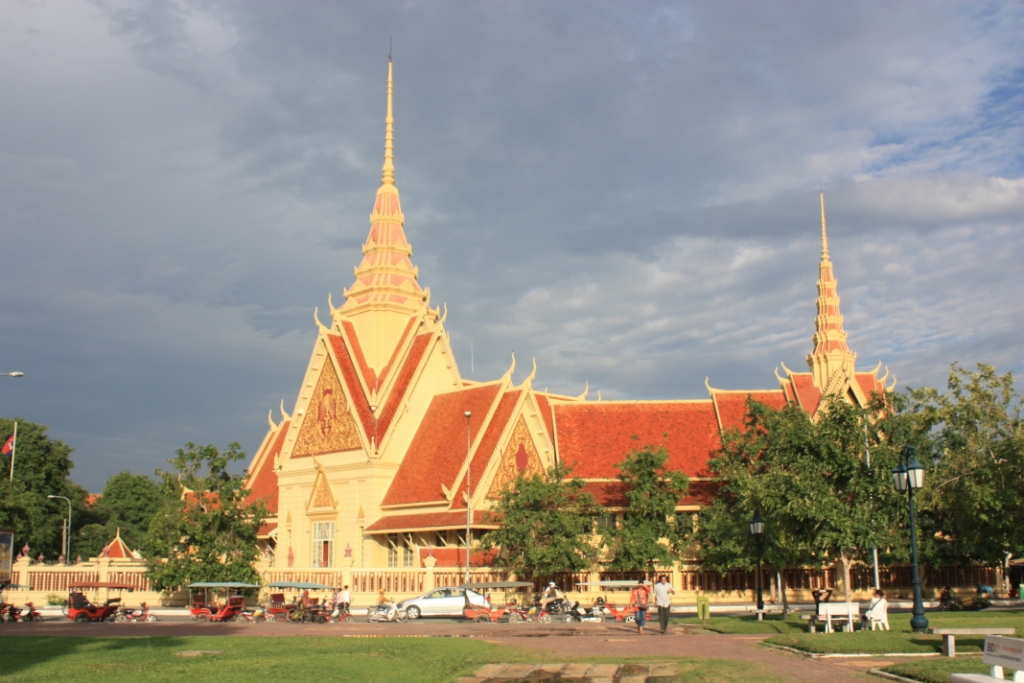
Supreme Court of Cambodia, Phnom Penh
Supreme Court of Cambodia, Phnom Penh

In the courtyard of the National Museum of Cambodia
The National Museum of Cambodia is picturesque. The collection is small and simple, but impressive in quality. For those of us who run out of “ooh” and “ahh” stamina after a few hundred artifacts, it’s just the right size. It’s also not stuffy in the usual way of museums– large barred windows are unshuttered while the museum is open. (This is probably less than ideal from both the perspective of security and artifact preservation, but it gives the place a certain ambiance, and maybe helped the exodus of the bats that took up residence during the museum’s dormant period)
It’s great to see what they’ve done with the place considering the state of disrepair it was said to be in after the Khmer Rouge period. With respect to my comment about it not being a large collection, it’s a wonder that any collection exists at all after the wave of lootings from the French through Vietnamese soldiers that took place in the country.
Be forewarned, once one is inside, one will be confronted by Buddhists from a monument preservation society seeking donations at about half a dozen different Buddhas around the museum. If you aren’t a Buddhist, this can be a bit of an annoyance. If you are a Buddhist, you may find their approach disconcertingly unBuddhist. They will try to press incense into one’s palm in order to corner one into paying homage to the Buddha so they can make some dough for their cause. However, they don’t follow one around once refused (as similar individuals have been known to do at Angkor.) It may be a great cause, but they’d probably do better if they restricted it to one per museum and not one per gallery, and just let people drop cash rather than insisting on the idol worship first. I’m nondenominationally happy-go-lucky myself, but I can imagine this being troublesome for some visitors. At any rate, it’s symptomatic of the country’s poverty and their inability to support their deity at the level to which he has apparently become accustomed.

Central Market
Phnom Penh’s Central Market is an art deco building that dates to the 1930’s. This “X”-shaped building has a circular, domed core. On the inside of the building one can find clothes, jewelry, sunglasses, and– sadly– ivory. Most of what you will find there is knock-offs, as should be apparent from the prices. The “V”-shaped spaces between the wings of the building are chock full of more mundane goods such as foodstuffs, hardware, and tourist T-shirts. In the market one can get anything from wriggling seafood to rice to produce (I’d recommend those with Western constitutions –cast-iron or not– stay away from the meat.) Refrigeration is not so common in Cambodia, a few places get large blocks of ice to put their meat on, but many just lay it out on cardboard until it sells.
 First They Killed My Father: A Daughter of Cambodia Remembers by Loung Ung
My rating: 5 of 5 stars
Warning: This is about as depressing a book as one can imagine reading. It is told from the author’s perspective as a child during the Khmer Rouge period of Cambodia’s history. Her father had been in the Lon Nol government, and this made life particularly perilous for their family. It follows the family from the day they are forced to leave their comfortable upper-middle-class existence in Phnom Penh through her move to the US. In between, you are shown what its like to be starving (literally), to be a child separated from one’s family, and to see a long string of man’s inhumanity to man.
While it is a sad story, it is well-written and candid.
I was often reminded about what Viktor Frankl wrote (much more eloquently than my paraphrase), that the sad fact that survivors have to live with is the knowledge that the best did not survive. The author tells of the actions that she was not proud of that she was driven to by starvation and life as an orphan.
I highly recommend this book, but be prepared to be sad.


 Tiger Riding for Beginners