
BOOK REVIEW: The Martian by Andy Weir

The MartianThe Martian by Andy Weir

My rating: 5 of 5 stars

Amazon page

If you like suspenseful science-fiction, humor, and are fascinated by science, you must read this book. I’m not kidding.

The premise is a simple cast-away story, except that it takes place on Mars—an environment in which a human can’t last for seconds without a lot of properly functioning technology. Astronaut Mark Watney is left for dead when a severe storm blows in, impaling him with a piece of metal, knocking out his vital statistics monitor, and blowing him into a drift. Having lost visual contact with Watney, showing no vital statistics, and facing the toppling of the crew’s escape vehicle by high winds, the mission commander decides that she can’t risk the lives of the entire crew to cart Watney’s body back home. The thing is; Watney isn’t dead.

The book is a rollercoaster ride of highs and lows associated with events that nearly kill Watney—either in an instant or by making his long-term survival impossible. The botanist / engineer must figure out how to survive for four years (until the next Mars mission is due—if it doesn’t get cancelled) with less than six months of supplies. (The mission was supposed to be one month but was aborted in the first week, but there were five other crew members whose rations were left behind.) If you think Tom Hanks had it bad in Cast Away, imagine having to produce food on Mars.

This book taps into the visceral feeling that works so well in the movie Gravity (but Weir does more homework on the science.) For tension, it’s hard to beat being adrift in space, utterly isolated from one’s species—or any species for that matter–and knowing you will die when your resources run out.

The main character, who is the only character for the first six chapters or so, is intensely likable. Mark Watney is funny, intelligent, self-deprecatingly humble, and can confidently problem solve in the midst of any crisis. If there’s a critique of the realism of this story (as sci-fi goes it is extremely realistic), it’s that Watney is preternaturally skilled at adapting to complete solitude. However, I don’t deduct for this, because if it showed him at the depths of despair that someone in his circumstance would inevitably go through, it wouldn’t be nearly as pleasing a book to read. If you’ve read a lot about sensory deprivation and / or what happens to prisoners over long stints in solitary confinement, I’d suspend the disbelief that might come from that knowledge and just accept that Watney is exceedingly good at saying, “Pity-party over. It’s time to make this work.” In short, humorous Watney is just a lot more fun to read than would be a despondent astronaut.

I think I’ve been clear that this is an outstanding book, and everyone should read it. I guess if you absolutely hate science (of any kind–because there’s botany, biology, physics, chemistry, engineering, etc. all rolled up into this book), you may find that it’s hard to stick with the glut of scientific / engineering discussions coming at you. Still, you shouldn’t hate science that much—what the hell is the matter with you. Weir writes in a readable style and the reader doesn’t get awash in minutiae. (For example, Watney even names the unit kilowatt-hour/sol [sol=a Mar’s day] the “Pirate-ninja” to make it more palatable and humorous.)

Read it. You’ll like it. Also, don’t wait because the movie is supposed to come out in the Fall.

View all my reviews

READING REPORT: January 23, 2015

If I were a kid today, I’d be diagnosed with ADD in a heartbeat. I rarely read one book straight through. However, I read a lot, and that means I switching from one book to the next–reading a chapter at a time. I do try to read no more than one book of a given type/genre at a time–often unsuccessfully, as you’ll see. With this in mind, I thought I’d experiment with a weekly post on what I’ve been reading that week.

Book-Review-The-Martian

Fiction: The novel that I’m currently reading is Andy Weir’s The Martian. This book is gripping. It’s considered to be one of the best–if not the best–science fiction works of 2014, although it was self-published in 2011. This is a great example of a book that couldn’t get published despite being spectacular, and which will now make a bazillion dollars. It also explains how a 2014 novel is set to have a big budget movie adaptation come out in late 2015. This book is like the movie Gravity set on Mars, except that it’s smarter.  It taps into that visceral fear of what it would be like to die alone in space–not in a flash but with time to know you are going to die. An unlikely, but plausible sounding, set of circumstances result in astronaut Mark Watney being left for dead on the surface of Mars. But, of course, he’s not dead. Watney has to be creative to figure out how to live for four years in hopes that the next manned Mars mission will go forward as planned. It’s a roller coaster ride between him thinking he will surely die and him coming up with clever solutions. If you are into science, it’s particularly intriguing. I’m about 20% of the way through.


Foreign Fiction: I’ve also continued to read a Hungarian novel called Quarantine in the Grand Hotel by Jenő Rejtő. This is a silly (in a good way) locked-door murder mystery. I picked it up in Hungary over the holidays, and will probably finish it in the next week or so. (I’m about 2/3rds of the way through, and it’s only a 160 page book.) It’s short, highly readable, and humorous.

I also read a chapter from The Mandala of Sherlock Holmes by Jamyang Norbu. A number of authors have picked up the mantle of Sherlock Holmes from Sir Arthur Conan Doyle.  (Not to mention TV shows and movies.) This book is published in India by a Tibetan author who imagines Sherlock Holmes traveled to India and Tibet after he was believed to have been killed (along with Professor Moriarty) in Switzerland. (Going over the falls as depicted in the second Sherlock Holmes movie featuring Robert Downey Jr.) There are three parts to the book: India, Tibet, and Beyond. I’m in the last couple chapters of the first part, most of which takes place in Bombay.


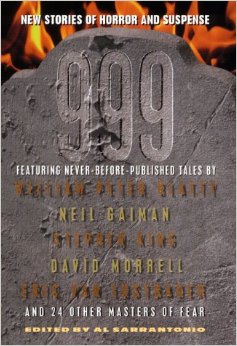
Short Stories: I’m about 85% of the way through 999: New Stories of Horror and Suspense. This is a collection of short fiction of horror / dark suspense. It features authors such as Joyce Carol Oates, Stephen King, Neil Gaiman, Eric Van Lustbader, and David Morrell.  All of the  works are short stories except for a novella/short novel by William Peter Batty. The novella is the last piece, and I’ve just started part II of it.

999_Horror&Suspense


Martial Arts: I just finished Dr. Anthony Catanese’s The Medical Care of the Judokabut I posted a review yesterday so I won’t get into that book. My next martial arts book will be The Pyjama Game by Mark Law, but I haven’t yet begun it.


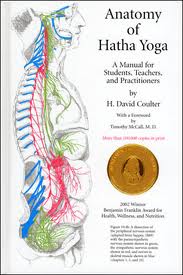
Yoga: I’ve been reading two books related to yoga this week. I just finished Chapter 2 of Coulter’s Anatomy of Hatha Yoga. This chapter dealt with the anatomy and physiology of breathing. This book is an excellent resource for yoga teachers, but it’s pretty dense–which may explain why I’m only on Chapter 3. Not only does the chapter give general information on respiration, it also provides information specific to various yogic breathing methods such as abdominal, yogic, thoracic, paradoxical, and diaphragmatic.

The second yoga book I’m reading is Singleton’s Yoga Body, which is a history of yoga postural practice (asana practice). This book presents a controversial thesis, which is that postural practice (asana) wasn’t really a part of mainstream yoga until quite recently, and that it’s as much a product of what happened in the Western world in the early 20th century as it is a result of Indian yogic traditions–if not more. Having finished the first three chapters (about 30% through), I’m not sure whether I buy his argument or not. He has some documentary evidence on his side, but I know there is also a proclivity to equate the current era in which everybody documents laundry day with the past in which many people were much more secretive. It’s also often not true that the most vocal are not the mainstream. He may be correct, but he has yet to wow me. (Part of his argument is people like Max Muller and HP Blavatsky found hatha yoga [the style which most emphasizes posture] to be the domain of conmen and beggars.)


AnatomyHathaYoga_CoulterYogaBody_Singleton


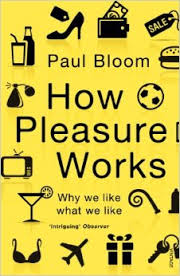
Miscellaneous Nonfiction: I’ve got about 70 more pages to finish in a book called How Pleasure Works by Paul Bloom. As the title implies, this book is about the science of why people get pleasure from various things from food to sex to freaky sex to art to music, etc. The primary thesis is that there are hidden essences that are the source of pleasure. The chapter I just finished talked about an interesting study in which violinist extraordinaire Joshua Bell went into a subway station and played his $3.5million violin, and barely netted $30–even though there were people passing him who’d paid $200 to hear him in his tuxedo at a concert hall later that evening. The chapter also talked about art forgeries, and how some art is valuable when it’s associated with a famous painter and worthless when it’s a forgery by a presumably equally skilled forger (I say equally skilled because these individuals have been able to pass their work off to experts as a painting by a famous artist. In some cases, they weren’t forgeries but rather originals in the style of the famous artist and submitted as an unknown work found in a basement somewhere.)

HowPleasureWorks


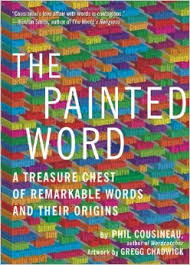
I also finished the letter “B” in the book The Painted Word  by Phil Cousineau. This book is organized like a dictionary, except that it only contains certain English language words that the author finds particularly intriguing, and it gives background on usage and how the meanings have migrated. If you love language, you’ll find this book much less painfully boring than I have made it sound.

Painted Word


That completes the books I’ve been reading over the past week. I did purchase two books this week, but they’re far down the queue to be read. One is the graphic novel The League of Extraordinary Gentleman by Alan Moore, and the other is Right Ho, Jeeves by P.G. Wodehouse.