BOOK REVIEW: All’s Well That Ends Well by William Shakespeare

All's Well That Ends WellAll’s Well That Ends Well by William Shakespeare
My rating: 5 of 5 stars

Amazon page


This play, like “Measure for Measure,” is one of Shakespeare’s “problem plays” – not consistently light-hearted enough to comfortably be called a comedy, but lacking the body count of a tragedy.

Helena loves Bertram, but he’s a Count and she’s the daughter of a deceased physician (a doctor who, while he was of great renown for his skill, wouldn’t be considered to be in a high-status career in those times.) Despite the fact that Helena is beloved by just about everyone – including Bertram’s mother, who became her guardian upon her father’s death – the relationship could never work… under ordinary circumstances. But those circumstances change when Helena saves the life of a dying King of France using her father’s proprietary medicines and methods. The grateful King removes [almost] all roadblocks to the marriage by allowing the wedding between a commoner and an aristocrat, providing Helena the wealth for a substantial dowry, and putting the squeeze on Bertram by telling the Count that if he loved his King he’d agree to allow the King to preserve his royal honor by rewarding Helena with all she truly wants.

The one roadblock the King can’t remove is Bertram’s feeling that he is too good for Helena because he’s a Count and she’s a nobody. The couple is married, but before the marriage can be consummated, Bertram slinks off to Italy under the pretext of fighting a war. He sends Helena back to his home where he thinks his mother will support him by making life hell for her new daughter in-law, but – joke is on him – his mother thinks that he’s being a jerk and she gives Helena a warm reception. Bertram forwards a note to Helena that unless she can get the ring off his finger and a baby is in her womb sprung from his loins, she shouldn’t really consider them married. Again the joke is on him, because Helena is the smartest person in the play and she develops a clever plot (that in part is similar to the “Measure for Measure” ploy) that is designed to meet the “impossible” requirements of Bertram, as well get the Count back to France where his failure to behave as a husband will be taken as a slap in the face to the King.

Of course “All’s Well That Ends Well” is worth reading. It’s Shakespeare. But I will say that I found “Measure for Measure” to be a better story. The major hurdle in this play is in accepting that Helena remains so stuck on Bertram, despite the fact that he’s portrayed as a jerk. Bertram does conduct himself admirably in war, but the “the heart wants what the heart wants” rationale is all we really get by way of explanation. It’s not clear whether Helena’s plot is playing out from the time she runs away from the Countess’s place, or whether she legitimately runs away to be a nun, but exploits a target of opportunity. Either way, there’s some deus ex machina to that part of the play. Also, her stock drops as we see the elaborate length she’ll go to in order to get her man.

I’d recommend this play, but if you can only do so much Shakespeare and haven’t read “Measure for Measure” yet, I’d recommend that one over this.

View all my reviews

BOOK REVIEW: Letters Written and Not Sent by William Louis-Dreyfus

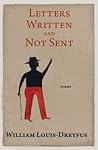
Letters Written and Not SentLetters Written and Not Sent by William Louis-Dreyfus
My rating: 5 of 5 stars

Amazon page


This collection consists of about 55 poems, mostly of the short-form free verse variety. The author passed away between completion and publication of the volume. He was that rarest of creatures, a rich poet. (Though he was not an impossible creature – i.e. he didn’t become a billionaire by writing poetry. It was his side gig between trading in commodities.)

One of the poems toward the end of the book, “How to keep from being devoured,” changed my attitude toward the book. Up until that poem, I found the collection to be just okay. It was alright, but didn’t feel like anything special. However, that one poem made its mark on me, and I suspect other readers will find their own favorites among the collection. The poems are finely crafted. The fact that this one short volume is billed as the man’s “lifetime work” suggests that he focused on quality rather than quantity of verse.

I found a gem among a body well-composed poetic works, and I’m pleased I took the time to read this collection.

View all my reviews

BOOK REVIEW: Measure for Measure by William Shakespeare

Measure for MeasureMeasure for Measure by William Shakespeare
My rating: 5 of 5 stars

Amazon page


“Measure for Measure” was originally grouped as one of Shakespeare’s comedies (back when there were just three categories: tragedy, comedy, and history,) but more recently it’s been reclassified as one of the three “problem plays” of Shakespeare. Problem plays are neither clearly comedy nor clearly tragedy, but mix elements of both.

Vincentio, the Duke of Vienna, is taking a mysterious trip, and he’s left his deputy, Angelo, in charge. Angelo is a stickler for the law (or, at least, appears to be at first) and one of his first official acts is to sign a death sentence on Claudio. Claudio is a young man who knocked up his girlfriend. While the law calls for death, everyone advises Angelo that the details of the case don’t merit such a sentence. Those details being that the young woman, Juliet, is in love with Claudio, consensually partook of sexual intercourse, and both she and he are eager to marry so that the child will not be born out of wedlock. Angelo is unmoved by petitions from just about everyone to let Claudio live as long as he weds Juliet. When Claudio’s sister, Isabella, who heard the news in the convent where she is a postulant [in training to be a nun, but not yet one,] comes before Angelo seeking leniency for her brother, Angelo’s tune slowly changes, and he betrays himself as the worst form of hypocrite. If Juliet will “consent” [used loosely] to Angelo taking her virginity, he’ll let Claudio go. Obviously, Juliet isn’t at all keen on this arrangement, being a nun wanna-be and having the strict moral values one might expect of one who’s chosen such a life. She goes off preparing to tell her brother that he must die because the only way out is for her to sex up Angelo. Isabella fully expects Claudio will accept this, but Claudio has a moment of weakness in which he shares his terror of death and requests Juliet do the deed with Angelo. However, she won’t do it.

At this point, things look grim for Claudio, but we find out that the Duke is pulling a Henry V, and (far from visiting foreign lands to unknown purpose) is making his way in disguise through Vienna, learning what happens in his absence. The Duke [pretending to be a friar] has various meetings with Isabella, Claudio, the Provost (a warden), and others. The Duke-turned-friar hatches a plot that hinges on a piece of inside information that he holds.

It turns out that the sight of lovely Isabella wasn’t the first cause of Angelo being a jerk, there was a previous incident. Angelo was once betrothed to a woman, but before they could wed the woman’s fortunes changed when a storm sank the boat carrying wealth that included her dowry. Lacking a dowry, Angelo kicked the woman to the curb where she ended up turning tricks in a Viennese brothel because for fortune had sunk — literally.

The Duke / friar’s plan is that Isabella go to Angelo and say that she agrees to his despicable propositions, and that she will do the vile deed on the condition that it be someplace pitch dark so that her lady bits can remain unseen and so she won’t throw up in the lousy face of her rapist. She also insists she be able to bring a servant to the place in question. The plan revolves around getting the wronged ex-fiancé turned prostitute to agree to pull a switch-a-roo, with her engaging in intercourse in the dark with Angelo instead of the virgin Isabella doing so. Angelo having committed the same offense as the man he signed a death warrant for will have to either change his order regarding Claudio or submit himself to the same punishment.

One can see why this play is not easily classified. It contains a lot of dark subject matter. However, it does have numerous lighthearted moments of humor, including Lucio badmouthing the Duke (to the Duke’s friar-disguised face) and the servant of a local brothel’s Madame, Pompey, becoming an assistant to the executioner. As in comedies, everything works out more or less happily for all parties.

I was gripped by this play. It’s among my favorites of the Shakespearean comedies. It has an intense storyline and some fascinating moral conundrums. The Duke works his plot such that more than one character must confront a moral dilemma and choose whether to be a better version of him-, or herself. This is definitely worth reading.

View all my reviews

BOOK REVIEW: Why Dylan Matters by Richard F. Thomas

Why Dylan MattersWhy Dylan Matters by Richard F Thomas
My rating: 4 of 5 stars

Amazon page


Obviously, in the annals of popular music, the work of Bob Dylan matters. To make sense of the title and related objective of this book (which might otherwise seem presumptuous and demeaning) one has to know a little about some recent history of the politics of the Nobel Prize for Literature. (No, not the internal scandal that delayed the issuance of the 2018 Prize to 2019.) In 2016, an American hadn’t won since 1993 (Toni Morrison,) and given the relative volume of publications from America this was coming to be seen as a major “screw you” to the nation’s literary community. The Nobel committee claimed it was because American authors didn’t get their works translated and were too insular with respect to the global literary community. Still, the disparity was on the minds of many. Then, Bob Dylan was issued the Prize. While some who were offended by this disparity were placated, many thought it was an even bigger “screw you” than if the Committee again hadn’t issued it to an American – like it was a “you asked for it, you got it; now shut up for at least the next 15 years!” kind of award. I doubt anyone would deny that, as a pop music lyricist, Bob Dylan is brilliant – if not the best — but for many that still just made him a middling poet. (Dylan wrote one piece of prose poetry, “Tarantula” as well as “memoirs” [that were apparently largely an act of creative writing,] but only his lyrics could feasibly merit issue of the award.)

It was with that mess in mind that Thomas delivers this book. It seems to be his objective to not just prove that Dylan matters — generally speaking — but that Dylan’s work matters as literature – presumably, such that he’s at least as deserving of the Nobel Prize as any living American poet, story-writer, or novelist. The thrust of Thomas’s approach is in showing that Dylan’s work is dialed into the global literary canon. As a classicist, Thomas puts particular emphasis on Dylan’s stealing from, and referencing of, Greek and Roman figures like Homer and Ovid. (I mean “stealing” only in the sense that word used by artists, and there is considerable discussion of that subject, herein.) However, he does also show how Dylan uses and references other poets from Shakespeare to an obscure Confederate poet.

So, the logical question is whether Thomas answers his book’s titular question with enough authority to convince the reader that Dylan does matter. Thomas certainly convinces us why Dylan matters enough to have classes taught about him, like the one Thomas teaches a Harvard. However, I can’t say that I was convinced that Dylan is on-par with… for instance, Cormac McCarthy or Salman Rushdie (who resides in the US, as I understand it) as a major literary figure. While Thomas does show that Dylan’s work is literature because Dylan’s work is wrapped up in literature, the only real argument he offers for whether Dylan is at the highest echelon of literature is his intense fan-boy devotion. We see a lot of comments like: “He had all that he needed to write ‘Masters of War,’ the greatest anti-war song ever written.” Not “one of the best,” not “the best, in my opinion,” not “the best rock-n-roll anti-war song,” but a gratuitous presumption that nothing else could be considered in the running enough for there to be a debate. Thomas’s enthusiasm that Dylan is among the biggest artistic geniuses of our time – if not all time – is certainly potent, but not necessarily compelling.

The book is annotated, has a bibliography and a graphic discography.

I enjoyed this book. I learned a lot about the works of Bob Dylan and I found the author’s fervor for Dylan’s songs contagious — if not altogether convincing that it merits Dylan’s inclusion with Hemingway and Faulkner as an American literary icon. [Though I would not in the least challenge his inclusion as an icon of folk, rock, or pop music.] If you’re interested in Dylan, or this question of whether he’s the best American for the job of Literary Nobel Laureate, this book is worth a read.

View all my reviews

BOOK REVIEW: Three Tang Dynasty Poets by Wang Wei, Li Po, and Tu Fu

Three Tang Dynasty PoetsThree Tang Dynasty Poets by Wang Wei
My rating: 5 of 5 stars

Amazon page


This book is in a series put out by Penguin Books entitled “Little Black Classics.” As the series name implies, these are booklets featuring classic works (or fragments, thereof.) This book features a combined 33 poems by three Chinese poets who lived in the eight century.

In the 14 poems by Wang Wei (a.k.a. Wang Youcheng) we see his famed mastery of landscape and nature poems, and we feel the effect of his Cha’an (Zen) Buddhist mindset.

Among the ten poems by Li Po (a.k.a. Li Bai) we are introduced from the beginning to the poet’s legendary proclivity for drink. While it’s not all carousing, human characters do play a more central role in Li Po’s work.
There are nine poems by Tu Fu (or, Du Fu), which share Li Po’s inclination to feature humanity at the heart of each poem, if in a more straight-laced way.

I enjoyed the poems in both their imagery and sound quality. I can’t really speak to how skilled the translation was, i.e. how much better or worse they could have been. The translators were G.W. Robinson and Arthur Cooper, who I know nothing of, but who apparently both translated a considerable amount of classic Chinese literature.

The poems are almost all short form works, so – with one exception – the poems are included in their entirety (i.e. not excerpted.)

The booklet has an appendix that features a two-page prose story entitled “The Story of the Peach Blossom Spring” by Tao Yuanming. The reason for including the story is that it’s the inspiration for the Wang Wei poem that opens the volume.

I enjoyed reading this little booklet of poetry. The translations are easy to follow, and the imagery is appealing. The Zen / Taoist feel that is widespread in these works is pleasant.

View all my reviews

BOOK REVIEW: The Hidden Girl and Other Stories by Ken Liu

The Hidden Girl and Other StoriesThe Hidden Girl and Other Stories by Ken Liu
My rating: 5 of 5 stars

Amazon page

Out: February 25, 2020


This smart collection of speculative short stories by Ken Liu is mostly science fiction, but includes a few works of fantasy (including the titular story, which is what one might call “martial arts-fantasy” – i.e. imagine “Crouching Tiger, Hidden Dragon” with more magic.) Depending how one counts up the stories, one could call the collection nineteen stories or sixteen stories and a novella. The novella, broken into three parts, is “storified” enough that its sections are interspersed among the other stories.

Liu doesn’t neatly contain his stories within boundaries of genre. In some cases, he jumps through time — including historical fiction, contemporary / near future, and distant future within a single story. He also takes on social issues like the Japanese internment during World War II in “Maxwell’s Demon” and the blight of technology on social interaction (best shown in “Thoughts and Prayers.”) There are hard sci-fi stories that show intergalactic travelers in a distant future, such as “The Message,” but there are even more that peer into the worries of the near future, such as artificial intelligence or the replicating of human consciousness in computers.

The novella imagines a world in which companies have captured the consciousnesses of great, but dying, minds for their own purposes. It then explores considerations such as: what happens when a great mind gets tired of being trapped as an acorporeal intelligence for the benefit of a company, and what does humanity mean in the context of fully replicated human minds?

I found these stories to be both intriguing and thought-provoking. I enjoy a good story, but stories that make one think deeply hold that much more allure. I’d highly recommend this collection for fiction readers. Whether or not you read genre fiction, you’ll find stories of great appeal.

View all my reviews

BOOK REVIEW: Hogg by Samuel R. Delany

HoggHogg by Samuel R. Delany
My rating: 4 of 5 stars

Amazon page


If you’re familiar with Samuel R. Delany, it’s probably as a writer of science-fiction. His most famous works are “Dhalgren” and “Babel-17.” However, this book isn’t science-fiction, and I’m not sure that there is a consensus term for the particular genre that would categorize it. Astute readers will point out that it’s described as “erotica” right on the cover. But, in as much as erotica is a genre whose dominant intention is to evoke feelings of arousal, I’m not sure the majority of people would classify it that way (though I have no doubt there is a fetish community that would.) This isn’t to say that the book isn’t loaded with sexual activity. It is, across virtually every page, but the way those acts are presented — I suspect — will be found more cringe-inducing than arousing to the average reader. I’m specifically talking about the extreme unhygienic behavior that takes place throughout this book – much of which is tied up in sexual activity, but not all of it. Let it be known that I’m not commenting on the nature of the sexual activity, which is pansexual. I’m not even talking about the moral disgust of the fact that most of the scenes in which a woman is present involve rape of a particularly vicious nature, and that child molestation takes place throughout. By the same token, horror isn’t a good classifier either, though the book does have many horrifying scenes, and might best be categorized by a type of horror subgenre. If horror is a genre designed to evoke fear, “Hogg” is a book designed to evoke disgust – and it does so with great success. So, the first thing a reader should be aware of before taking on this book is that you may throw up in your mouth at one or more points during the reading of it.

So strong is aversion to disgust that probably most readers will have given up on this review by now and given up any intention of reading the book. Those who are still here, however, may want to know whether the book has redeeming qualities. The answer is: Yes. It has a smart story, psychological intrigue, and skillful use of language (even if much of that skill is directed at making one physically queasy.) While “Hogg” is often painful to read, it is adroit storytelling.

The book tells the story of the unnamed narrator, a boy who is known throughout only by a slang term for “giver of fellatio.” The narrator spends much of the book in service to the titular character, Hogg. Hogg is about as loathsome a character as one can imagine, and he needs the extra “g” because to call him a hog wouldn’t be an insult to swine. He exercises little control over where he urinates and defecates, and prides himself in unhygienic behavior. His job is contract work, but instead of murder he rapes and beats women who’ve run afoul of despicable and cowardly men. The lead character seems to be motivated by a need to please and / or capture the attention of an individual who has no capacity for human connection. The psychotic Hogg seems perfect target for such “affections,” and that’s why after bouncing from master to master, the narrator ends up with Hogg for such a time.

One of the most psychologically interesting elements of the book is its depiction of the bizarro morality of individuals who have an anarchic mindset. At one point, Hogg decides that he can’t tolerate a customer who insists on explaining his reason for hiring Hogg and his crew. In Hogg’s mind, the fact that the man can come up with a reason for the horrific act, other than the pure bliss of it, indicates that the man is crazy and will ultimately feel guilty and be the ruin of them all.

The story is swept along through its climax and resolution when Hogg’s most junior crew member (not counting the narrator who is only along for the ride) goes on a killing spree after an ill-advised penis-piercing. The reader never learns for certain whether this individual just lost his mind as a result of being drawn into Hogg’s world, if it was toxicity from the rusty metal he was pierced with, or some combination of both. However, we know from his chronic, public masturbation that he was never completely right in the head to begin with.

This book is not for everybody. Reading it is almost an act of courage and discipline. As a piece of literature, it’s intense and thought-provoking, but if you find any of the following intolerable to read about, you’ll not get through it: child molestation, rape, violence, the n-word, or coprophilia.

View all my reviews

BOOK REVIEW: The Wild Boys by William S. Burroughs

The Wild BoysThe Wild Boys by William S. Burroughs
My rating: 4 of 5 stars

Amazon page


This is a work of the Beat novelist best known for “The Naked Lunch.” It’s one of those dystopian novels (like “1984”) that makes for a strange read because the date of the hugely transformed world which it envisions has come and gone with nothing close to it so far. [To be fair, it was written in the late 60’s, first published in the early 70’s, and imagines the world in 1988, but – also – I don’t think this is meant to be our universe.] The world it imagines is one in which hedonistically homoerotic gangs of young men are taking over the world, literally. When they aren’t engaged with staggering amounts of masturbation and intercourse, these “Wild Boys” are a force to be reckoned with because of their penchant for violence and mind-altering drugs.

As I’ve heard said of other works by Burroughs, his drug-fueled writing creates a work that has flashes of brilliance but also tracks where it’s not at all clear where the book is going — if anywhere. Some of the language is poetic and the description fascinating in its surreal psychedelicness. On the other hand, it also manages to make ostensibly thrilling subjects like sex and violence tedious both by dragging along with them till a rut forms and by offering the reader indistinct characters. When I’d gotten to the end, I thought it interesting that there were no named characters, but when I flipped through I saw that there were several recurring named characters, they just didn’t develop any life of their own. Certainly, all the wild boys seem like sex-driven versions of the Borg from “Star Trek” – meaning they are indistinguishable because they have the same motive (in the case of the wild boys: 90% sexual release / 10% fight) and they all behave identically. A number of the other characters are similarly boxed caricatures, e.g. the righteous and naïve military officer.

About two-thirds or three-fourths of the way through, the book has an interesting and comedic sequence in which we find out that America intends to save the day and rid the world of these packs of “deviants.” There is support among local communities from Mexico to Marrakesh — as one would expect from normal people tired of roving gangs of jock-strap covered, knife-wielding youths taking over their cities. At any rate, this seems to be a metaphor for the Vietnam War. We have these high-ranking officers who are under the impression that their technological and resource superiority – but especially their moral superiority – will grant them a quick victory over the primitive and morally bankrupt enemy. As with Vietnam, they are proven wrong.

This is a bizarre book and kind of hard to rate. It begins with an intriguing start in Mexico, but I’m not sure where that line went. It has a long period of drag that reminded me of Sade’s “120 Days of Sodom” in that it just becomes so bogged down in hedonism that it manages to make it tiresome. Then this battle line opens up, and that is fascinating and amusing.

As for recommendations, I imagine there is the widest possible set of views on this book, from those who despise it to those who find it to be a masterpiece of a novel. Hopefully, I’ve presented enough for you to make up your own mind about which class you are likely to fall into.

View all my reviews

BOOK REVIEW: Foamy Sky by Miklós Radnóti


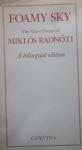
Foamy Sky the Major Poems of Miklos Radnoti A Bilingual Edition by Miklós Radnóti
My rating: 5 of 5 stars

Amazon page


The short life of Miklós Radnóti was bookended by tragedy, and in the years between he wrote some of the most hauntingly beautiful – if morose – poetry of the twentieth century. The event of his birth was marked by the death of both his mother and his twin, and he died in northwestern Hungary on the route of a forced march from the copper mine in Serbia where he labored toward a Nazi concentration camp that he never reached.

One might say of these bookends to a life that only the former event, his traumatic birth, could have left a mark on his poetry, and you’d probably be right. As a rational skeptic, I’m not a big believer in precognition. However, some of Radnóti’s poetry (e.g. “Just Walk On, Condemned to Die” / “Járkálj csak, halálraítélt!” [written eight years before his death, before the War began]) is as potent an argument for prevision as exists. Yes, it’s probably true that if one writes as much about death as did Radnóti, one is bound to seem prescient about one’s own death, but when one’s words are magic enough to make a skeptic consider the possibility, that’s a powerful testament.

The book contains about eighty poems. I could talk about a selection from across the collection that are among my personal favorites, but they are all great works. The more meaningful distinction to point out is that the last ten poems in the book (four of which are collectively labeled as “Razglednicas”) are Radnóti’s final ten poems and they arose from a grave, having been buried in his coat pocket. When his body was exhumed, the poems were discovered written in an address book in his pocket.

As the poems were all written in Hungarian, the natural question is how good is the translation. After all, poetry translation is a bit like trying to put a queen-size sheet on a king-size mattress (where the corners are: metering / arrangement, sound (e.g. rhyme, alliteration, etc.), imagery, and emotional content / message.) The more that one insists on perfectly capturing one corner, the more the other ends of the sheet curl up. Getting the sheet to hold on each corner takes skill and selective compromise. I think the duo of translators from the University of Texas, Dallas did a tremendous job. The team included one person with expertise in Hungarian, English, and translation, Zsuzsanna Ozsváth, and one with expertise in poetry and poetic form, Frederick Turner. Both of these individuals contributed some prose to the book, Ozsváth wrote the Introduction and Turner offered a Translator’s Epilogue. The latter presents some insight into how the two went about trying to achieve the best translation possible. Meter and rhyme schemes were not sacrificed as they often might be in a modern translation.

One nice feature of the Corvina edition of this book is that it is bilingual with the English on the page opposed the original Hungarian. My (almost non-existent) Hungarian is far too sparse for the task of reading poetry. However, I was able to take in at least the sound quality of Radnóti’s original, and given that he wrote in metered verse, this is not inconsequential.

This is a fantastic collection and I would recommend it for all poetry readers – even if you can only read the English editions, you’ll be moved by these poems.

View all my reviews

POEM: Kurtz & Marlow of the Mind

Everyone has a darkness to navigate.

I chased my Kurtz into the river’s savage tracts  —

steamboat long since left behind —

portaging to lands above the cataract ledge.

You’ve heard it said, “You are every character in your dream?”

That thought flickered into my awareness

just as I realized I felt as much Kurtz as Marlow.

My sole consolation was that my Kurtz was dying.

And since I felt that one man can’t die two deaths —

[wishful thoughts of legacy be damned]

I felt my Marlow would outlive my Kurtz.

But when Kurtz-of-Dreamland sucked his last breath,

he didn’t stick to script with “The Horror! The Horror!”

Instead, he said, “Box my bones up for the elephants.”

Which seemed as nice as remembering his fiancée’s name —

as far as I was concerned.