BOOK REVIEW: Neverwhere by Neil Gaiman

NeverwhereNeverwhere by Neil Gaiman

My rating: 5 of 5 stars

Amazon page

Neverwhere taps into a reader’s imagination and the fantasy that beyond closed doors and locked grates, beyond the prying eyes of common men, lies something magical—not just the mundane sewers and conduits our rational mind tells us exist there. This magical world is “London Below,” and–to a lesser extent–rooftop London. It’s a world that exists below the workaday London that we know. It’s a London of angels and cutthroats, witches and warriors. It’s a London trapped in time, but unconstrained by the laws of physics or men as we know them.

The lead character is Richard Mayhew, a perfectly normal resident of London Above. He has a fine—if boring—job in the business world, and a fiancé isn’t right for him, but who he believes is close enough for an imperfect world by virtue of her being pretty, smart, and capable.

Mayhew is living an ordinary and comfortable life until he and his girlfriend come across an injured young woman on the street. While his fiancé, Jessica, steps over the girl because the couple are on their way to meet Jessica’s VIP boss, Richard refuses to leave the girl. The injured girl is a resident of London Below, and had collapsed to the sidewalk after escaping from the two London Below master assassins who killed her family. It turns out the girl, Door, is from a family whose magical gift is the ability to open doors—even doors that are locked, sealed, or that no one even recognizes the existence of. As no good deed goes unpunished, Richard’s assistance of Door pulls him into the world of London Below, and he soon finds that he’s almost invisible to the residents of London Above and that he’s been forgotten by Jessica, his friends, and his coworkers.

The rest of the book is a hero’s quest in which Door is trying to discover who ordered the assassination of her family and why, and Richard is trying to find out whether (and, if so, how) he can get back his life in London Above. Because the fates of Richard and Door are intertwined, they travel together along with a bodyguard named Hunter and a Marquis / conman in the debt of Door’s father named the Marquis de Carabas.

I enjoyed this book immensely. It’s highly readable and the reader will be drawn to the fate of the characters. It has that page-turner quality. I’d highly recommend this book for anyone who reads fantasy / speculative fiction–or who doesn’t but is willing to give it a try.

Neil Gaiman is, as always, the master storyteller. When the story calls for humor, it is genuinely funny. When it’s time to be scary, it creates shivers. The storytelling was good enough that I was willing to overlook an ending that—in less capable hands—would have felt flat and too easy.

I didn’t realize that Neverwhere was based on a BBC miniseries. In other words, for a change the book is based on the movie rather than the other way round. However, the book does concisely but vividly portray setting—a task that one might imagine being easier having gone in this developmental direction. And, of course, setting is extremely important in this book. The distinct feel of London Below, London Above, and Rooftop London must be conveyed.

Here is a link to a piece of said BBC miniseries:

View all my reviews

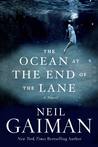
BOOK REVIEW: The Ocean at the End of the Lane by Neil Gaiman

The Ocean at the End of the LaneThe Ocean at the End of the Lane by Neil Gaiman

My rating: 4 of 5 stars

Amazon page

As the title suggests, The Ocean at the End of the Lane takes place in a world in which the supernatural and spectacular lay camouflaged amid the most mundane of settings. The story is about a boy’s interaction with a tri-generational household of women who I’ll—controversially—call “good witches.” The characters explicitly gainsay the title of “witch,” but for lack of any better term with which to describe these ladies other than “a trio of females with supernatural abilities and benevolent purpose,” I’ll call them good witches.

In particular the boy befriends the youngest good witch, a girl who physically appears not much older than he, but whom he comes to realize seems much older. It’s the girl who refers to the pond on her family homestead as the “Ocean.” The girl introduces the unnamed boyish male lead to a supernatural parallel universe, but—in doing so—unwittingly gets the boy tangled up in peril. The boy tracks a portal into his world through which a malevolent creature can slip through. The shape-shifting creature becomes his nanny. However, he is the only one in his family who can recognize the creature’s true nature, and it will do anything to keep the boy from ruining its new gig.

The good witches become the boy’s protectors, and powerful protectors they are. But they aren’t omnipotent, and the forces arrayed against them are formidable as well. Among the morals of the story are that the more powerful enemy of one’s enemy is not only not necessarily one’s friend, but may spell one’s doom. The book also speaks to the rashness of youth running headlong into trouble, and the value of wisdom and experience to find solutions.

This book is short and highly readable. It’s appropriate for young adult readers, but can be enjoyed by adult readers as well. The ending is slightly too deus ex machina for my taste, but overall it’s an intriguing book.

View all my reviews

BOOK REVIEW: The Color of Magic by Terry Prachett

The Color of Magic (Discworld, #1)The Color of Magic by Terry Pratchett

My rating: 3 of 5 stars

Amazon page
The Color of Magic is a hero’s journey tale done in comedic fashion. It’s the first book in Prachett’s disc world series. An incompetent wizard, Rincewind, becomes the guide to a goofy but wealthy tourist named Twoflower. However, as it happens the events that confront these two on their journey are part of a game being played between gods. I loved the humor, liked the story, but wasn’t a fan of the organization of the book.

I should admit up front that fantasy is–hands down–my least favorite genre, and I can’t say that view didn’t jaundice my perception of this book. However, it’s a testament to Pratchett’s humor and readability that I continued reading it.

What is my beef with fantasy in general? First, once one introduces magic, how does one maintain tension in an environment in which anything can happen effortlessly? Obviously, fantasy fans find plenty of tension to keep them reading, but I just don’t get it personally. I know that one retort is that the same could be said of other speculative fiction genres. To the degree that is true, I also don’t care for those other genres so much either. However, sci-fi (for example) has a basis for constraints that can be widely agreed upon. Second, the appeal of feudal society for setting perplexes me. I guess there is a certain romance to these periods for fans (perhaps because they imagine themselves in the statistically-unlikely role of king or knight as opposed to the much more likely position of serfdom, but whatever), but I see this type of society as backward and unsustainable (a ten millennia old kingdom maybe possible in a world of magic, but not in a world as we know it.)

I know fantasy fans will be able to come up with examples of how their favorite authors avoid both of the pet peeves mentioned. In truth, Pratchett does a good job of negating these pitfalls. With respect to the magic problem, he makes the protagonist wizard really inept and, therefore, easily in situations over his head. Simply put, he makes his lead weak relative to those confronting him. With respect to the setting issue, Pratchett creates an entirely different kind of world, the disc world. This is not Charlemagne’s Europe with wizards.

Prachett is often compared to Douglas Adams. In fact, if you Google “the Douglas Adams of fantasy,” you are sure to pull sites pertaining to Pratchett. One can see the same type of absurdist humor in Prachett’s work. Here’s a compilation of a few of my favorite lines:

“Being Ymor’s right-hand man was like being gently flogged to death with scented bootlaces.”

“No, what he didn’t like about heroes was that they were usually suicidally gloomy when sober and homicidally insane when drunk.”

“Yah. I outnumber you one to two.”

“He wondered what kind of life it would be, having to keep swimming all the time to stay exactly in the same place. Pretty similar to his own, he decided.”

“But the captain had long ago decided that he would, on the whole, prefer to achieve immortality by not dying.”

“Your affected air of craven cowardness does not fool me.”

Pratchett appeals to the downtrodden in all of us. This can best be gleaned from the tale of Goldeneyes Silverhand Dactylos. Dactylos is a superb craftsman who is blinded, has his hand cut off, and suffers ever greater indignities because the Emir wants him to never again produce anything as lovely. It’s like the myth about Shah Jahan having the hands cut off Taj Mahal craftsman, except Pratchett’s Emir keeps asking the same man of increasing handicaps back to construct ever greater marvels of engineering.

The book is arranged in just four chapters. This is a bit of an oddity for commercial fiction, and I don’t really care for the sparse employment of breaking points in this book. Again, if I was enough of a fan of fantasy to read this in a single sitting (or even a few sittings) I would likely not find this to be an issue. However, I read it over time and interspersed with many other books (a lot of which were more captivating to me personally.) This might seem like a ridiculously nit-picky point, but for those of us who have a lot of reading up in the air at once, being able to readily put a book down and pick it up seamlessly later without losing the story is of great benefit.

If you like humor, this book will appeal to you. If you like fantasy, I suspect you’ll doubly like it–as long as you have a sense of humor. If you don’t like either, this book will not be for you.

View all my reviews