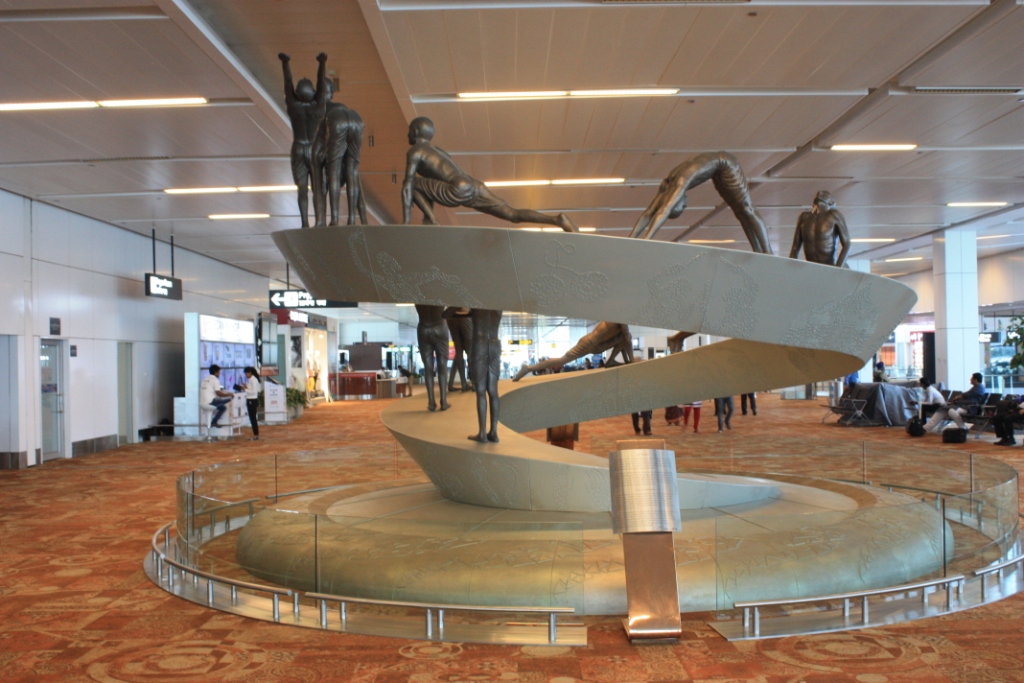
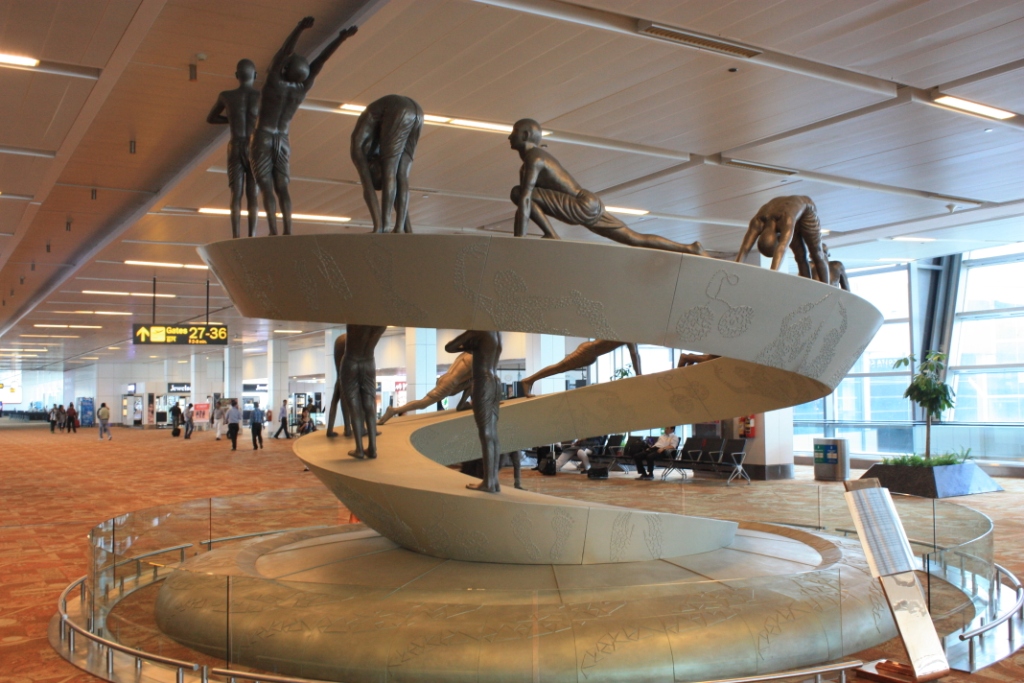
Sun Salutations (i.e. Surya Namaskara) are a sequence of poses (asana) popular in Hatha Yoga for warming up both the joints and the core — among other reasons. There are a number of variations on this practice. The version I demonstrate in the video is common, and is often associated with Swami Sivananda. Below are a few points for consideration.
5.) Don’t forget the quad when in the Lunge (Ashwa Sanchalanasana): While stepping back and forward into the lunge position (ashwa sanchalanasana), sink the thigh of the backward extended leg down to get a stretch in the hip flexors and quad. This is commonly glossed over, missing a good opportunity. Secondary note: look forward in the lunge or at least not back and down between the legs (the latter suggesting excessive rounding of back.)
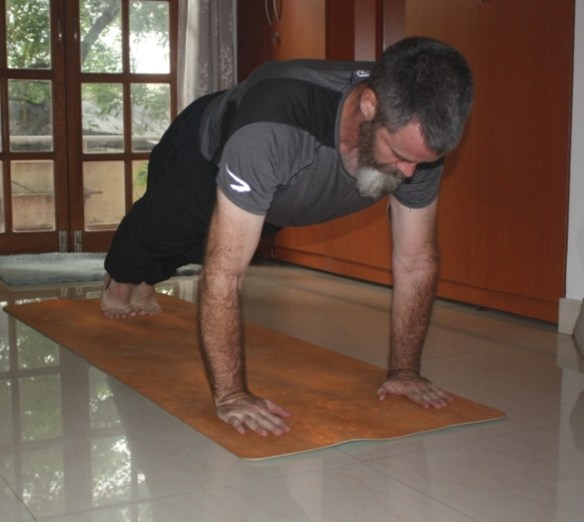
4.) Lift up into Plank (Utthita Chataranga Dandasana): If you have a valley between your shoulder blades, engage the serratus anterior, lift the torso up away from the floor, and turn that valley into a small, gentle-sloping hill. In other words, try to get the shoulder blades to come further apart.
3.) Place the ankle under the knee in the return Lunge (Ashwa Sanchalanasana): This is a challenge for many students depending upon a range of factors from flexibility to thigh girth to waist girth. It’s better to put the back knee down and use your hand to pull the lower leg into place than to try to stand up with the knee considerably forward of the toes. The latter puts a lot of load on connective tissues rather than transferring it down the length of the shin into the foot and floor.
2.) Keep hips up in “Knees-Chest-Chin-Down” (Ashtanga Namaskara), if you can safely do so: This is another challenging one for many students, particularly given the common nature of thoracic hyperkyphosis (i.e. excessively rounded upper back.) If one does have hyperkyphosis, one doesn’t want to force the matter. However, this does counteract that forward rounding tendency by stretching tight muscles out.
1.) Keep shoulders down and away from ears in Cobra pose (Bhujangasana): Unlike the previous common errors, this one seems to come down to lack of awareness or effort as much as it does to physical limitations. Of course, thoracic hyperkyphosis can also make Cobra challenging because the spine wants to bend the other way. I see students who have trouble keeping their navel on the ground and their arms bent because they have an almost “S” curve in their backs.
Tag Archives: Surya Namaskara
5 Exercises to Wed Your Yoga and Calisthenic Practices
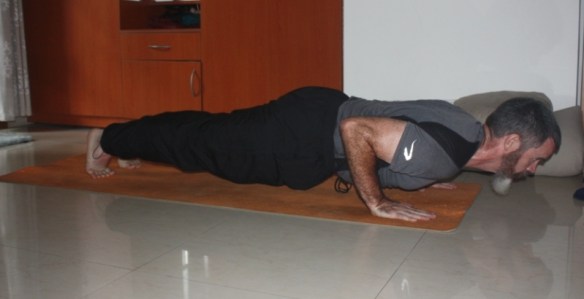
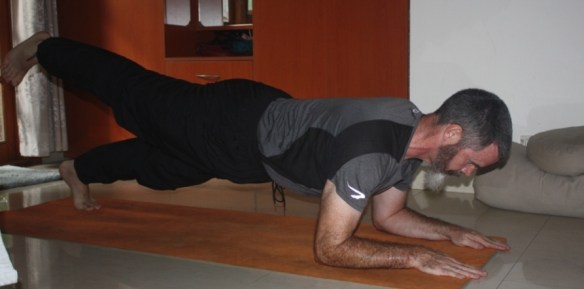
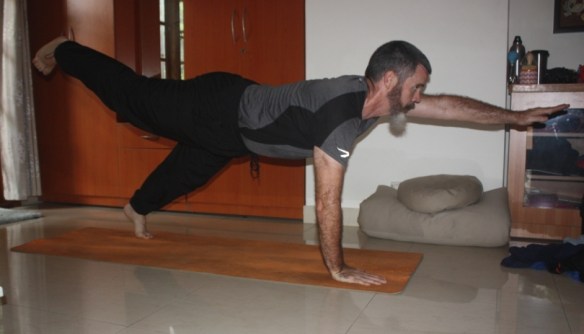
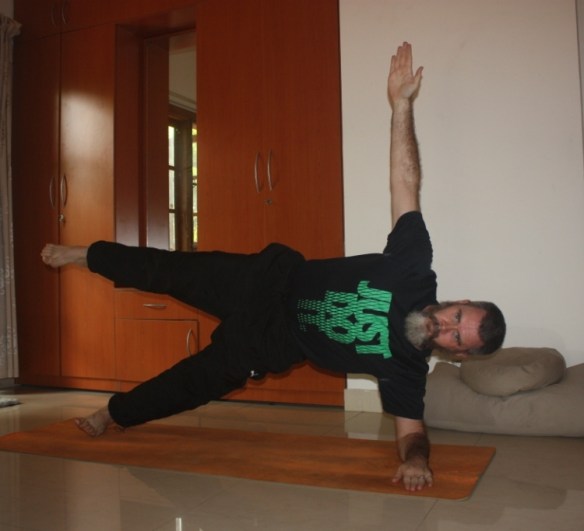
5.) Anything plank (a.k.a. adho mukha dandasana / santolanasana): Who knows how long planks have been a feature of yoga? Plank postures are a fixture in Hatha Yoga, playing a role in most versions of Surya Namaskara (sun salutations), and being used to both to build core strength and to prepare for arm balances.
Planks have also gained immense popularity with calisthenic practitioners. In my gym class days, sit-ups and crunches were the go to ab exercises. No more. Now many bodyweight fitness practitioners are ditching sit-ups and crunches altogether for a number of exercises deemed more effective–include many variations on the plank.
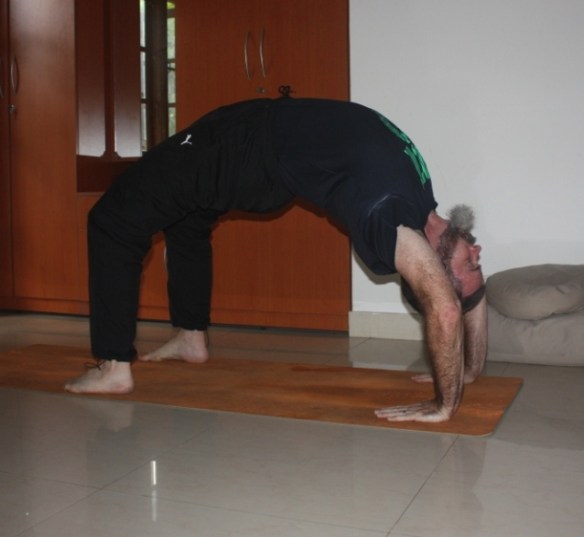
4.) Back bridge (a.k.a. Chakrasana): This is another yoga classic that’s being brought into calisthenics training in a big way. You may note a recurring theme in my selections for this post, exercises and postures (asana) that help to build shoulder joints that are strong, stable, and yet sufficiently flexible. This is a big challenge for bodyweight workout practitioners. One can get stability by bulking the muscles up, but if you don’t have the range of motion to achieve proper alignment, it’s not going to do one a lot of good.
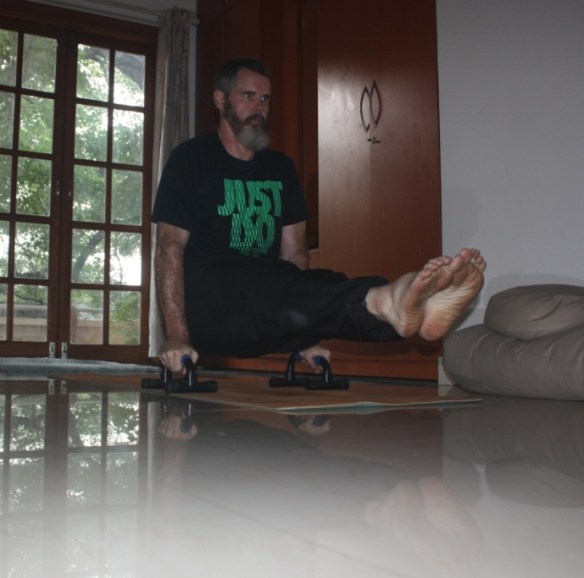
3.) L-sit (a.k.a. Bramcharyasana): Of course, the other recurring theme (besides building shoulder stability) is core strength. This exercise is both a yoga classic and is probably as old as gymnastics itself. Its Sanskrit name, Brahcharyasana, means celibate’s pose–but as far as I’m concerned that’s purely optional.
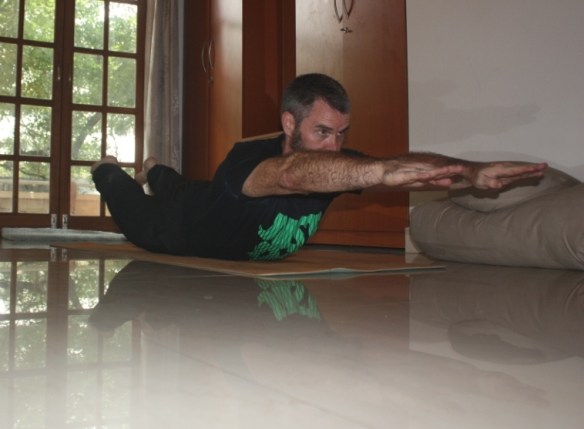
2.) “Supermans” (a.k.a. shalabasana [locust pose]): Another core exercise, but one that strengthens the back muscles.
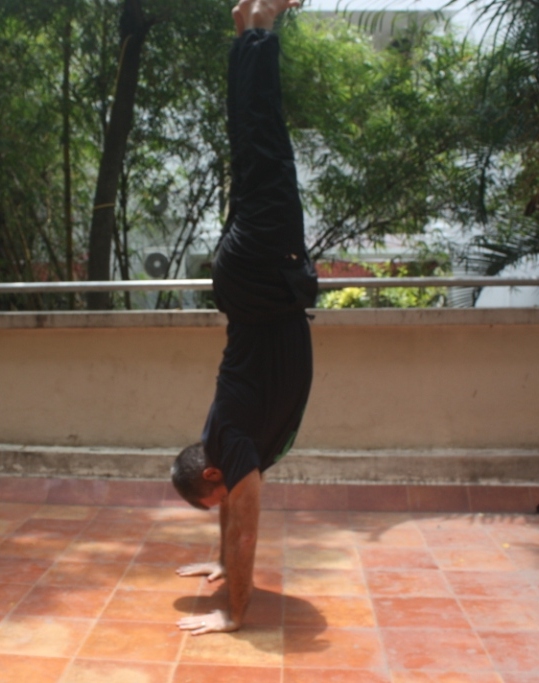
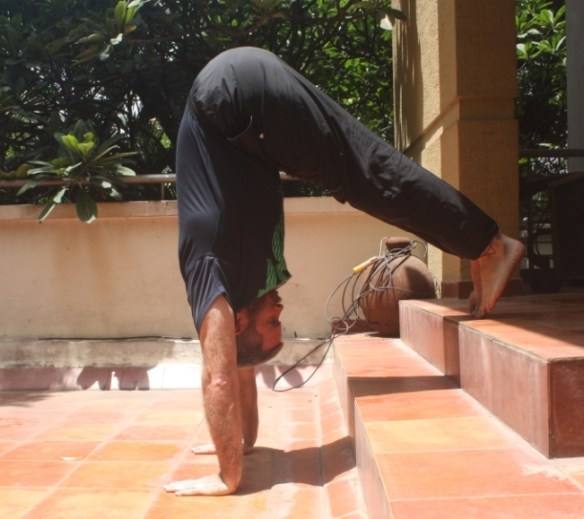
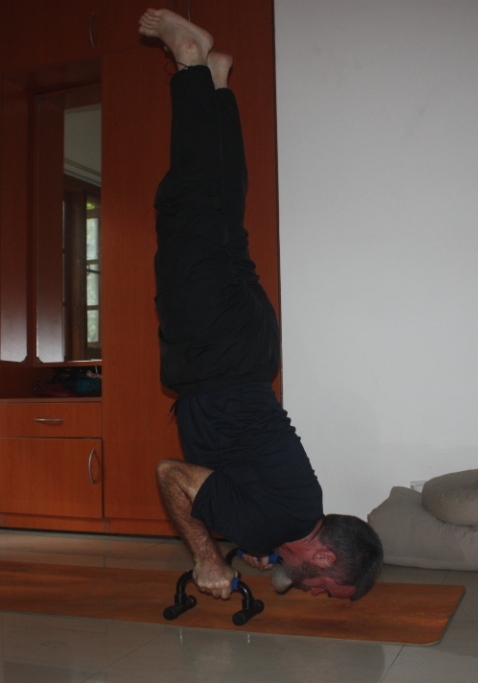
1.) Handstands and Handstand Preppers (a.k.a. adho mukha vrksasana): This practice isn’t just about looking impressive. As mentioned above, it’s hard to build shoulder joints that allow enough stability and range of motion to have the command of one’s body that one would like. Our shoulders are optimized to maximum mobility. That helped our ancestors to be awesome throwers of spears and rocks, but it makes it tough to support our weight in an inverted position. The handstand is a good way to build stability in the shoulders.

If it’s too hard, use your legs to stabilize you (but still try to get that straight up-and-down arm position)
Vinyāsa: A Few Thoughts
I attended a Vinyāsa Workshop this weekend at a1000Yoga in Bangalore. The workshop was taught by Bharath Shetty, who is the founder of the IndeaYoga Shala in Mysore, and who was a student of–among others–B.K.S. Iyengar.
The word vinyāsa has multiple meanings, but most commonly–and in this case–it refers to a style of yoga in which postures are linked together through transitional movements. (And, importantly, these transitioning movements establish a flow of breathing throughout the practice.) Vinyāsa practices tend to be vigorous and challenging because one keeps moving when one isn’t holding a posture (i.e. there’s no down time), and the transitions require a lot of lifting oneself up, which necessitates a strong core and reasonably strong arms / shoulders.
Vinyāsa practices can have fixed-sequences (the same asana, or poses, are always done in the same order) or not have a fixed-sequence (the details of the practice will very from one session to the next.) There’s a great argument for the practice of a fixed-sequence. That is, one can get beyond focusing on crude alignment details and put one’s mind on fine details of breath, drishti (focal point), and keeping a slight tension in the perineum. Such facts can slip away when one is struggling to get the sequence and postural details down pat.
However, there’s a great counter-argument against fixed-sequence programs. The counter-argument goes like this, “If you get so bored out of your wits that you quit, you will also never get to the part where you focus on higher level details.” My advice would be “know thyself.” In other words, if you can keep to a fixed-sequence, you should. However, if your practice will peter out without constant fresh challenges, don’t force yourself into a fixed-sequence box. It’s better to take longer to get to a higher level of practice than to quit.
The most famous fixed-sequence vinyāsa style is the Ashtanga Vinyāsa system handed down by Sri K. Pattabhi Jois. (Note: some people call this system Ashtanga Yoga, and others don’t like that name because it implies that this system is heir apparent to Patanjali’s yoga as described in The Yoga Sutras. [In other words, there’s an argument that that name was already taken.] Furthermore, Jois’s system isn’t really any more of an Ashtanga Yoga [in the Patanjalian sense] than any other Hatha yoga style because it focuses on only a few of the limbs (i.e. asana, pranayama, etc.) at least until one gets to very advanced stages of practice.
The most famous vinyāsa style without a fixed sequence is probably Power Yoga, although many people practice classic Hatha asana in a vinyāsa. Power Yoga emphasizes core strength building, and was originally developed by Ashtanga vinyāsa practitioners to give one the workout of Ashtanga vinyāsa without its monotony.
This was my first experienced with a fix-sequence vinyāsa program other than Ashtanga Vinyāsa, so I didn’t know what to expect. This was the second workshop I’d attended by Bharath Shetty, so I knew that he was a skilled and knowledgeable teacher. However, I didn’t know what Indea Vinyasa, itself, would be like.
It turned out to be much like Ashtanga Vinyāsa. The general organization is identical. That is, there are two versions of Surya Namaskara, a standing sequence, a floor sequence, and a finishing sequence. Note: I’ve only been taught the first series of each of these systems, and so I can’t say how they vary at more advanced levels.
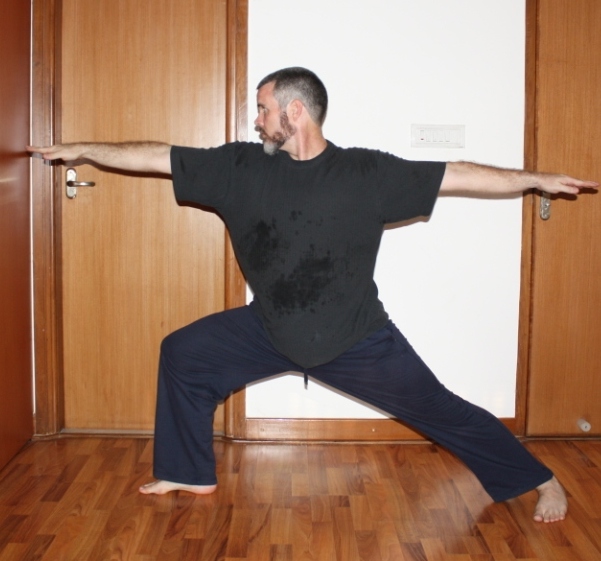
The Surya Namaskaras of Indea Vinyāsa mirror those of Ashtanga Vinyāsa, but they aren’t identical. The Indea Vinyāsa Surya Namaskara-A is slightly more involved, and includes an Utkatasana. The Indea Surya Namaskara-B, like Ashtanga Vinyāsa, features Warrior I, but doesn’t include Utkatasana (chair pose.)
The standing sequences of the two systems are identical. However, the floor sequence is very different. The Ashtanga Vinyāsa preliminary series (as mentioned above, both systems have multiple series) focuses heavily on forward bends, but the Indea Vinyāsa preliminary series is more balanced between forward and back bends. The finishing sequence is also quite similar between the two styles. The sarvangasana-halasana-karnapidasana-matsyasana sequence is the core of both finishing sequences.
DAILY PHOTO: Spiraling Sun Salutations
In the Delhi airport, there is a series of 12 bronze sculptures set up on a spiral platform that together demonstrate the yoga sequence called Surya Namaskara (i.e. Sun Salutation) The sculptor is Nikhil Bhandari.
I think this was a nice move. If ever one needed yoga, it’s in an airport–having been packed into a tiny space for hours and with high stress about whether one will get where one wants to go, it’s the perfect place to bust out the yoga.