
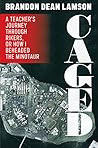
BOOK: Caged by Brandon Dean Lamson

Caged: A Teacher's Journey Through Rikers, or How I Beheaded the MinotaurCaged: A Teacher’s Journey Through Rikers, or How I Beheaded the Minotaur by Brandon Dean Lamson
My rating: 5 of 5 stars

Amazon.in Page

In Caged, Brandon Dean Lamson tells the story of his time teaching inmates on Rikers Island, finding himself in conflict both with students and with the guards. There is definitely a unique culture to the world of incarceration. I found myself thinking about the Stanford Prison Experiments in which ordinary people were randomly assigned to play either inmate or guard. The subjects’ behavior changed during the short period of the experiment, guards becoming more domineering and sadistic and inmates becoming more scheming and duplicitous than these people were in their regular lives. One sees evidence of this strange power dynamic and the resulting unusual behavior throughout the book. Lamson and the other teachers and staff involved with the school often saw the guards as vicious fascists, but – at the same time — they couldn’t trust the prisoners because learning was never an inmate’s top priority but rather was a combination of survival and maintenance of status.

As interesting as the story inside the wire is, it’s equally fascinating to learn what happens with Lamson outside his workday. The author is forthright about changes in his own psychology as he developed a need to work out his own violent tendencies as well as uncharacteristic sexual behavior. Lamson describes time spent in a boxing gym and S&M dungeon in service of these changes.

The book also offers some insight into what teaching methods worked or didn’t. Some of this pedagogical insight might be exclusively applicable to jails and prisons, but some would likely be of use to regular teachers, particularly in dealing with troubled or challenging kids. Lamson is also forthright about his own teaching missteps and failures, while offering the reader insight to what he learned from those teachers who seemed to be unusually effective.

I found this to be a fascinating book. It’s well-written and thought-provoking. I’d highly recommend it for readers of nonfiction.


View all my reviews

BOOK REVIEW: Teaching Artfully by Meghan Parker

Teaching ArtfullyTeaching Artfully by Meghan Parker
My rating: 5 of 5 stars

Amazon.in page

Out: May 4, 2021 in India (It may be out already where you live.)


While I’m not an art teacher and this book is clearly directed at art teachers, I took away a number of useful lessons nevertheless. The book is laid out as a comic book, and is meant to extol the virtues of that artform while at the same time conveying knowledge about art, teaching, and the teaching of art.

The book is organized into seven chapters that are loosely themed according to the seven elements of art: line, color, form, texture, shape, space, and value [in the sense of the level of lightness / darkness.] The connection between the artistic characteristic and what is conveyed in its chapter is more readily apparent for some chapters than for others.

Chapter one (Line) both presents how the book came to be and what the intention behind it is, and also has something to say about process. The second chapter is entitled “Color,” and it touches upon issues such as the nature of aesthetics, the value of the notion of embodiment to the artistic endeavor, and the role of imagination. Chapter three is “Form” and it explores how time, space, and story play into conveying knowledge, as well as offering insight into how form influences perception. The next chapter is “Texture, and it has a lot to do with interaction and human relationships as they pertain to the art classroom. “Shape” investigates the issue of boundaries, such as what really differentiates artist from non-artist, the grammar of comics, and the role of the teacher. It also presents a number projects that might be introduced in the classroom or in one’s self-study. “Space” is probably the most literal title as it discusses the classroom space as well as the more figurative space given to students. The final chapter (Value) has a lot to say about frames of reference and the analogy of painting frames to the frames that individuals operate in and see the world through.

There is a Conclusion that provides some summation of ideas, and there are also notes and a page of references. This book shined a spotlight on a few other books that intrigue me, but that would have been completely outside my awareness — given I don’t read much about the visual arts, but I’m increasingly finding it to be a topic of interest.

As I said, even though its outside my bailiwick, I took away some intriguing lessons from this book — particularly about how variations in the elements of art encourage different emotional and psychological responses. There are a few excellent quotes as well. These powerful lessons weren’t in every frame. A fair amount of space is devoted to both platitudes and [hopefully] cathartic rants about the challenge of being a teacher, and particularly a teacher of art.

The book is festively drawn and colored and (as befits a book focusing on the visual arts) I got even more out of how ideas were portrayed visually than how they were discussed textually. The book takes a light and whimsical approach, and is pretty to look at.

If you’re interested in learning more about the visual arts, I’d highly recommend picking this book up.

View all my reviews