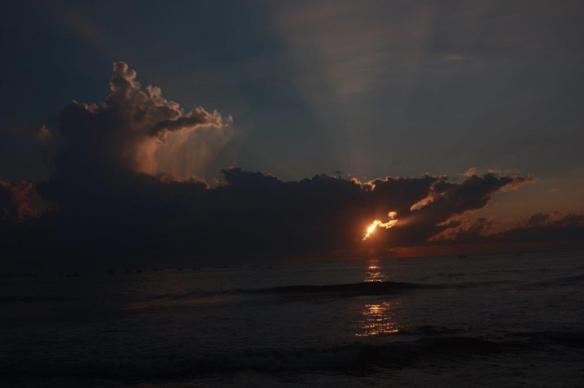
Taken on October 8, 2019 at Gingee Fort


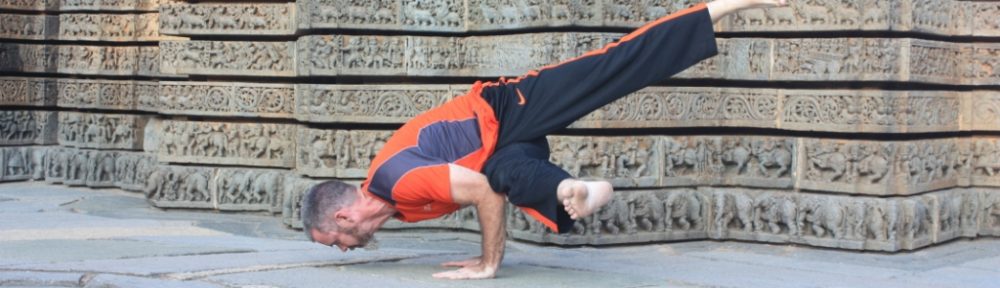
i blacked out on the launch pad
so, if you came to see me soar
sorry you had to hear me snore
i’ll not, today, become the fad
i remember my dear, old dad
he broke the very speed of sound
but I can’t claim I was around
i’d trotted off to Leningrad
but powering down made me glad
i can’t rocket into that cold night
a tragic rider with Quixote’s sight
my only hope lies in going mad
what great men have gone this way
cursing in the light of day
pounding out a soul song
read it right, don’t get it wrong
wait for cops to come along
and move me back to my cell
there is an iron kind of hell
i heard the cry and felt the swell
after life had rung my bell,
and doused me in a sea of hope
seek out neither king nor Pope
you’ll end up hanging by the rope
a poor and pitiless lonely dope
who never learned right from wrong

Taken in October of 2019 in Auroville
There are so many things in this life that I wish to — but cannot — understand. One is how this snail moved his entire house onto a leaf barely wider than said house and a fraction of its weight. Riddle me that.
 Beyond the Boulevards by Aditi Sriram
My rating: 4 of 5 stars
I came across a reference to this book on someone’s blog, fortuitously, a week before our first trip to Pondicherry. And I finished reading the short book during said trip. Pondicherry, technically now known as “Puducherry” but more often than not called “Pondy” by Indians, is a fascinating place on India’s coast with the Bay of Bengal. It’s both the name of the city and the Union Territory (UT) of which it is part. [The book deals mostly with the city, but it does explain the UT briefly.] UT’s are generally smaller than States and are usually managed by the national government. The UT of Pondicherry consists of four discontiguous pieces of land.
There are a few facts that stand out in making Pondy unique within India, and the book deals with them all in some detail. First of all, Pondicherry was a French colony and this is reflected both in the cuisine and architecture on offer. Chapter 6 focuses especially on the city’s French history, but one will find discussions and references of that past throughout.
Secondly, a famous member of the Indian Independence movement turned Karma Yogi, Sri Aurobindo, set up shop here after fleeing the Brits. This resulted in “Auroville” (an experimental township intended to be a utopia that sits a short drive from Pondy) as well as a large Ashram that owns a lot of property in Pondy proper. Sri Aurobindo’s lead student turned collaborator (called “Mother” by Ashramites) apparently bought up distressed property at bargain prices. Chapter seven deals extensively with Aurobindo, Mother, and their legacies in terms of Auroville and the ashram, but – again – these individuals are touched upon throughout. If the reader is looking for the skinny on any controversies regarding Auroville, they are only touched upon obliquely. [Moving to Auroville is said to involve surrendering all of one’s wealth into a communal collection, which is a common trait of cults.] Mostly, Sriram just includes some of the views of locals, which range from weakly positive to unenthusiastically negative.
Finally, while Pondy has this distinctive colonial history and an influx of international visitors to the Ashram, it can’t be forgotten that it’s literally surrounded by Tamil Nadu, and so there is that flavor throughout as well. People may hear about the unique flavor of Pondicherry and how it tends to be tidier than most Indian cities, and they might be expecting that it’s like being in a different country. Rest assured, the Indian influence dominates the landscape, it’s just that it’s diverse in a unique way.
The book mixes history from ancient to modern with discussions with current residents about current issues. When I say “ancient history,” it should be noted that there is an old Roman outpost called Arikamedu a short drive out of town, and it is discussed in the book. Travelers should note that the artifacts from the Roman era – including Greek and Roman pieces – are kept in the Puducherry Museum, and the ruins at Arikamedu are from more recent visitors (though they are photogenic if you’re willing to take a little effort to get there, which involves meandering around some small lanes and sandy roads.) One of the most interesting history-centric chapters is three, which tells the tale of the beautiful prostitute, Aayi, who had a water well built that kept Pondicherry hydrated during both pre-colonial and colonial times.
I found this book to be interesting, and I learned a few things that I probably wouldn’t have otherwise. If you’re traveling to Pondicherry, or have an interest in the city, it’s worth checking out.
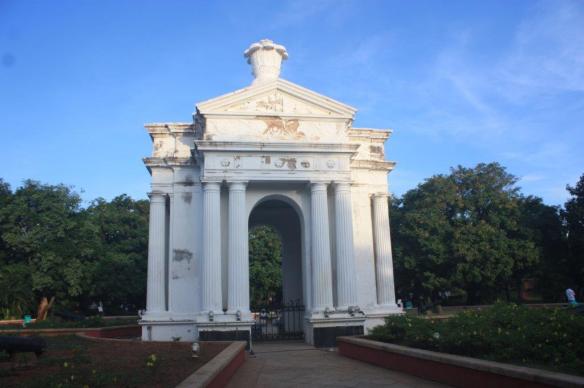
Taken on October 6, 2019 in Pondicherry
Built at the behest of Napoleon III to honor a prostitute whose well provided water to Pondicherry for many years.
There are many versions of the story. The gist of the one I read is that this lady-of-the-evening was stunningly gorgeous and — as a result of all her customers and shrewd financial planning — she was rich. When the King came by he was angry that she had a nicer house than him, and so he had it burnt down. However, by volunteering to build a well of unparalleled output and hygiene for the people of the area, she put the King in a rough spot in which he could neither have her executed nor force her into his harem.

Taken in October of 2019 near Gingee Fort
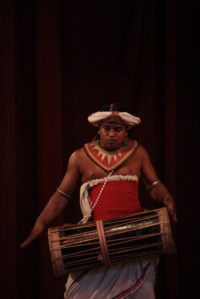 there’s a drum rhythm that sends a soul reverberating
a vibration,
resonant & synchronous,
building dynamic tension through the bones,
until the last slap of the skin shatters the crusty buildup on the soul wall,
and it crashes — crumbling to dust
the naked ape in its natural state
stripped bare of fear, living an altered trait
ashen against the sun, rinsed by the rain
his brain had long ago forgotten pain
folks see so much, and think they know him
but they can’t read his face in scowl or grin