
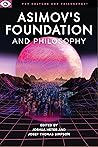
 Asimov’s Foundation and Philosophy by Heter Joshua
My rating: 5 of 5 stars
Amazon.in Page
Release Date: August 24, 2023 [Paperback; ebook is out]
When I was a budding social science grad student, I learned that Asimov’s “Foundation” series was impetus for many young nerds of the previous generation to enter fields like Economics and Poli-Sci. The reason? At the heart of the story is a fictional discipline called Psycho-history, a mathematical field that’s premised on the idea that [while one can’t reliably forecast what an individual (or even small groups) will do,] given a large enough population one can make grand over-arching predictions about what will happen to society as a whole. It’s an idea that Asimov drew from his education in Chemistry, a field where one couldn’t say much about individual molecules but you could accurately model collective parameters (e.g. temperature.) It turns out that humans and their interactions are more complicated than gas molecules and so Psycho-history only works as a powerful plot device (a fact that Asimov discovered himself, supposedly driving mid-course corrections in the limited space he had to make them.) Anyhow, the idea that one might predict the unfolding of societal, economic, and international events was a powerful scholarly aphrodisiac for individuals who might otherwise have dismissed study of the social world as hopelessly and absurdly chaotic.
With that background generating curiosity and having read a number of Asimov’s books, I was eager to investigate this book that explores the philosophic underpinnings of Asimov’s fictional world. I was not disappointed. The imaginative “Foundation” series of books provides plenty of situations and ideas to which one can apply the lens of philosophy, from the limitations of reason and symbolic logic as tools to solve humanity’s problems to the morality of manipulation and questions of transparency that follow from it to what kind of free will — if any — can exist in a universe where Psycho-history works. This anthology of essays considers questions of mind, logic, morality, free will, identity, and existence, as well as various ideas from the Philosophies of History, Religion, and Science. The twenty-one essays are grouped into six parts by philosophic subdiscipline.
There are so many of these “pop culture meets philosophy” books out there, but I think this one does better than most because Asimov’s creative mind really offered such a rich assortment of ideas upon which to reflect.
View all my reviews

 Tiger Riding for Beginners