DAILY PHOTO: Bangalore Palace

Taken on September 16, 2013.

Taken on September 16, 2013.

Some claim Bangalore Palace is modeled off of Windsor Castle, but the official line is that any resemblance is purely coincidental. I don’t think cars are normally allowed to park here, but it was rented out for a wedding– which my wife and I kinda / sorta crashed. I’m not sure if the wedding was over, or if they were in the intermission stage. (I’m told that the only thing longer and more mind-numbing than a Catholic wedding is an Indian wedding. Having experience attending the former, I can only imagine the latter.)

While impressive from the outside, the palace is not a very highly rated attraction. In part this may be because it’s quite expensive by Indian standards (when you’re not crashing a wedding.) In part it this may be because the outlying grounds are not particularly attractive. I can’t well speak to the innards of the castle.

Supposedly, construction was begun in 1862 and was not fully completed until 1944. I’m sure the US Civil War to World War II time-frame is purely coincidental. It was built by the Principal of Central High School, Reverend Garrett, and once owned by the Maharaja of Mysore.

7 Things I Dig About Bangalore

1.) Mornings:

Bangalore (Bengaluru) isn’t an early riser, and that makes the mornings an idyllic time for those of us who are so inclined. The weather is cool; the pollution is tamped down by all that plant respiration, and the wailing horns are sparse. It’s the best time to take a walk. One can actually cross busy intersections with minimal delay and risk to life and limb. Cubbon Park is closed to vehicular traffic.

Words to live by

Words to live by

2.) Parks:

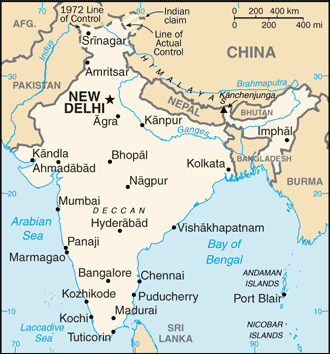
Bengaluru was once called the “Garden City.” While some refute this moniker in the face of the hyper-growth of this high-tech city, Cubbon Park, Lal Bagh Gardens, and numerous small parks offer aesthetically pleasing and relaxing oases.

Lal Bagh Botanical Gardens displays a large collection of Bonsai.

Lal Bagh Botanical Gardens displays a large collection of Bonsai.

3.) Restaurants: 

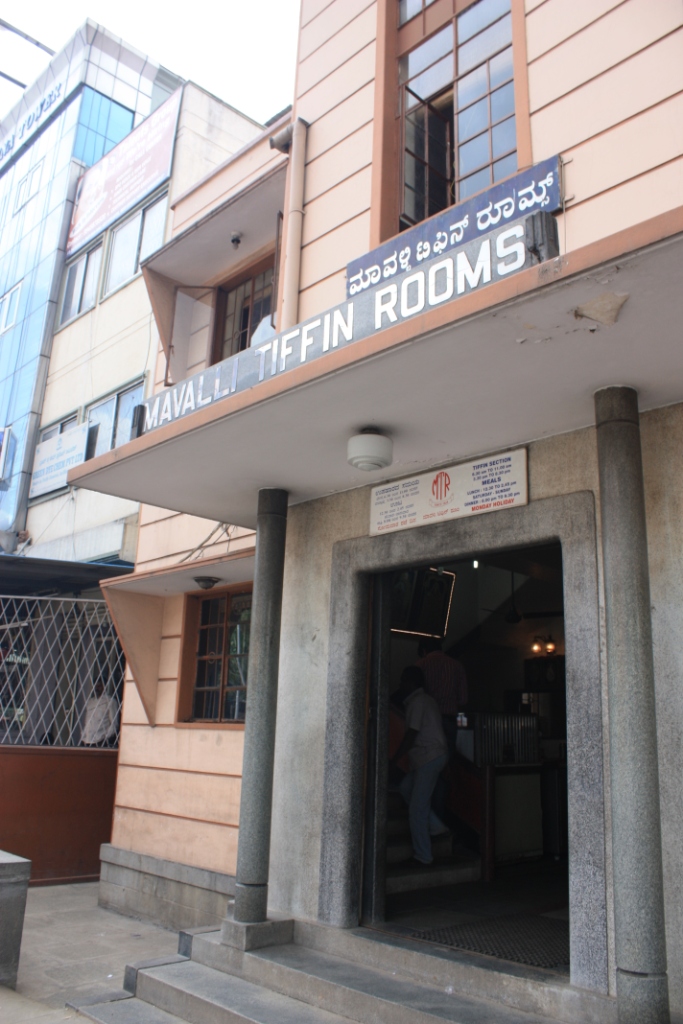
The city offers a wide range of options for both South Indian cuisine as well as more cosmopolitan fare. I’ve sampled many local restaurants as we’ve been getting settled. The most iconic place I’ve eaten at in Bangalore is the Lal Bagh Road location of the Mavalli Tiffin Rooms (MTR.) I had the lunch thali. (For those unfamiliar, a thali is India’s answer to China’s dim sum, or what foodies might call a “tasting menu”– which is to say small portions of a large assortment of foods. MTR offers an interesting dining experience. One sits down at a large table, quite probably with a group of strangers, while bustling stewards come around to ladle up the thali’s various component dishes. MTR’s food was delicious, but, more importantly, it’s hygienically prepared as well. The restaurant was built on the idea of strict food sanitation standards. I have anecdotal evidence to support this claim as I made my sole slip thus far by drinking water whose origin I didn’t know from a cup that was placed before me at this restaurant.  I was none the worse for the experience. I suspect MTR uses bottled water because there wasn’t any  flat taste that I associate with boiled water, but–whatever they did– they did something. While I have a fairly robust system by Western standards, I’m under no illusions that I’d do well drinking untreated tap water here. (Time Out Bengaluru did a little piece in its “The City by Numbers” segment in the current issue. They say that 59% of Bangalore’s tap water is not potable, and 8.4% of borewell water is contaminated by E. Coli. Incidentally 0% of borewell water is potable.)

The Lal Bagh Road store, which I understand is not the original location, but is  the oldest of the existing locations.

The Lal Bagh Road store, which is not the original location, but is the oldest of the existing locations.

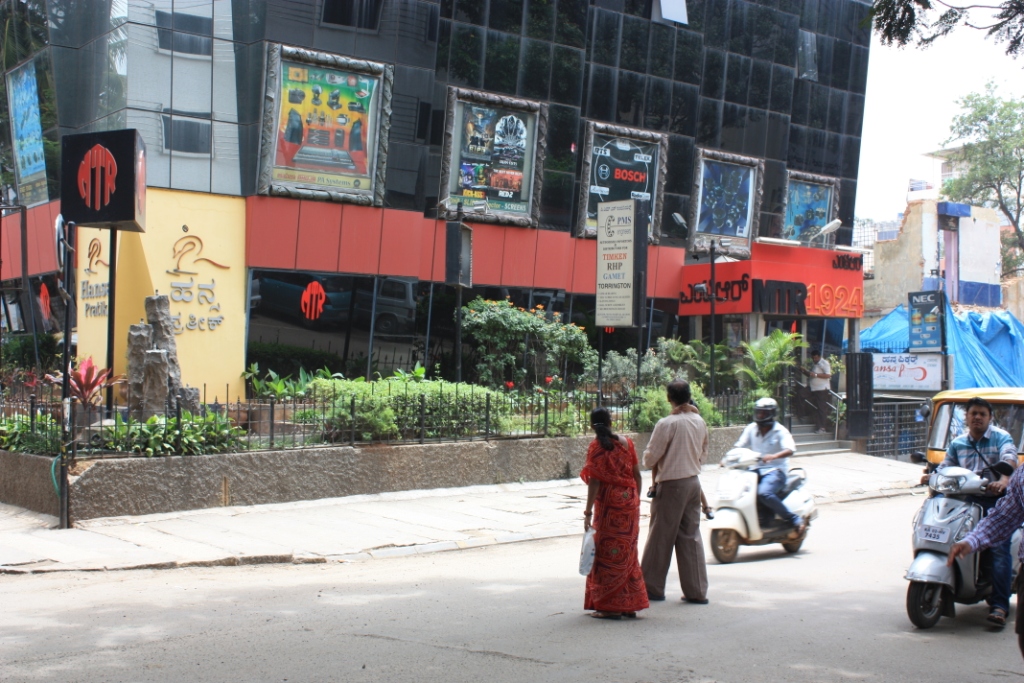
While I have not yet tried any of the other locations, it should be noted that some of the newer restaurants appear to be more hip, trendy, and not so utilitarian. I saw the location below near Janata Bazaar. There is also a location blocks from where I live.

MTR Gandhi Nagar location.

MTR Gandhi Nagar location.

4.) Serenity Against All Odds:

Despite the frenetic pace of this town, there are still many who manage to find some clarity and piece of mind. Besides the yoga practitioners in Cubbon Park and the adherents of various indigenous religions at temples and shrines throughout the city, there are large meditation centers headed by famous gurus. The most well-known of these are Sri Ravi Shankar’s Art of Living centers.

Cubbon Park with the roads closed to vehicles.

Cubbon Park with the roads closed to vehicles.

5.) Climate:

We’ve seen some heavy rains in the evenings and overnight since we’ve been here. This is apparently out of the usual as the rainy season should be over. However, even with nighttime rains, the weather has been great. Bangalore is the San Diego of India in that the climate doesn’t tend toward the extremes witnessed in many other parts of the country. This may have influenced the British decision to build a military base here. It most certainly influenced the wave of retirees who came here afterward. And it likely factors in to the calculus of all those IT firms that have converged here in recent years.

The Glass House of Lal Bagh gardens, and a typical Bangalorean sky.

The Glass House of Lal Bagh gardens, and a typical Bangalorean sky.

6.) Stree Life: 

In Atlanta, as in most of urban America, one won’t see wildlife bigger than a squirrel or animals bigger than a dog –at least not outside of the zoo. So large domesticated animals in the city is a big change, as is being able to go to the nearby countryside and see the likes of elephants. I’ve been surprised how freaked out some city dwellers in America got by the likes of a fox or a tomcat. It’s good to see people can move about in the presence of large animals without feeling the need to eliminate them.

The well-known Indian street bovine.

The well-known Indian street bovine.

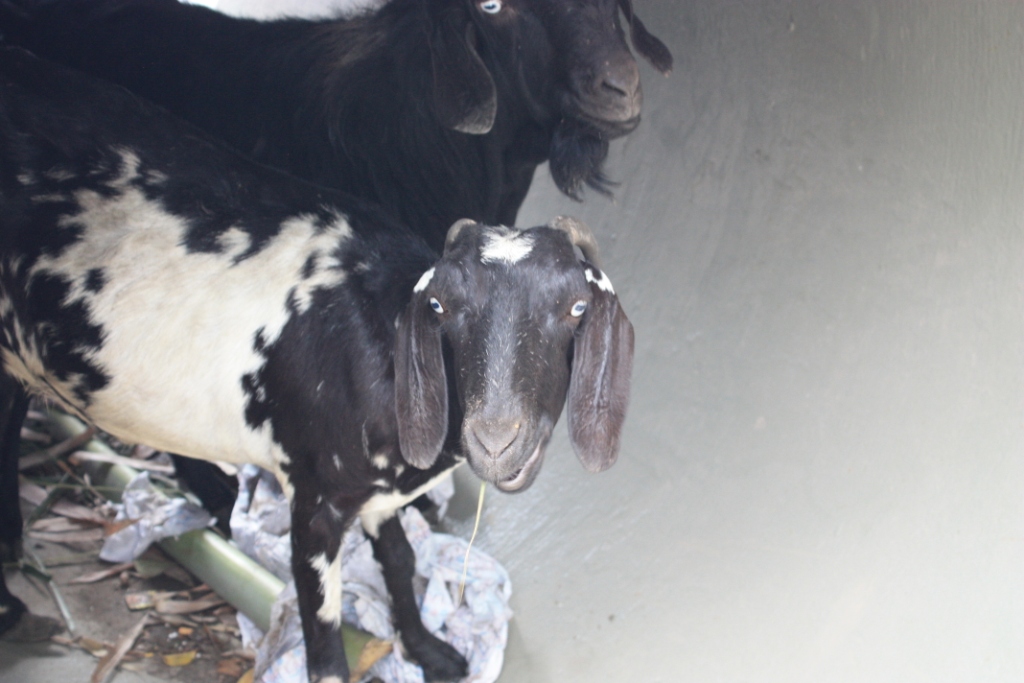
The lesser known Indian street goat.

The lesser known Indian street goat.

7.) Markets: 

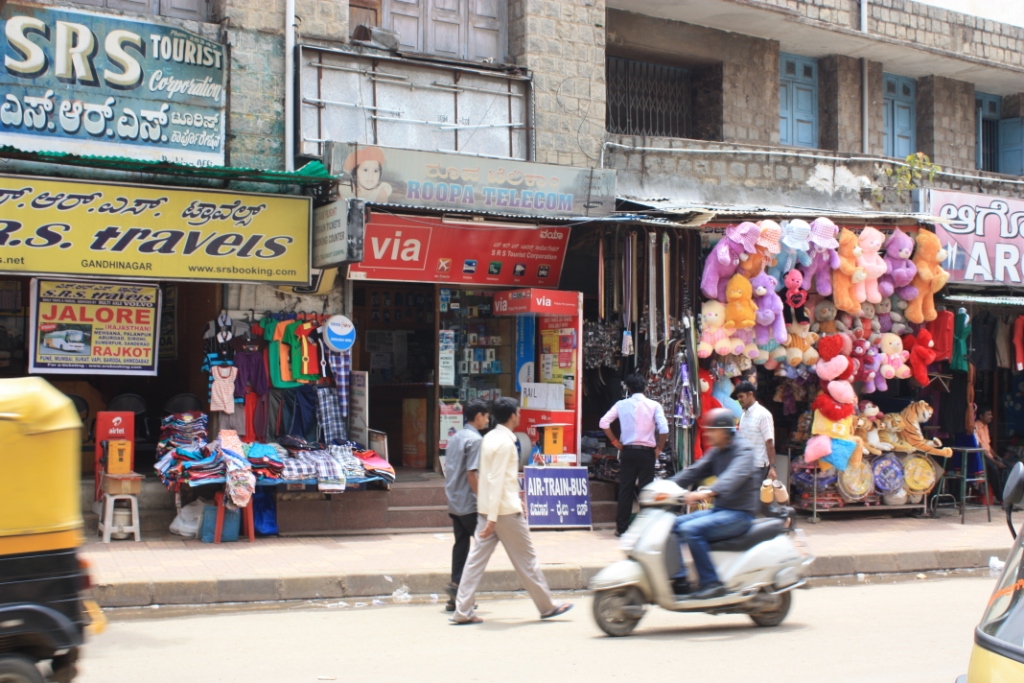
I’ve been to the City (KR) Market, the Janata Bazaar, the Gandhi Bazaar, and everything from large, modern shopping malls to little neighborhood shops. Commerce thrives throughout the city in all its varied forms.

Near Janata Bazaar

Near Janata Bazaar

Transmigration of Blog

india_sm_2012We’re down to about a month until our move to India.

The house is largely in order with only a few odds and ends remaining.

Most of our worldly possessions are in storage, and I haven’t really missed any of it. (A lot of “moss” collects when your stone stops rolling for a few years.) The house now echoes. Movers will be coming to get the small amount of stuff we’ll ship to India in the next couple weeks. Then we’ll really be living minimalist.

We’ve got all our shots with the exception of the final doses for Hepatitis. We’ll get those in country. With respect to shots, when moving to India, one has to get… well,  all of them.

Visas are in the works though we’ve had some delay on that front. However, fortuitously, the local Indian Consulate is beginning to take applications, and so I won’t have to send my application off to another city and can eliminate the time and risk of postal transit.

My list of things to do consists of fewer large, all-consuming tasks and more quick and easy jobs.

All of this means that I’m getting back to writing.  This is a bit like getting a corroded junk-yard jalopy running again. It’s remarkable how much the creative juices curdle when one spends a few months focusing on home repairs, monitoring contractors, getting shots, and other mundane tasks of international relocation. I worked almost exclusively on drafting two novels for a period of a little over a year, and now–as I resume writing and revisions–I’m having to re-read just to figure out what they’re about. On the bright side, I sometime surprise myself with what I wrote. For me, there’s definitely economy of scale in long writing  projects. Writing eight hours a day yields a lot more than eight times writing for one hour a day. I lose voices, character idiosyncrasies, and plot detail so easily unless I’m immersed in them.

As for this blog, I think a rebirth is in order. Since I’m moving to India, I’ve invoked the concept of transmigration of soul. In Hinduism, some sects of Buddhism, as well as a few lesser known religions, there’s a belief in reincarnation in which the soul may be reborn into an altogether different type of container. For example, if you were good in your last life, you might come back as a lama or a lap cat. If you were bad in your last life, you might come back as a slug or a Congressman. So the question of the moment is what this blog will be reborn as when  it sputters up from out of the ashes.

I would like the site to remain (or, perhaps, become)  humorous, but I’d like the humor to be less curmudgeonly. This presents a challenge because I’m not sure that I know how to be funny without being a curmudgeon. In point of fact, I’m not sure I know how to not be a curmudgeon–funny or otherwise.

I want this site to be reflective of my new life. I’ll continue posting photos, though after the move they will be disproportionately from Bangalore, India, and a few adjacent countries to which I will be traveling. So it’ll remain part travel site. I’m sure I’ll have plenty of lessons learned about travel in India to share.

When I’m not writing or sleeping, I’ll be engaged in a quest of self-improvement. The development of mind and body have been raised to high art in India, and I hope to  find some of those individuals with that knowledge.

Expanding my abilities and understanding of martial arts is one of my goals for this period. It’ll be a challenge to keep from becoming rusty in the jissen kobudō (Japanese old school martial arts that emphasize pragmatic skills) that I have been studying my entire adult life. However, in addition to working on what I know, there are other activities that I think will help expand my understanding while keeping me suitable limber and conditioned. I would like to learn  a little about indigenous Indian martial arts such as kalaripayattu, silambam, and–if time permits–gatka. Furthermore, I would like find a place to train in Bangalore where I can do some training in what I’d call general jissen (practical fighting) skills.

However, my attempts to improve myself will not be limited to martial arts alone. India might be cursed with plagues of poverty, pollution, and–well–plague, but they have no shortage of gurus–whether I can find one that’s reputable and willing is another matter. The older I’ve gotten, the more I’ve realized that I don’t have a firm grasp of my mind. My mind runs and I don’t pay enough attention to what it is telling me; I don’t put enough effort into fixing what is broken. I read a quote recently about people who put great effort into studying the external world, but who remain ignorant of themselves.  This struck close to home, but it’s not just me–it’s widespread. People study psychology in school and learn about cognitive biases, but they don’t put the information to use in becoming more virtuous people. For example, a person might learn about the “self-serving bias” –whereby people claim responsibility for successes but place blame for failures on external factors–and say, “yeah, it’s funny that other people totally do that.”

Part of practicing martial arts is keeping one’s self healthy, against all odds. While I’ve never practiced yoga, I appreciate the belief that mind and body are inseparable. I would like to work on building a body that is less likely to be crippled by the practice of martial arts as I age. I intend to study Thai yoga massage, which incorporates stretching and pressure point massage. There’s an interesting connection between India and Thailand with respect to this form of bodywork. While it’s most closely associated with Thailand, some claim that its roots are in Northern India with a master called Guru Jivaka. While visiting Thailand, I developed an appreciation for the health benefits of this type of massage–particularly for one prone to have things out of whack. However, I didn’t have the time to study it during that visit. There is also the more distinctly indigenous holistic healing system of India, Ayurveda, and I would like to learn more about it as well.

In short, I intend to have a pretty full agenda while living in India, and I hope readers will find my posts about these experiences interesting and worthwhile.

Blatant Blog Post Theft by Martial Arts Outfitters

In all my years of blogging, I haven’t caught any incidents of blatant plagiarism of my posts… until now.  I was looking  through the martial arts posts and saw this post on the MartialArtsOutfitters.com blog posted Thursday.  It immediately seemed to me that it looked just like a post that I had posted a year and a half ago. (See: Yoroi Kumiuchi.) Then I realized that they were the same word-for-word.

This is blatant plagiarism. I mean they copied everything including the photo (granted that was public domain and not mine) and title, and then published them on the same platform (i.e. WordPress.) This wasn’t reblogged, which is a function that I allow because it comes with attribution and a hit to one’s site. The fact that reblogging would have been easier for them to do means that this company was outright trying to steal content.

What’s particularly sad to me is that the thief is an organization that is involved with martial arts. The martial arts should be about advancing virtue not practicing vice. I guess they are targeting those scheezy pedophile “teachers” one hears about in the news, and not high-caliber martial artists.

What is doubly disappointing is that this is a business, and, thus, one would expect that they would be in favor of people paying for what they take in principle.

If you are a WordPress blogger and write martial arts posts, you might want to look at the feed of http://www.martialartsoutfitters.com to make sure they aren’t ripping you off.

If you are a supplier of http://www.martialartsoutfitters.com, be warned they don’t feel obliged to pay for what they take.

It’s All Fish Balls and Kipper Snacks From Here on Out

FishballsOwing to a freakish and inexplicable popularity of this blog with Norwegians, I recently received a quasi-lucrative endorsement offer from the King Oscar Canned Fish Corporation. In exchange for tweaking this blog’s content, I will receive all the canned fish products that I can eat– for life. Yeah, that’s right, I get all the minced mackerel, pickled herring, and fish balls that I can stomach. (FYI- Fish balls aren’t aquatic rocky mountain oysters, if you were wondering.)  This is almost as good an offer as was received by Flipper, and he had immense star power. The first truckload arrived this morning as promised, putting me on retainer. Therefore, from this moment onward, the content of this blog will be devoted to the delectable joys of such foods as herring fillets in monkfish sauce or Kipper snacks in oil.

Rest assured, I’ll continue to present the same type material I have in the past, but it will now all have a canned seafood theme running through it. For example, for those who have enjoyed my poetry, I have a doozy coming up entitled “Ode to the Happy Anchovie.”  I will continue to produce humorous postings. There is only one subject off the table… no, not pedophilia… I will never make fun of the delicious Norwegian canned fish snacks of the King Oscar Corporation. However, I have a scathing rant against people who don’t want anchovies on their half of the pizza that I think you’ll find particularly rib-tickling.

In conclusion, I’d like to wish you all a happy April Fool’s Day.

The Bullets that Bore no Name: or, the Burden we all Bear

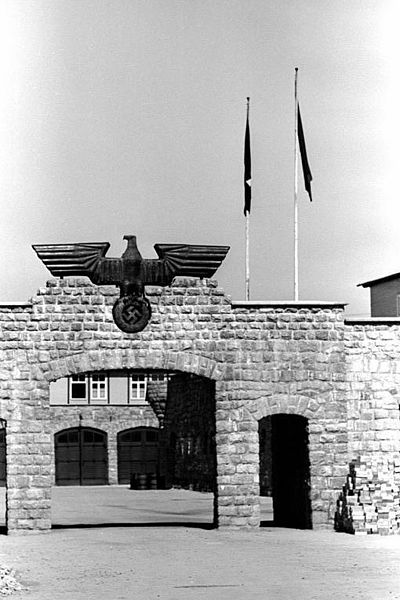
Attribution: Bundesarchiv, Bild 192-334 / CC-BY-SA

Mauthausen                     Attribution: Bundesarchiv, Bild 192-334 / CC-BY-SA

Thanks for joining me on the veranda. If you don’t know what I’m talking about, this post flows from a book review I did on Elie Wiesel’s Night, which can be seen here. But don’t wander off just yet.

I married into a family of holocaust survivors.

Being sufficiently narcissistic, I haven’t been able to avoid thinking of the profound impact this had on my life.  I am married to the most extraordinary woman in the universe [my apologies to all other women, I’m sure you’re someone else’s most extraordinary woman] by virtue of the strength of a man who wrestled his way to the top of a pile of corpses, bleeding profusely from multiple shrapnel wounds, clawing his way out of a pit, and cleaning the gashes with his urine. That man was married to a woman, tiny of body but colossal of mind, who was in the group force marched from Budapest to Mauthausen. After the war, they had a child–my mother-in-law. Yada-yada-yada. I have marital bliss.

Not being completely narcissistic, I’m reminded that every one of our lives have been shaped by strong people who lived through close calls. Each of us comes hither as a gift from men and women who passed through a hail of bullets that bore no name. Some, like my wife’s grandfather, were riddled by bullets bearing their name, and still refused to heed their deadly whisper.  Every holocaust survivor survived by a thin margin. Every battlefield veteran’s life is an execution order rescinded. Every prisoner of war was one germ away from an unmarked grave.

No pressure or anything, but that sounds like a heavy debt we  all bear.

Telling this story in greater detail is one of my bucket list tasks. It’s a project I’ve had on the back burner for far too long. There are several reasons for this. The most feeble of which is a hope to find the right timing. Sadly, there are so many such stories that I fear it will be lost amid a sea of sorrow.  Then there is my need to develop grace with language sufficient to do the story justice. In a way the two novels I have drafted, and whose mess I am now painstakingly trying to dance into shape, are practice exercises.  Wish me luck.

On the plus side, my wife’s uncle had the foresight to have her grandfather speak his story onto about 20 tapes before he died. With today’s technology, there’s no excuse for anyone’s life-altering story to go untold.  So I guess if there is a moral to my rambling post it’s this: don’t let anyone in your life with a spectacular story pass from this world without it being heard.

TODAY’S RANT: Pronunciation Police

Pronunciation is tricky.

Pronunciation is tricky.

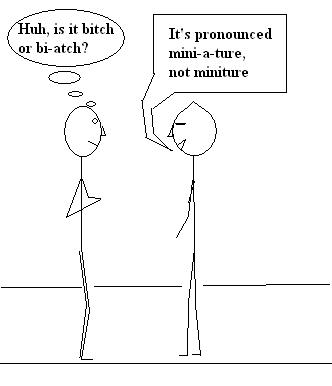
If you’ve ever had someone tell you that any water can be put in a pot (for pronouncing drinking water pot-table rather that po-table), then you may be with me here. If you frequently exercise your perogative, rather than your prerogative, you may agree. Have you had sherbert, or only sherbet? Do both your eggs and oxen have yokes?

If you’re not with me, you –my friend– might be the person on the right in my little stick cartoon.

I’m as anal about language as the next writer, but let’s try to dial down the pretentiousness. The big question I have for pronunciation police is this: What in your experience with the English language has led you to believe it is a phonetic language?

For those who think English is phonetic because they learned it via “Phonics,” let me expose you to a poem that says it more eloquently than I ever could. (I would attribute the poem, but it is to my knowledge owed to that most prolific “Anonymous” chap.)

Hints on Pronunciation for Foreigners

I take it you already know
of tough and bough and cough and dough.
Others may stumble, but not you,
On hiccough, thorough, laugh and through.
Well done! And now you wish, perhaps,
To learn of less familiar traps.

Beware of heard, a dreadful word
That looks like beard and sounds like bird.
And dead-it’s said like bed, not bead.
For goodness sake, don’t call it deed!
Watch out for meat and great and threat.
They rhyme with suite and straight and debt.

A moth is not a moth in mother,
Nor both in bother, broth in brother,
And here is not a match for there,
Nor dear and fear for pear and bear.
And then there’s dose and rose and lose
Just look them up–and goose and choose.
And cork and work and card and ward.
And font and front and word and sword.
And do and go, then thwart and cart.
Come, come I’ve hardly made a start.

A dreadful language? Man alive,
I’d mastered it when I was five!

If you still don’t believe that the language can handle multiple pronunciations, check out what the experts say.

TODAY’S RANT: TMI in Advertising

I was reading the label of a bottled tea this morning. It said something like:

To offer you the fullest flavor, our leaves are not washed prior to steeping. The first time they experience water is when boiling spring-water is poured over them for brewing. This is why it’s so important that we use organic farming methods. This ensures the product you get is only tea… and water… and trace amounts of poop.

Sometimes I think big advertising is out of control. Nowhere is this more readily apparent than on Sesame Street. Big money letters like “M” get all the play and “Q” ends up being the stumbling block letter in the road-trip “ABC” game. No one wants to make more words starting with “X” or “Z” any more. Sure there’s a grassroots counter-culture movement, such as Ernest Vincent Wright’s short novel called Gadsby. Wright’s book was written entirely without the letter “e.” To be sure, “e” is a big money letter; it’s made more money off of Wheel of Fortune than any other vowel. Vanna turns the “e”s and the whole puzzle becomes clear. I heard e’s manager wanted to make its purchase value higher than the other vowels, but Pat Sajak showed his ugly side and “e” backed down.

You probably thought this post was going to be about the Super Bowl ads. I didn’t get past the first Go Daddy ad, which creeped me out. I still don’t know who Go Daddy is and what he does. (His name sounds a little like a pimp.) Which, by the way, is just like the medicine commercials. They have these ads for medicine that leave me like, “I don’t know whether your product will give me a boner or loosen my bowels, why are you advertising to me– especially if you’re going to end by telling me that, ‘Side effects may include a bleeding rectum?'”

Here’s said Go Daddy ad. Bon appetit.

TODAY’S RANT: Preferred Customer Cards

Today at the grocery store, the cashier asked whether I had a preferred customer card.

To which I, of course, replied, “No. Do you have one of my preferred cashier cards?”

I thought that she would be devastated when she realized that she didn’t have my card, but she apparently thought I was joking — which saddened me a little.

I don’t sign up for such cards for a number of reasons, most of which have to do with being a dude.

1.) Wallet real estate premium: As a man, any extra card has to be wedged under one of my butt cheeks where it will sit all day trying to cause scoliosis. While your firm’s card may seem thin, they add up. Therefore, the card had better offer great perqs, such as an option to cut to the front of the line any time I so choose or the knowledge that –should there be a maniac on the loose in the store– lesser favored customers will be shoveled in front of me as human shields.

2.) Commitment limitations: One idea behind these cards is to build customer loyalty. I’m a man who has been happily married coming up on 19 years. Every ounce of my capacity for commitment is spoken for. I have no excess loyalty to spare on a brand of canned corn or on a particular store (you all sell the same stuff.) Sorry Keebler Elves, but I am not above a midnight rendezvous with some freaky Nabisco Oreos. Don’t make me perpetrate a lie.

3.) The Fudgesicle Dossier: When thinking about who to confess my moments of greatest weakness to (as reflected in buying a gallon of “Chunky Monkey” ice cream): a friend, a loved one, a priest; oddly enough Acxiom Incorporated does not spring to mind. Acxiom is one of the big companies that collects information about when you buy tampons or condoms or gas station sushi. Somewhere in a massive server farm sits an e-file, an indelible record of a lifetime of bad decisions as reflected in my consumer purchasing history. I’m not going to feed that monster.

Any way, getting back to my story. The cashier said that without the card my total would come to $21.70, but with one it would only be $12.95. She then proceeded to “blip” a card that she had stored next to the register. It saved me a bundle, so I felt obligated to give her one of my preferred cashier cards.

TODAY’S RANT: Emerson Haters

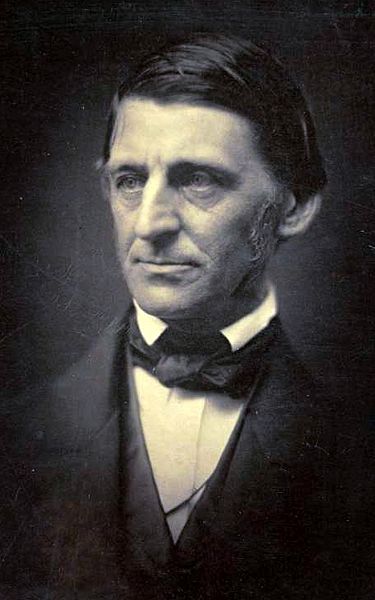
Ralph_Waldo_Emerson_ca1857_retouchedI began reading the Best American Essays of 2012 and was disappointed by the first  essay entitled, The Foul Reign of Self-Reliance by Benjamin Anastas.

Self-Reliance: In or out of the canon?:

Anastas rails against the essay Self-Reliance by Ralph Waldo Emerson. The only nice thing he has to say about Emerson (as a parenthetical insert) was that the philosopher spoke out against slavery and the poor treatment of American Indians.  Anastas suggests Emerson’s essay should be eliminated from the  canon of required reading. This desire to censor ideas that he (or his collective) find objectionable is a telling indicator of why he finds Emerson so vile. In my ideal world, students would read Emerson and Marx and Jefferson and Socrates and Confucius and eventually even the likes of Hitler and they’d make up their own minds about what ideas were sound and which were suspect. I’m  confident that on the whole that a free-thinking people will overwhelming reject the poorest and most vile of ideas. Obviously, not all will draw the same conclusions as I about which ideas are best, but I prefer the company of such people to those who completely agree with me but have turned their thinking caps off. Anastas seems to favor control of the flow of ideas to those society or teachers or some collective finds agreeable.

An undeniably powerful idea:

About all that Anastas and I agree on is that the thesis of Emerson’s Self-Reliance is powerful. By a powerful idea, I mean one that has the ability to grab a reader by the collar and demand his or her attention –whether they like it or not. Where Anastas sees Emerson’s ideas as perniciously powerful, I see them as sagely powerful. While we seem to be in near complete disagreement, I don’t want to go into a point by point refutation. I want to focus on what I believe is Anastas’s central point, that our current political dysfunction is the fault of Emersonian thinking. On this I think Anastas is shows perfection in his wrongheadedness.

The reason I don’t bother arguing point by point is because  much of my difference of opinion with Anastas comes down to being on radically different places on the Borg-Anarchist continuum. Reasonable people may disagree. I have a set of beliefs that inform my position on the Borg-Anarchist continuum that range from my opinion on free will to ideas about the value of optimizing (minimizing) what I would call “social friction” (others have used that term in another way.) That’s neither here nor there, Anastas may have his own justification for his views, though he doesn’t lay them out. For example, he uses the phrase, “excessive love of individual liberty” without indicating what he believes would be the appropriate amount to love liberty, let alone how he drew his conclusion. It may be that he doesn’t have a rationale, but rather has suborned his views to some collective that he believes is representative of society (that would be the true anti-Emersonian approach.)

The Borg-Anarchist continuum:

I should explain what I call the “Borg-Anarchist continuum” for those who are neither Star Trek fans nor wonky. Humans are inescapably both individualistic and social creatures. We know that people get morbidly depressed when they feel they aren’t valued as individuals (Tom Hanks at the beginning of Joe Versus the Volcano), but it’s also true that people go nuts when they are completely isolated from others (Tom Hanks in Castaway.) [Please, don’t draw conclusions about which is “better” on the relative merit of those two movies.] This leads to one of our most fundamental dilemmas. Where our individuality bumps up a social unit, how does one reconcile theses conflicts?

We can imagine a continuum where at one end are the Borg and at the other end are Anarchists. Borg were a powerful enemy in the Star Trek universe. The Borg were a collective in which any given individual was inconsequential and all gave themselves fully to the objective of the collective (i.e. universal domination.) Anarchists are those who feel there should be no authority over the individual. Virtually no one fits into the extreme camps because they’re both blatantly flawed. No one would have any incentive to do anything in Borg world, and an anarchy will inevitably devolve into chaos. No one would invite the Borg or Anarchists to their cocktail party. In practice, one might think of a Communist-Libertarian continuum. Communists believe the state owns the means of production and should be able to regulate ideas as intimately personal as religion, but they don’t attempt to completely stamp out all vestiges of individuality (e.g. people still have names instead of the Borg’s “4 of 7.”) Libertarians believe that authority over the individual should be minimal, but that there’s a role for governance in punishing the illegitimate use of force or the use of fraud.

Yes, I realize that in being one-dimensional, a Republican and a Democrat could occupy the exact same space on the continuum (i.e. wanting the same amount of governance, just not in the exact same domain.)

Is political dysfunction a product of Emersonian thought?:

So, let’s go back to the issue of blaming political dysfunction on Emersonian ideals. It’s my belief that we have political dysfunction because politicians aren’t following Emerson’s advice, rather than that too many are doing so. Let’s consider Anastas’s argument.

“’A man is to carry himself in the presence of all opposition,’ Emerson advises, ‘as if every thing were titular and ephemeral but he.’ If this isn’t the official motto of the 112th Congress of the United States, well, it should be.”

Anastas is saying that the idea that one shouldn’t bend to the ideas of other men, as suggested by Emerson, is the cause of the problem. However, this requires us to believe that politicians engaged in free thinking consistently come down in the perfectly bifurcated set of positions required for grid-lock to take hold on a wide range of issues.  This is dubious. I find it much more probable that politicians do not think freely, but rather they subordinate their opinion to their party and to what the people of their district think. That, my friends, is the source of the problem. Politicians are doing exactly what Anastas wants, which is subordinating their opinion to the majority in their districts. The two-part problem is that: a.) districts are drawn to have clear winners. b.) our society has abandoned the Emersonian idea and taken party and sect as a substitute for thinking. We’ve created a two-party grid-lock machine, and we’re surprised that it works.

Yes, Emerson tells us to be obstinate in holding to ones own beliefs in the face of other people. If every politician did this, our political field would be much richer with many sets of opinions and not just the two captured by the party platforms of the two ruling parties. (At least it wouldn’t hold sway always on anything important.)  What Emerson does not ask of us is to be obstinate in the face of new or better information. Anastas’s own selection of quotes says as much.

“Speak what you think now in hard words,” Emerson exhorted, “and tomorrow speak what tomorrow thinks in hard words again, though it contradict every thing you said today.”

In other words, Emerson is suggesting that one should be able to change one’s mind (one just shouldn’t do this in deference to the views of other people.) One should changes one’s mind when one has new or better information or one’s thinking about the subject is clearer. Changing one’s mind has a bad rap in our political system. There’s a kind of changing of one’s mind that should leave us with a bad taste in our mouths, and that’s pandering. However, not all mind-changing is pandering. If we ask a politician why he changed his mind and he says, “Because I learned X, and that new information made me conclude Y,” then that person should be applauded. The ideas of people of party and sect don’t change regardless of new information. This stagnancy is part of the problem as well. An individual can change his or her mind rapidly but an ideological organization is never swift. When people subordinate their thinking to their sect, this is when we end up unable to get out-of-the-way of slow-moving freight train problems like many that we face today.

The animus that characterizes our political domain is not a function of Emersonian thinking. While Emerson may not address it because it isn’t part of what he’s trying to get across in this essay, it stands to reason that if everyone thinks for themselves people will draw different conclusions. The Maytag repairman is not the loneliest person; the loneliest person in the world is a free-thinker who can’t get along with people who don’t share his exact slate of thinking across a range of  subjects. Thinking for oneself is not only consistent with tolerance, it breeds it. It’s only when one conforms one’s thinking to that of a collective that one can afford to act like people who think differently from one are pure evil.

Other thoughts on the subject:

For another post of mine about Emerson’s Self-Reliance see here.

Also, Emerson was not the only one in the 19th century who was dismayed by the trend toward subordinating political views to party, Mark Twain had a lighter essay on the subject called Corn Pone Opinions.